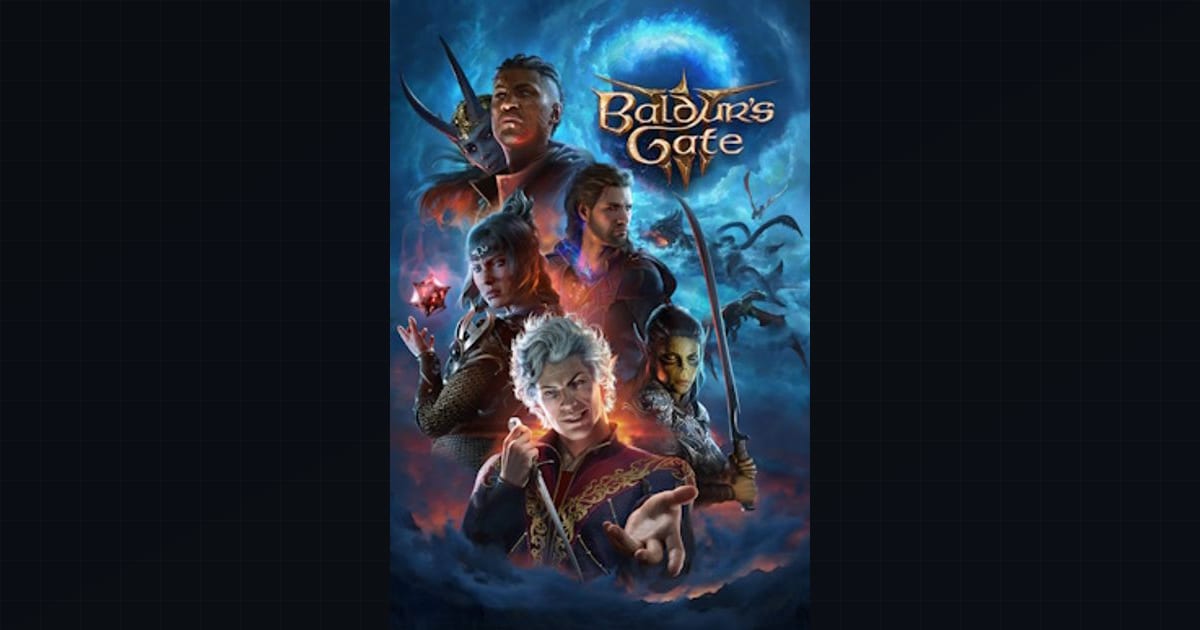
Larian Studios’ Baldur’s Gate 3 is a role-playing game adapted from the fifth edition of Dungeons & Dragons, set in the Forgotten Realms. It is the third installment in the Baldur’s Gate series and launched in early access in August 2020 before reaching full Windows release on August 3, 2023. PlayStation 5, macOS, and Xbox Series X/S versions followed later that year, with a Linux release slated for September 2025.
That timeline is itself significant. Three full years in early access let Larian treat release-scale player data as a balancing instrument: encounter tuning, dialogue reactivityreactivity. When the game world changes in response to player choices — NPCs remember your deeds, towns reshape, dialogue shifts., and the enormous branch graph of Act 1 were all stress-tested by millions of runs before the game ever carried a “1.0” label. Most RPGs ship their most fragile content first and patch their way out afterward. Larian effectively inverted that model, and the polish of the final product at launch is the direct result.
Core Mechanics & Gameplay
The game operates on D&D 5e rules, with a major feature being outcome resolution via a twenty-sided die (d20). Rolls can occur with “advantage” or “disadvantage,” where two d20s are rolled and the higher or lower result is used, respectively. Gameplay combines real-time exploration of large areas with turn-based combat and narrative choices that affect both the party and the wider world. The camera is free-floating, adjustable from a top-down isometric perspective to third person.
Character creation lets players select a class, species, and backstory. Magic-using classes choose starting spells. Characters level up by earning experience points through exploration, combat, and puzzle-solving, unlocking new class features up to a maximum level of 12—lower than the tabletop’s level 20 cap. Feats at certain intervals allow stat increases or new abilities. Multiclassing lets players place levels into different classes.
Two of these decisions deserve closer attention. First, the level-12 cap. In the tabletop rules, levels 13 through 20 introduce spells and abilities that are, in practice, campaign-ending tools—full resurrection, mass teleportation, reality-warping wishes. Capping at 12 keeps the power curve inside a band where a scripted, authored game can still meaningfully challenge the player, and where encounters can be hand-designed rather than statistically amortized. It is a design constraint disguised as a limitation: every level granted is dense with features precisely because there are only twelve of them per class.
Second, the advantage/disadvantage system is the single most important mechanical transplant from tabletop 5e, because it makes probability legible. Instead of opaque situational modifiers stacked behind the scenes, the player can see the two dice. That visibility turns positioning, lighting, and status effects into an economy players can reason about: is it worth spending a spell to gain advantage here? The system converts tabletop arithmetic into a tactical loop that reads well on screen, and it is a large part of why the combat feels fair even when rolls go badly.
Structure & Content
The game spans three acts, each tied to a large explorable location. It contains 288 quests with significant creative freedom in completion; some are mutually exclusive or unfold across multiple arcs. Companions have their own side quests, but the game can be completed without them. Almost any character can die, including those central to the narrative, and all speaking characters are fully voiced. Players can communicate with animals via spells or potions, and a limited number of corpses. Camping provides rest mechanics—long and short—to replenish hit points and spell slots, with 17 unique camp locations. The NPC Withers enables respecs at camp.
Why It Matters
The structural choices sketched above form a coherent philosophy: player agency is load-bearing, not decorative. Mutual exclusivity between quests means a playthrough is defined by what the player didn’t do as much as what they did. The fact that narratively central characters can die—permanently—removes the plot armor that usually telegraphs which NPCs are “safe” and which are expendable. And full voice acting for every speaking character is what makes those branches survivable from a production standpoint: most narrative RPGs fall back on text-only side content to keep branching manageable, which invisibly marks it as second-tier. Voicing everything erases that hierarchy and signals that no path is the “real” one.
The respec system, delivered through Withers at camp, quietly solves one of CRPG design’s oldest failure modes—the 20-hour sunk-cost mistake. A player who builds their character badly doesn’t reroll or abandon the game; they pay a trivial in-game fee and reallocate. Combined with multiclassing and feats, this transforms the character sheet from a rigid commitment into something iteratively tunable, closer to a live build experiment. It is the single most player-friendly concession in the entire design, and it costs the game’s challenge nothing, because encounter difficulty is authored rather than derived from your sheet.
The Take
The five-sweep Game of the Year result reads, in hindsight, like the market correcting for years of wrong assumptions. The received wisdom for most of a decade was that mainstream players would not tolerate turn-based combat, that party management was friction, and that full branching reactivity was a cost center with no audience beyond a niche. Baldur’s Gate 3 disproved all three at blockbuster scale—not with a dumbed-down hybrid, but with the most rules-literal adaptation of a tabletop system ever attempted at this budget. The takeaway for any studio still trimming reactivity from its pitch decks is uncomfortable: the friction wasn’t the problem. The lack of respect for the player was.
What It Signals
The financial success benefiting both Larian and Hasbro points to a second-order effect: the licensable-ruleset model worked. Hasbro owns D&D 5e; Larian’s adaptation demonstrated that a licensed system, handled by a studio with genuine fluency in the source material, can outperform most internally invented rule sets—because the design burden of rules is offloaded onto a mature, playtested framework, freeing the studio’s entire effort for content, systems integration, and reactivity. Expect more publishers to pursue deep system licenses rather than building rules in-house.
Reception & Awards
Baldur’s Gate 3 received critical acclaim for its cinematic visuals, writing, production quality, and performances. It became the first title to win Game of the Year at all five major video game awards ceremonies and is widely regarded as one of the greatest video games ever made. The game was a financial success, generating significant profits for both Larian Studios and Hasbro.
The clean sweep across all five ceremonies matters beyond the trophy count: it means the acclaim crossed every constituency those bodies represent—critics, peers, players, and both English-language academies—with no dissenting bloc. That is unusually hard to achieve for a systemically dense, turn-based RPGRPG. Role-Playing Game — a game built around character progression, story, and player choices., a genre historically loved by critics and tolerated by everyone else. Whatever one thinks of any individual award, the unanimity is the data point: this was not a genre victory. It was a genre redefinition.