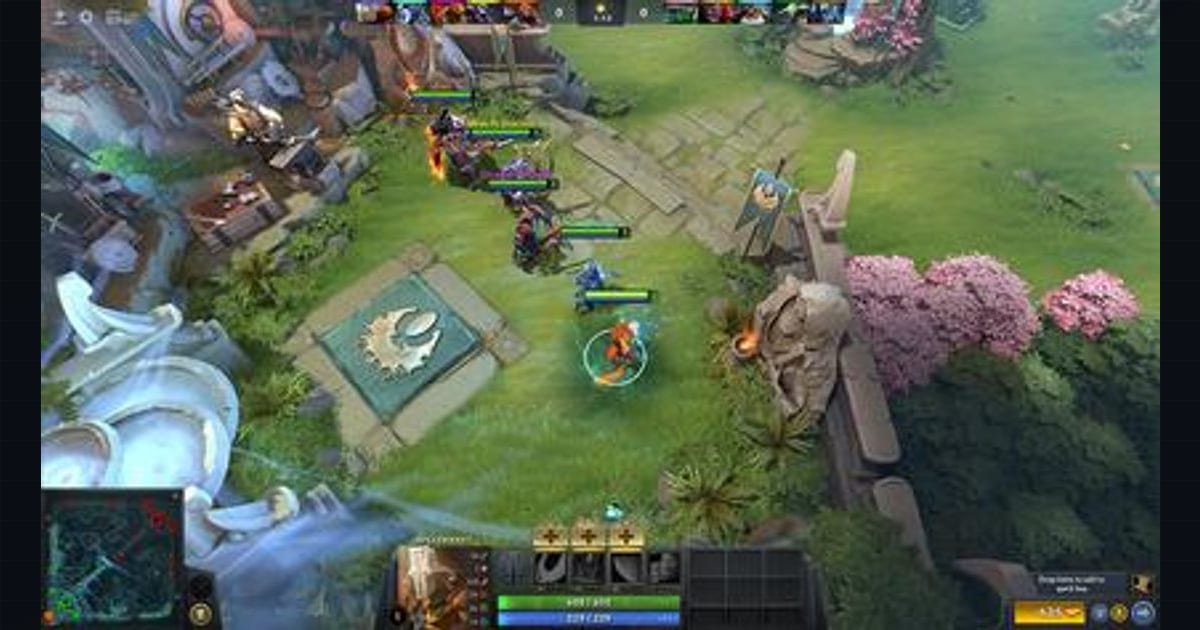
Position 5 is the player who spends much of a limited income on vision. Position 1 normally has first claim on farm. Neither sentence is a Valve rule, and that is the first thing to understand about Dota 2’s five roles: the game documents official hero-role tags, while the 1-to-5 farm priority is a player convention documented separately.
The live build is 7.41f. Valve’s patch feed timestamps it at 15 September 2026, the seventh entry in a 7.41 line that opened on 24 March. What that line did to the roles themselves was close to nothing — its notes are filed under Global Changes, Map Objectives, Terrain Changes and Mechanics Changes, and no note renames a position or reorders who farms first. What 7.41 moved was the ground the five positions stand on, which makes November 2026 role advice mostly a map question wearing a job title.
What this covers: the job description of positions 1 to 5 on patch 7.41f — what each owes a team, the timing each one has to hit, and the single decision that belongs to that player. Why it matters: farm priority decides who takes the creep wave and who buys the ward, and getting that division wrong is one way a team that was winning at fifteen minutes fails to finish. What it is not: a tier list, a hero recommendation, or a claim that Valve ranks the roles. It is not a patch summary either — the returning-player primer already carries that, and this piece links back to it rather than repeating it.
The five numbers measure gold, not importance
Liquipedia states the system plainly: “The standard way to look at hero roles is the position system, which indicates the hero’s farm priority and thus the hero’s expected contribution to a team.” Position 1 “has the highest priority for farming and spends a significant portion of the match doing so, while 5 has the lowest priority and dedicates their time elsewhere.”
Two consequences follow, and both matter more than they look.
The first is that the number is an ordering, not a rank of skill. A position 5 is not a worse player than a position 1; they are a player whose hero does not need the gold, and Liquipedia’s own description of the role says as much — position 5 heroes “need very little gold to perform their duties”. If you have ever been told you were “only” a support, the numbering is where that phrasing came from, and it is a misreading.
The second is that Valve does publish role names, and they are a different list. Liquipedia files eight official ones: Carry, Support, Nuker, Disabler, Durable, Escape, Pusher and Initiator. Those describe what a hero can do in a fight. They do not describe what a player owes a team. The list also shrinks: Liquipedia records that the ninth, Jungler, “was removed in January 10, 2023 Patch”. That is the last change to the game’s own role vocabulary a returning player needs to know about.
So a hero tagged Carry can be your position 2, and a hero tagged Support can be your position 3. The tag is the hero’s skillset. The number is the player’s job.
The five jobs, in farm order
| Pos | Liquipedia’s name | Where they start | Farm priority | The decision that belongs to them |
|---|---|---|---|---|
| 1 | Carry | Safe lane, with a support protecting them | Highest | Whether to take the fight in front of them or the farm behind it |
| 2 | Midlaner | Middle lane, solo | Second | When to leave mid |
| 3 | Offlaner | The opponent’s safe lane | Third | How much of the lane they are willing to lose |
| 4 | Soft Support or Utility Support | A lane to establish control of, then the map | Fourth | Whether to stay in the lane or rotate out of it |
| 5 | Hard Support | Safe lane, beside the carry | Lowest | Whether the next purchase is a ward or an item |
The starting-lane column follows Liquipedia, except position 4’s, which the role sources do not assign — that cell is general guidance. The last column is mine, and it is framing rather than doctrine — no patch note assigns decisions to positions. Read the table as a division of labour, not a rulebook.
Position 1: the carry, who owes an objective
Liquipedia’s carry “is typically weakest in the early game and most reliant on farm to become powerful”, starts “in the safe lane where early farming is easiest, with a support hero dedicated to protecting them”, and is “typically capable objective takers who can kill Towers, Roshan, and the Tormentor”.
That last clause is the job description. Farm is not the deliverable; a building is. A carry who finishes with the highest net worth on the map and no tower to show for it has converted the team’s gold into a number in a scoreboard.
7.41 makes the opening slightly different in their favour. The patch “adjusted the meeting point of the lane creeps toward the offlane”, which includes making safe lane creeps “slightly accelerated upon leaving the base for a couple of seconds” — both changes running “until the 7:30 mark”. It also moved “the tier 1 safe lane towers slightly away from their pull camps and where the creeps meet” — a change the note states without giving a measured distance.
The timings that decide a carry’s game are item costs, and 7.41f raised three of them: a recipe going from 900 to 1,000 gold for a 5,100 to 5,200 total, another from 450 to 550 for 1,900 to 2,000, and a third from 700 to 800 for 5,200 to 5,300. The same patch cut lifesteal on two items, 30% to 25% and 24% to 22%. None of those numbers changes the job. They change the minute the job becomes possible, which is why a build order copied from an older video can now be a step behind the game it is played in.
Position 2: the midlaner, who owes the first rotation
Mid is the lane with one player in it, and Liquipedia’s description is why that matters: position 2 heroes “are dependent on both items and levels to be impactful and quickly become the most powerful team member in the earlygame due to their solo experience advantage”. They are also expected to “hold their own in the 1v1 lane”.
The decision that is theirs alone is when to leave. Nobody else on the map can hand a side lane a level advantage at minute seven, and nobody else can throw the mid tower doing it. Everything else a midlaner does — the rune timings, the wave management, the bottle — is in service of that one call.
The map changed underneath it in 7.41. Currents, the river speed zones, now behave uniformly: “All sections of currents now give a max movement speed bonus of 150”, where previously only “sections on the base and near it” gave that and other sections gave a maximum of 100. A rotation through the river sections formerly capped at 100 can now receive up to 150; the sections on and near the base already gave that much.
The other 7.41f change worth a midlaner’s attention is a sustain cut: Ghost Shroud’s restoration amplification fell from 55/65/75/85% to 45/55/65/75%, and the same hero’s kill-heal multiplier went from 6 to 4. That is the shape of the whole patch for position 2 — not a rework, a margin.
Position 3: the offlaner, who owes pressure
The offlaner is the one core Liquipedia says “may have to forgo a great deal of farm in order to simply stay alive”. Their lane is the opponent’s safe lane, where “They lane in the opponent’s safelane, collecting what farm they can while prioritizing pressure on the enemy Carry”, and “Offlaners are expected to provide a frontline for their team while a fight develops”.
Which is why their decision is not “how do I win this lane”. It is how much lane they are willing to spend. Every death that keeps the enemy carry off a creep wave is a trade, and the position 3 is the player on the team who is expected to make it.
7.41 pushed the lane in their direction and then took something back. The creep meeting point moved “toward the offlane”, with offlane creeps “slightly slowed upon leaving the base for a couple of seconds” until 7:30 — the wave now forms closer to the offlaner’s own tower. But “the medium neutral camp near offlane defender’s gate has been demoted to a small neutral camp”, so the camp a position 3 or 4 used to fall back on is worth less than it was in March.
Position 4: the soft support, who owes the first kill
Liquipedia calls position 4 “the Soft Support or Utility Support” and describes them as “typically the most capable playmaking hero”, looking “for high-impact kills and objectives early into the game”, and “often the first to begin moving around the map”.
Their decision is the roam: stay and secure the offlane, or leave it and hunt. A position 4’s income depends on being right about which lane is winnable, because a rotation that finds nothing costs them the farm they would have taken by staying.
7.41f cut the gold on the ability that most obviously pays a roaming support: Track’s self bonus fell from 130/225/320 to 80/160/240 and the ally bonus from 50/90/130 to 40/80/120. At level one that is 130 down to 80 — a 50-gold cut on a 130-gold bonus, which is 38% of it gone. Gold on a position 4 is not a reward; it is the item that makes the next gank land.
Two additions in 7.41 work the other way. Tier 1 neutral items now arrive at 0:00 instead of 5:00, and enchantment offers are no longer randomised — “options are based on your hero’s primary attribute, with some enchantments available to all heroes”. And a new support item entered the shop at a 1,775-gold total: Urn of Shadows at 825, Chainmail at 500, Wizard Hat at 250 and a 200 recipe. Its active, Soul Release, gives an ally 40 health regeneration that is lost if they are attacked by an enemy hero or Roshan, and on an enemy it deals 25 damage per second, grants True Sight and shares their vision for 8 seconds.
Position 5: the hard support, who owes the clock
Liquipedia describes position 5 as “typically a powerful laner” who enables their carry’s game, with heroes who “need very little gold to perform their duties” and who focus on “strategic Observer Ward and Sentry Ward placement”.
The decision is the small one that repeats all game: the next two hundred gold goes on vision or on the item. There is no patch that makes that choice easier, and 7.41 made the reason for it more expensive to ignore.
Start with the objectives the hard support is expected to contest. Tormentor’s “spawn preference has switched”, and it “now begins in the Bottom Chasm”. Its Unyielding Shield went from a 2000 base barrier to 3000, gaining 50 per minute instead of 20, while Reflect’s base reflection dropped from 50% to 30%. It “no longer deals damage to neutral units” and now carries 25% status resistance. Roshan’s “pit preference has switched” too — “Now begins in the Top Pit”.
Then the economy around those fights. “Wisdom Shrine Experience changed from 280 per interval to 200 base and 300 per subsequent shrine (200/500/800 etc)”, and “Wisdom Shrines and Lotus Pools now reverse their countdowns if heroes from opposing teams enter the area, instead of pausing the countdown”. For a position 5 the shrine is not a personal bonus; it is the team’s level curve, and it now punishes standing next to it while an enemy walks in. The Tormentor shardshard. A separate copy of a game world running on its own server; players on one shard don't share the world with another. economy also tightened: the player who receives the shard “will no longer receive 175 gold”, total team gold fell from 875 to 700, and the all-shards fallback reward from 455 to 415.
One mechanic rewrite matters directly to this role. 7.41 made “Health Restoration now applies to all forms of life gain”, and made “Incoming Heal Amplification now stack diminishingly with Health Restoration instead of additively with Outgoing Heal Amplification”. If your hero’s job is healing, both your numbers and the enemy’s are not what you learned.
The clock the five positions share
| Clock or rate | What 7.41 sets |
|---|---|
| 0:00 | Tier 1 neutral items available (previously 5:00) |
| 7:30 | The offlane and safe lane creep speed adjustment ends |
| 30:00 | First extra siegesiege. A timed, large-scale attack on a settlement — attackers try to destroy it, defenders try to hold it. creep (previously 35:00) |
| 60:00 | Second extra siege creep |
| 200, then 500, 800 | Wisdom Shrine experience per interval |
| 3,000 plus 50 per minute | Tormentor’s Unyielding Shield barrier |
| 875 to 700 | Tormentor team gold reward |
| 455 to 415 | Tormentor reward if every player already has a shard |
Read that table as a schedule of arguments. Every row is a moment when five players want different things, and the position numbers are the pre-agreed answer to who gets their way. The carry wants the wave that spawns at 30:00; the position 4 wants to be at the Tormentor; the position 5 wants vision on the approach. The numbering exists so that decision does not have to be negotiated in chat every game.
Which position should you pick
Pick the decision you are willing to make forty times a game, not the hero you like. If you enjoy judging whether a fight is worth joining, that is position 1. If you enjoy being early to something, it is position 2 or 4. If you enjoy spending your own gold on someone else’s survival, it is position 5.
Then keep the pool small. The number is a job, and jobs are learned by repetition — the StarCraft II returning primer makes the same point about build orders, and the Heroes of the Storm role guide shows what happens to a game that collapses five jobs into one queue. Dota has kept the five positions and their farm order; 7.41 changed the map, the economy and the mechanics around them.