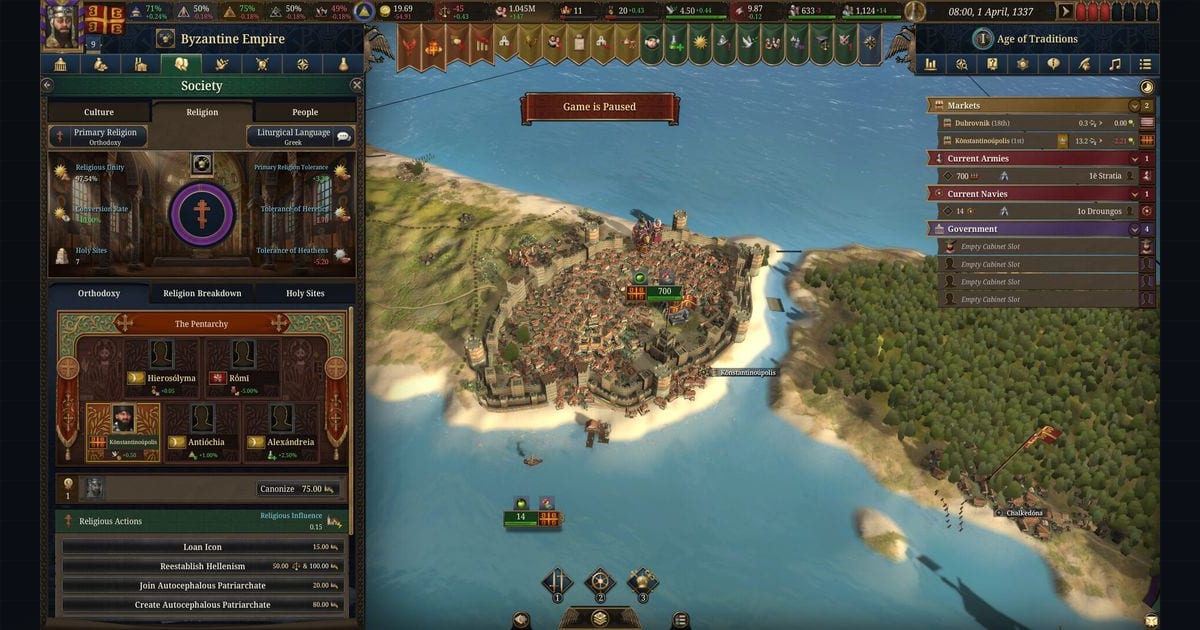
Europa Universalis V players can now restore the fading glories of the Eastern Roman Empire. The game’s first post-launch expansion, Fate of the Phoenix, launched on May 6, 2026, alongside the free Patch 1.2 Echinades update that introduces economy reworks, military adjustments, and over 2,000 bug fixes.
Developed by Paradox Tinto and published by Paradox Interactive, this Immersion Pack marks the beginning of Europa Universalis V’s post-launch content roadmap, offering Byzantine-focused mechanics that allow players to either reverse the empire’s historical decline or pursue alternative restoration strategies that diverge from recorded history.
What’s New in Fate of the Phoenix
The Immersion Pack centers entirely on Byzantine Empire gameplay, offering multiple historical and alternative paths for players attempting to reverse the empire’s decline or pursue unconventional restoration strategies. The expansion introduces several interconnected mechanics that reshape how players approach late-game Byzantine campaigns.
Byzantine Bureaucracies introduces unique content for the Bureaucracy system designed specifically for larger imperial powers. This mechanic acknowledges the administrative complexity of managing a sprawling medieval empire while offering meaningful choices about governance philosophy. Players must choose between maintaining centuries-old administrative traditions in hopes of restoring the empire’s former borders, or discarding that ambition to follow a more modest, sustainable course. The system integrates with existing government reforms while providing Byzantine-specific options unavailable to other nations.
Latinitas vs Romanismos presents a unique Societal Value exclusive to the Byzantine Empire. This mechanic forces players to decide between reconciling with Latin powers in Western Europe or entrenching native Greek culture and independence. The choice shapes diplomatic relations and internal stability throughout the campaign, affecting everything from marriage alliances to trade agreements. Players pursuing Latinitas gain improved relations with Catholic nations and access to Western European technology, while Romanismos strengthens Orthodox ties and provides bonuses to Greek culture conversion.
Fate of the Phoenix Disaster provides a structured path for players working to reverse the empire’s crumbling fortunes. Unlike generic disaster mechanics, this system offers multiple branching choices that reflect the complex political situation facing Byzantium in the late medieval period. The disaster mechanic offers multiple branching choices: expand rapidly to stabilize through conquest, pursue diplomatic solutions with neighboring powers, or implement internal reforms to strengthen the state from within. Each path carries distinct risks and rewards, requiring players to balance immediate survival against long-term restoration goals.
Religious and Cultural Mechanics
The expansion significantly expands Orthodox Christianity content, addressing community feedback about limited religious diversity in the base game. Players can interact with Ecumenical Patriarchs through new diplomatic actions, restore the Pentarchy to strengthen the Eastern Church’s institutional structure, and pursue the ambitious goal of expanding Orthodoxy to Rome itself to mend the Great Schism. This religious content integrates with existing situation mechanics, creating multi-stage event chains that span decades of gameplay.
For players seeking alternative religious paths, Hellenism allows the Byzantine Empire to revive belief in the old pagan gods. This mechanic includes invoking omens and seeking favor from ancient deities, offering a historically unconventional but mechanically viable restoration strategy. The Hellenism system provides unique character interactions, religious buildings, and piety mechanics that differ substantially from both Christian and pagan religions in the base game.
Alternatively, players can embrace Latin Culture, pursuing a total return to old Roman roots. This path emphasizes the empire’s connection to its pre-Greek Roman heritage, complete with Latin naming conventions and cultural mechanics. This option appeals to players interested in alternate history scenarios where Byzantium successfully reintegrates with Western European powers.
The expansion includes new art assets throughout: portraits for Byzantine characters, illustrations for event chains, city models for Eastern Mediterranean settlements, and unit models inspired by Byzantine military history. These visual updates distinguish Byzantine forces and territories from neighboring factions.
Patch 1.2 Echinades Free Update
All Europa Universalis V owners receive Patch 1.2 alongside the DLC release, regardless of whether they purchase Fate of the Phoenix. The update introduces new mechanics across economy, military, diplomacy, and AI systems, plus new content for Orthodoxy and the Balkans region that complements the paid expansion.
According to Paradox Interactive’s official announcement, Patch 1.2 delivers “new mechanics, reworks to the economy, military, diplomacy and AI, and new content for the Orthodoxy and the Balkans,” alongside “over 2,000 fixes.” The patch addresses community-reported issues including personal union inheritance bugs, economic production chain errors, and diplomatic interaction glitches that affected multiplayer stability.
Paradox Tinto has specifically targeted crash-to-desktop errors and performance bottlenecks identified during the open beta period. The development team implemented memory management improvements and optimized tooltip rendering to reduce stuttering during late-game sessions with multiple active nations.
Key free content additions include expanded Orthodox religion mechanics that benefit all players controlling Orthodox nations, not just Byzantium. The Balkans region receives new historical events, building types, and cultural interactions that enhance gameplay for Serbia, Bulgaria, Albania, and other regional powers.
Development Timeline and Roadmap
Fate of the Phoenix released later than originally announced. Paradox Interactive confirmed the May 6, 2026 release date in April 2026, approximately two months before launch. The delay pushed back other Premium Edition content accordingly, affecting the entire post-launch schedule.
According to the official Steam roadmap, the next Immersion Pack, Across the Pillars, focuses on the Iberian peninsula conflict between Castile and Morocco. This Chronicle Pack explores the final centuries of Moorish presence in Spain, offering gameplay mechanics for both Christian reconquest and Muslim defense scenarios. Across the Pillars is expected between July and September 2026.
The third DLC, The Auld Alliance Chronicle Pack, adds historical content for France and Scotland, exploring their mutual defense relationship against England. This pack introduces unique event chains for both nations, character interactions reflecting the historical alliance, and military bonuses when fighting English forces. The Auld Alliance targets an early 2027 release window.
Players who purchased the Premium Upgrade receive access to all three DLC packs plus the Sacred Sites instant unlock, which adds eight historical holy sites to the game map as a cosmetic enhancement.
Pricing and Availability
Fate of the Phoenix is available as a standalone purchase for $9.99 on Steam. This pricing aligns with Paradox Interactive’s typical Immersion Pack pricing strategy, positioning it as a mid-tier content release between minor cosmetic packs and major expansion releases.
The DLC is also included in the Europa Universalis V Premium Upgrade ($39.99), which bundles all three planned DLC packs plus the Sacred Sites instant unlock cosmetic pack. This bundle offers cost savings for players committed to purchasing all post-launch content.
The base game remains priced at $59.99, with the Premium Edition (including all DLC) available for $84.99. Premium Edition purchasers receive Fate of the Phoenix automatically upon release, along with future DLC as it becomes available.
System Requirements
Fate of the Phoenix requires the base Europa Universalis V game to play. System requirements match the base game: Windows 10 64-bit, Intel Core i7-8700K or AMD Ryzen 5 3600 processor, 16 GB RAM, and Nvidia GTX 1060 6GB or AMD RX 580 8GB graphics. Recommended specifications call for Windows 11, Intel Core i7-14700K or AMD Ryzen 7 7800X3D, 32 GB RAM, and Nvidia RTX 3060 Ti or AMD RX 6700 XT graphics.
The expansion requires approximately 20 GB of available storage space, matching the base game installation size.
Community Reception
Early player reviews on Steam show mixed reception, with some players praising the Byzantine-focused content while others express frustration with unresolved base game issues. Common positive feedback highlights the depth of Byzantine mechanics and the quality of new art assets. Critical feedback focuses on desires for mission tree additions and performance improvements that remain in development.
Paradox Tinto has acknowledged community feedback through regular Tinto Talks developer diaries, outlining ongoing work on automation improvements, military management quality-of-life features, and late-game performance optimization.