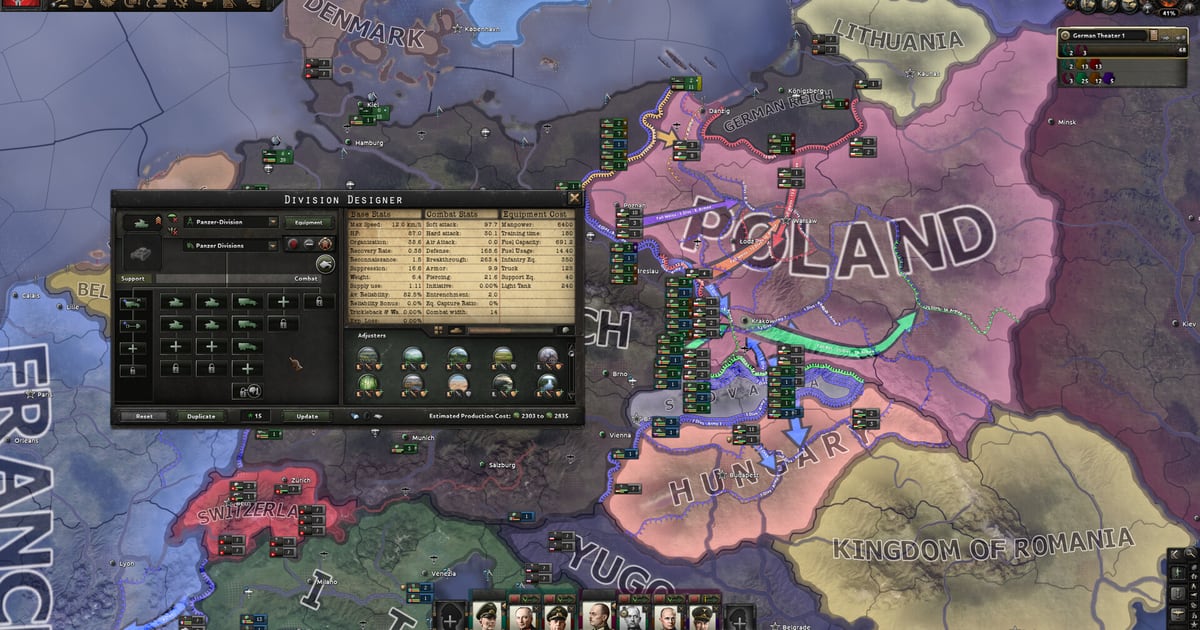
Hearts of Iron IV hands you a world war and asks you to sustain it. Most of the mechanics players argue about — division templates, tank variants, doctrine — only matter while a division has ammunition, fuel and organisation to spend. The moment a front outruns its supply network, those advantages drain away and the offensive stops without a shot being fired.
Supply in Hearts of Iron IV is not something you produce. The wiki describes a province’s supply level as a “support capacity” rather than a stockpile, “a soft stacking limit” that units draw against. Understanding where that capacity comes from, what caps it, and how it degrades is the difference between a plan and a reachable one.
What this covers: The three supply pools, how rail level sets a hub’s throughput, what motorisation and trains actually cost, and the penalty ladder a division climbs as it runs dry. Why it matters: The weakest segment on a rail route decides the whole route’s capacity, so upgrading the wrong tile buys nothing. Who should read it: Players planning an offensive into territory whose rail network is thinner and more damaged than their own.
The three supply pools
A province’s supply comes from three sources, and they are applied in a fixed order: state supply first, hub supply second, and aerial supply last.
State supply is fixed for the whole state. The wiki lists four inputs: victory points, infrastructure, population, and a base value some states do not have. A state with a victory point gets 0.2 supply from it, plus 0.05 for each point of total victory-point value. Infrastructure contributes 0.3 per level while it is undamaged. Population adds supply on a falling scale. State supply does not decay with distance, which is why a lone garrison in a quiet province keeps functioning; it is also spread across every unit in the state, including aircraft and ships, so it thins quickly once an army arrives.
Hub supply is the one that wins or loses campaigns. It flows from the capital through supply hubs, ports, railways and convoy routes. Hubs and ports are the same class of node: a port “acts as a supply hub.”
Aerial supply is the emergency valve. Transport aircraft on an Air Supply mission make supply available across an entire air zone whether or not the aircraft can reach the province, and it is drawn last. At 100% mission efficiency each fully supplied transport plane provides 0.01 supply, a figure the wiki cites from the game’s defines file. That number is why air supply rescues a pocket and cannot sustain an army.
Railway level sets the ceiling
Every hub’s total capacity is capped by the railway connection back to the capital. A level 1 railway provides 15 supply throughput; each additional level adds 5, to a maximum of 35 at level 5. Ports work on the same principle but a longer ladder: 8 supply at level 1, rising by 3 per level to 35 at level 10.
| Level | Railway supply | Port supply |
|---|---|---|
| 1 | 15 | 8 |
| 2 | 20 | 11 |
| 3 | 25 | 14 |
| 4 | 30 | 17 |
| 5 | 35 | 20 |
| 6-10 | maximum 5 | 23 / 26 / 29 / 32 / 35 |
The rule underneath the table matters more than the numbers. A route is only as good as its weakest segment. The wiki’s worked example: three stretches of track at levels 2, 2 and 1 are treated as a level 1 connection delivering 15 supply, no matter how good the other two stretches are. The same logic applies where rail meets sea — a level 3 track feeding a level 6 port that connects to a level 5 port is treated as a level 5 port connection, worth 20 supply. Rivers count as level 1 rail connections.
That is why an offensive can stall in newly captured ground while the home network looks fine. You inherit the enemy’s track at the level they built it, and the bottleneck is usually behind your spearheads rather than beside them.
The capital hub is the exception to the ladder: its capacity is a base of 5 supply, supplemented by the number of civilian factories, military factories and naval dockyards in the nation.
Building your way out is not cheap. A railway tile costs 170 + 130 × level CIC, so a first level costs 300 CIC and a fifth 820 — the wiki puts the full cost of taking one province from nothing to level 5 at 2,800 CIC before construction bonuses and infrastructure effects. A new inland supply hub costs 20,000 CIC. Each level of infrastructure costs 6,000 CIC, so four levels in one state cost more than a new hub. Rail and factories draw on the same construction queue, covered in the HOI4 economy guide.
Motorisation: 40 or 80 trucks
Hub capacity is only half the story. Supply also has to travel from the hub to the divisions, and that distance is measured in provinces. By default a hub is “not motorized,” shown by a horse icon. Two further tiers cost 40 and 80 trucks respectively.
Motorisation does not create supply. It reduces the penalty for crossing each province, which extends how far the hub’s reach stretches. The trucks assigned to it consume no fuel and no manpower, which makes motorisation look free next to almost every other logistics decision — but they do take attrition in poor terrain and weather, and they can be destroyed by enemy aircraft flying logistics strike.
There are two ways to set it. Hubs can be motorised individually, or an army can be given a motorisation level, which automatically applies it to every hub in range of the army and reverts those hubs when the army moves away. The automatic route saves micromanagement at the cost of truck demand fluctuating as the army’s reach changes. The full benefit only arrives if the trucks exist: the wiki notes that when fewer trucks are available than are assigned, the effect is reduced in proportion to the shortfall.
Trains: the requirement behind the hub
Railways need rolling stock. A hub’s train requirement rises with the amount of supply drawn through it, and the network-wide figure is visible in the logistics tooltip. If the network has fewer trains than it needs, hub supply is reduced for the divisions drawing on it.
Trains are simulated rather than controlled. The Barbarossa dev diary describes the requirement as “derived from the overall supply usage of the nodes supplying your troops, and the distance factor that supply has to travel” — more troops and longer journeys mean more trains. Trains take no attrition, but enemy aircraft on logistics strike can destroy them outright.
Production has three options. The base train costs 70 MIC. An unarmored “austerity” train does the same job for 50 MIC. An armored train costs 105 MIC but is far more resistant to logistics strike, and if armored trains are in stock they are used before any other type.
What undersupply actually does
A division that cannot meet its supply requirement does not simply fight worse. It degrades in a specific order, the penalties scale with how far supply has fallen, and there can be a delay before the full penalty applies.
| What degrades | Detail |
|---|---|
| Speed | The first symptom, often misread as a pathing problem |
| Max organisation and org regain | Attack sequences collapse because org cannot rebuild between assaults |
| Attack | Up to −20% for attacking units, up to −50% for defending units |
| Breakthrough and defence | Breakthrough for attackers, defence for defenders |
| Attrition | Begins at 35% supply or lower, consuming equipment at a rising rate |
| Manpower reinforcement | Slows sharply, though equipment resupply speed is unaffected |
| Fuel | Stops entirely once supply is poor enough — air supply does not deliver fuel |
The fuel line is the one that turns a stall into a rout. An armored spearhead past its network does not merely slow down; it stops being armor. Air supply does not fix this, because transport aircraft cannot deliver fuel.
There is a small buffer. Divisions store supply above 100%, to a base maximum of 150%, which the wiki says lets them operate at full efficiency for two to three days in an undersupplied province before stored supply drops below 100%. Special forces can extend that grace with technology, and marines led by a general with the Amphibious trait get a large additional window.
Terrain and weather shrink the hub’s reach
Distance from a hub is only the starting penalty. Weather and terrain stack on top. The wiki separates the effects: a supply factor reduces the flow of supply out of a hub, shrinking its effective range, while a supply consumption factor increases how much a division uses in the first place.
The weather tables are blunter than the mechanic sounds. Deep snow carries a −40% supply factor. Mud carries −15% and a 500% truck attrition factor. A blizzard applies −25% to supply flow and +15% to supply consumption at the same time. Stacking deep snow with a blizzard, the wiki notes, “can substantially reduce the range of hub supply” for as long as those conditions last. That is the mechanical reason an offensive planned in autumn dies in February, and the reason motorising a forward hub in mud season is a bet against the weather.
Terrain adds a third modifier, the supply flow penalty factor, which adjusts the fall-off from the hub as distance increases. Urban terrain actually improves flow; the wiki notes this is a direct change to the supply figures shown in province tooltips, not a percentage.
Infrastructure is the counterweight, in two separate ways. It provides state supply at 0.3 per level, and it also reduces the drop-off from hubs — up to a maximum reduction of 0.3 at level 5. Crucially, the infrastructure that applies when supply crosses a border is the level in the state the supply is leaving, so a well-built state pushes supply into a poorer neighbour at its own standard.
Captured rail and the conversion clock
The most painful supply problem in the game is also the most predictable. Newly captured railways do not work immediately. The wiki gives the conversion cooldown: 10 days on non-core territory, 5 days on core territory, and none during a civil war. If another province on the path to a supply hub is captured while the clock is running, it resets to 10 days.
Supply hubs have no conversion time of their own, but a hub is useless until every province on its rail connection has finished converting, and the wiki warns there is no separate indicator for the hub province’s own conversion. Rivers have no conversion time at all, so a hub that can reach your network along a river you control comes online instantly. That makes river-adjacent hubs worth more than their supply figures suggest.
This is the actual reason a deep offensive decelerates: success extends the rail path that has to convert behind you.
Ports, convoys and the naval exception
Ports function as supply hubs, with throughput rising from 8 supply at level 1 to 35 at level 10, gaining 3 per level. A port with a clear convoy route back to the homeland does not need a rail connection at all. If that convoy route is raided, the supply the port delivers is reduced until the route recovers its capacity, which makes convoy raiding a supply weapon.
Naval units sit outside the province capacity system. A fleet draws the full supply available from the hub it is using rather than being limited by what the province can support, so ships are far less likely to be undersupplied than land or air units. Air units are the opposite case: an air wing’s supply comes from the province containing its airbase, and a wing at 72% supply suffers a 28% penalty to mission efficiency.
Allies complicate the picture. By default you share hub supply with your allies and they with you, but the wiki is clear that you cannot use an ally’s state supply — only their hubs. A division fighting on an ally’s soil therefore draws hub supply but loses the state layer beneath it. A host country can switch allied access off hub by hub, which makes it a diplomatic tool as much as a logistics one. The mechanics that tie this layer to ships and aircraft are covered in the naval and air guide.
Cutting the network
Because the whole system is a chain, it can be attacked rather than out-fought. The No Step Back expansion added the logistics strike air mission, which the dev diary describes as actively destroying trains and trucks and damaging railways in the target area. The same diary draws the distinction that matters for planning: strategic bombing also hits rail and supply infrastructure, but logistics strike is “a much more effective way of neutralizing an enemy’s fighting capabilities while retaining important industrial infrastructure” — the tool for ground you intend to occupy afterward.
Scorched Earth is the defensive version. The wiki lists it alongside strategic bombing as a way rail lines arrive damaged, and PCGamesN’s supply guide notes it sabotages state infrastructure as well as the rail network. A retreating player can hand an attacker a network that looks intact on the map and is dead in practice.
What has changed since 1.11
The land supply model described here has been stable since the 1.11 Barbarossa patch, which the wiki identifies as the version that overhauled it. The 2021 No Step Back expansion added the logistics strike mission, armored trains and Mulberry Harbours on top of that free update.
The November 2025 expansion No Compromise, No Surrender added two naval buildings, Naval Supply Hubs and Naval Headquarters, per Paradox’s own dev diary. Both require a level 8 naval base in the province before they can be constructed, and the Naval Supply Hub lets a fleet operate within range of its home base plus any other port that contains one. That is a naval-range change rather than a change to how hub supply reaches land divisions, but it means the port you capture is now worth checking for more than its supply throughput.