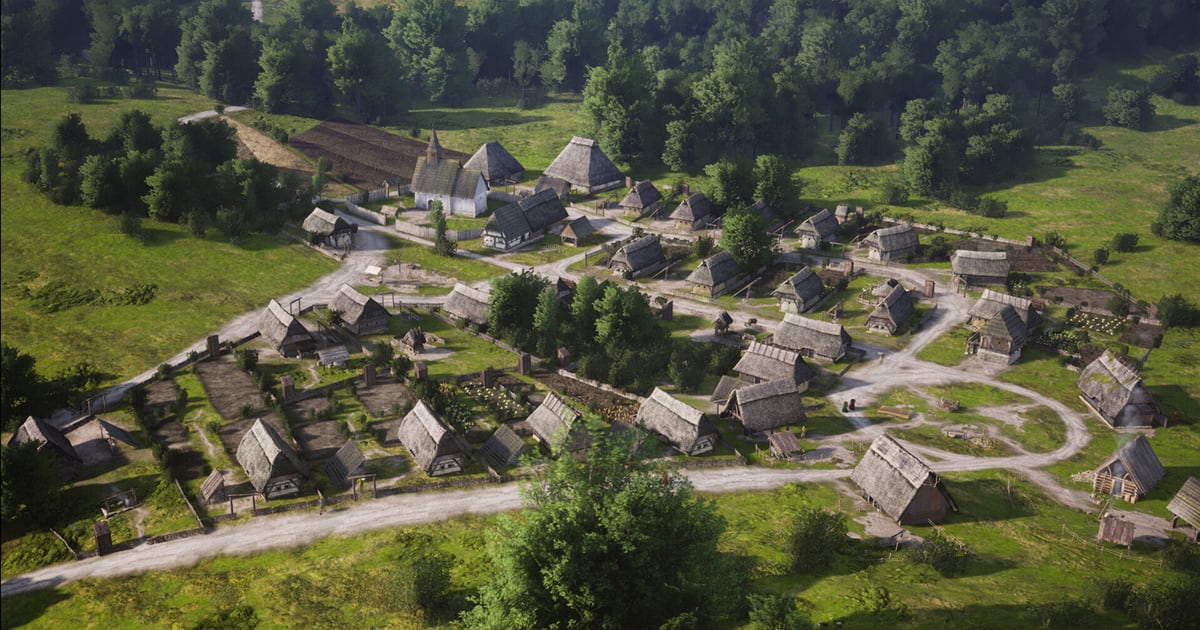
Construction gridlock is the most common reason early settlements collapse in Manor Lords. Unlike most city-building games where building supplies teleport directly into job sites from a magical global pool, Slavic Magic’s medieval simulation models physical transit. Timber logs cannot be hauled in wheelbarrows by generic unassigned families; each trunk requires a dedicated draft ox and an accompanying guide to drag it across dirt roads.
What this covers: Livestock mechanics, Hitching Post upgrades, dedicated Ox assignments, and timber logging transit paths. Why it matters: Without permanent oxen dedicated to sawpits and logging camps, construction queues freeze completely as winter approaches. Who should pick this: Lords whose construction projects stall at 0/1 Timber despite overflowing storage yards.
The Ox Transit Engine
Every region starts with only the homeless people’s tents — no livestock infrastructure arrives pre-built. The Hitching Post is a 1 Timber logistics building you construct yourself, and from it you can order an ox for 20 Regional Wealth. This working beast is responsible for three competing priorities:
- Dragging felled tree trunks from deep forest to the Logging Camp storage area.
- Hauling heavy timber from the Logging Camp directly to open construction footprints.
- Supplying the Sawpit with raw logs to cut into basic construction Planks.
If all three tasks demand attention simultaneously, your ox enters a queue priority loop, often prioritizing distant expansion foundations while domestic sawmills starve.
| Facility / Unit | Livestock Capacity | Assigned Role | Bottleneck Risk |
|---|---|---|---|
| Hitching Post | 1 Ox / Horse | Baseline hitch point | Livestock orders are never blocked by low stable space — just make sure room exists by the time the animal arrives |
| Small Stable | 2 Oxen / Horses | Shelter for working animals | Animals run away if the village’s total stable space is insufficient |
| Logging Camp | 1 Dedicated Ox Slot | Hauls raw felled trees from woods | Fill this assignment first to decouple forestry from town construction |
| Sawpit | 1 Dedicated Ox Slot | Hauls logs to sawmill blade | Without an ox to deliver timber, sawpit production halts entirely |
| Unassigned Ox | Free Pool | General building site delivery | Shared across all pending blueprints on the map |
| Pack Station | 2 Stable Space | Employs Mules to move goods between your own regions | Mules never haul timber — this is inter-region trade only |
| Livestock Trading Post | 2 Stable Space / 4 Pasture | Buys, sells, and holds animals | A supply source for animals, not a timber solution |
How the Ox Guide Role Actually Works
An ox resting at the Hitching Post is not reserved for anyone. In the default state, any worker who needs an animal to finish a task walks over, takes an idle ox, and guides it to the job. The official wiki’s example is a builder who needs timber: without help, that worker walks to the plot, picks up the ox, guides it into the woods, loads a trunk, drags it to the site, returns the animal, and only then starts building. Almost none of that time is spent constructing.
Assigning a family to the Hitching Post changes the arithmetic. Those workers become permanent Ox Guides, and the official description says a family working there “will always be prioritised to guide the ox and automatically seek out those tasks”, which frees other workers to begin their jobs immediately. It is the cheapest logistics upgrade in the game — the post supports two workplaces and costs nothing beyond the family you put in it.
The failure state to recognise is an ox that reports it is waiting for a guide. That message means nobody free can walk the animal to a job, usually because every family is assigned to a workplace or too many construction sites were queued at once. Community troubleshooting for the stuck-transport case recommends keeping at least one family on guide duty, locking one ox to the Logging Camp, and unpausing or cancelling stalled projects so the queue can drain.
What Timber Can and Cannot Do
Timber breaks several of the rules that govern every other resource in Manor Lords:
| Timber rule | What it means |
|---|---|
| Only oxen pull logs | Humans, horses, and mules cannot move timber; the Hitching Post wiki states plainly that a horse cannot pull lumber |
| One storage type | Logs stack only at a Logging Camp — Storehouses, Granaries, and Trading Posts will not accept them |
| Weather is harmless | Exposed timber is not destroyed by weather, so logs can lie on the map indefinitely |
| Overproduction is safe but costly | Loggers keep cutting once the camp is full and leave logs where they fall, forcing oxen to travel farther |
| No timber trade | Timber cannot be imported or exported — the only supply is trees inside the same region |
| Clearing is not harvesting | Trees removed to make way for a building do not become logs or firewood |
| Verify the real total | Hover the hammer-and-planks icon beside the region name to see every log the region actually holds |
A permanently assigned ox carries a hidden cost. It still occupies a stable slot, and once it is bound to the Logging Camp it is no longer available to haul logs to Sawpits or construction sites. Pinning an ox to a camp is a decision to decouple forestry from town building, not a free upgrade.
Step-by-Step Logistics Optimization
To build a resilient timber supply chain that supports rapid Tier 2 Burgage Plot upgrades, implement the following deployment sequence during your first spring:
1. Upgrade the Hitching Post Immediately
Before placing widespread housing footprints, spend 2 Planks to upgrade your Hitching Post into a Small Stable. Once completed, spend 20 Regional Wealth via the livestock ordering menu to purchase an additional Ox. Two draft animals allow one beast to handle pure forestry transport while the other services municipal construction.
2. Lock Dedicated Worksite Assignments
By default, purchased oxen roam the communal pool. Open your Logging Camp interface, navigate to the Advanced tab, and click the plus icon next to Permanent Livestock Assignment to permanently bind an ox to the logging camp. Do the exact same thing for your Sawpit once built.
- A permanently assigned logging ox will only drag logs into the logging yard, keeping storage at the 28-log cap.
- A permanently assigned sawpit ox will continuously shuttle logs to the sawblade, ensuring a steady stream of planks for church roofs and spear production.
3. Road Layout and Tree Clearing Radius
Always connect your Logging Camp directly to your central village green with a wide, straight dirt road. Furthermore, adjust the Work Area radius on the Logging Camp to clear immediate perimeter groves first before sending lumberjacks into distant tree lines.
Sawpit Reserves and Production Limits
The Sawpit is where early timber quietly disappears. Its Construction reserve field is the fix: once regional timber falls to that number or below, sawpit workers stop collecting logs to convert. The reserve is regional rather than per-building, so setting one Sawpit to 10 imposes the same floor on every Sawpit in that region. Community guides warn the value can occasionally reset to zero, which makes a periodic check worthwhile.
The Advanced tab exposes a matching pair of controls: a raw-material Reserve and a Production Limit. The official FAQ’s worked example is a Sawpit with a reserve of 10 and a production limit of 25 — workers stop making planks either when timber drops below 11 or when planks reach 21. That sets a soft stockpile ceiling per building without any hauling micro-management.
The classic “my Sawpit does nothing” complaint has the same answer in the FAQ and in PC Gamer’s write-up: the building has no logs because the ox is busy elsewhere. The recommended fixes are to upgrade the post and buy a second ox, assign a family to the Hitching Post as a guide, or set a permanent livestock assignment pointed at the Sawpit.
Livestock Beyond Oxen
Two other animals appear in the early livestock menu, and neither is a substitute for an ox:
- Horses cost 30 Regional Wealth and let traders move larger quantities of goods by cart. The Hitching Post wiki is explicit that a horse cannot pull lumber.
- Mules are ordered by the Pack Station and ferry goods between your own regions, up to 20 goods per trip.
Both are convenience units. If the construction queue is the problem, the answer is another ox.
Work Areas and Replanting
The Logging Camp’s Advanced tab lets you draw the area its families will work. Hold Ctrl and scroll the mouse wheel to resize the circle, then click to confirm; loggers then cut only inside it, and the game warns you when the area runs out of trees.
Restricting the circle matters because trees do not come back on their own — the official Logging Camp page states they generally do not regrow. A Forester’s Hut plants new trees, and overlapping a Forester’s Hut with a Logging Camp lets the same ground produce timber year after year. Trees take several years to mature and foresters cannot plant in winter, so a replanting programme started in year one pays off in year three rather than next spring.
A tight work area also protects the deposits that feed your other camps. Clearing the grove that shelters a deer herd or berry bushes removes the resource, so the practical rule is to leave the trees around wild food sources standing and rotate the cut elsewhere.
Avoiding the Winter Construction Trap
Burgage Plots consume one fuel per month, with fuel consumption doubling in winter. If your villagers are waiting on timber to complete roof framing on exposed Burgage Plots, unfulfilled needs will steadily drag approval downward. Pre-clear and stockpile at least 20 Timber and 30 Planks before the first flakes fall in November.
The Regional Wealth Loop Behind Every Ox
Every ox and horse is bought with Regional Wealth, not with the personal Treasury shown in the top-right corner, and the two pools are earned in completely different ways:
| Pool | Generated by | Spent on |
|---|---|---|
| Regional Wealth | Trade, and level 2 or higher Burgage Plots | Animals, backyard and artisan extensions, imports |
| Treasury | Tax from a Manor, and cleared Bandit Camps | Mercenaries, retinue, the annual royal tax, Settlers’ Camps |
The split has a practical bite. A second ox costs 20 Regional Wealth and arrives only after a trader delivers it — the wiki notes it takes roughly 30 days — so the animal is never instant. That same wealth also pays for Trade Route set-up unless you research the trade-logistics technology that caps the cost at 25 Regional Wealth, which means early livestock spending competes directly with the trade income that funds more livestock.
Settlement expansion runs on the other pool. Claiming an unclaimed region costs 1,000 Influence and an AI-held region 2,000, while a Settler’s Camp needs at least 250 Treasury and then 250, 500, or 750 more to set the new region’s starting supplies. A thriving ox economy in the first region is what makes the second region affordable.