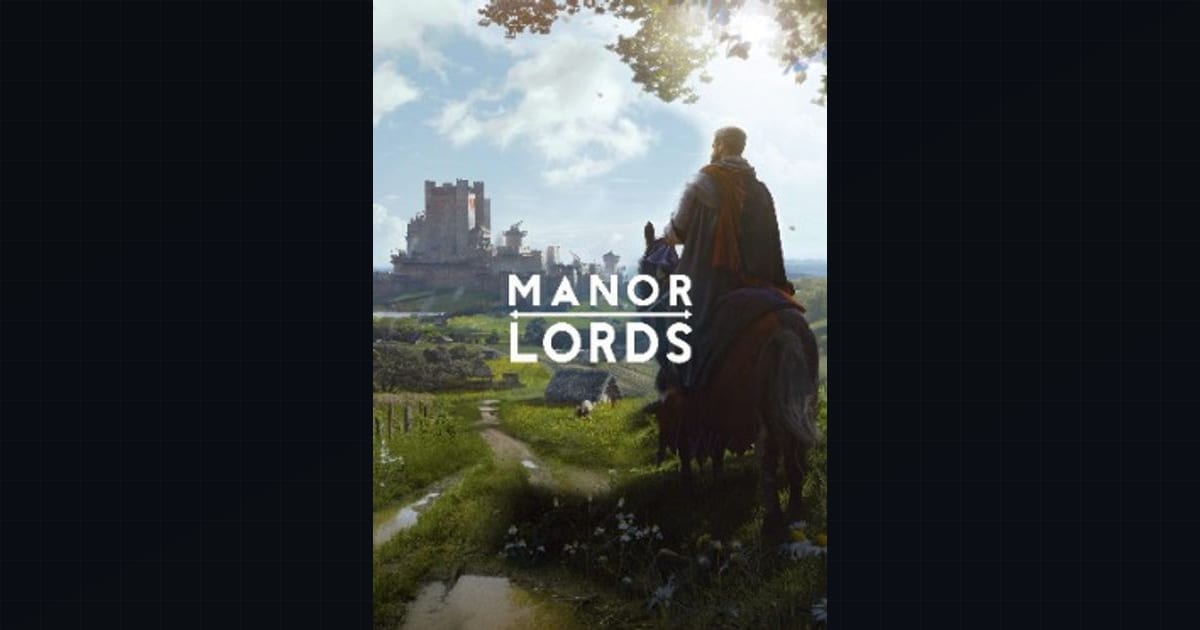
Manor Lords, the medieval city-builder and real-time tactics game from Slavic Magic, launched into early access on April 26, 2024 with immediate commercial success. The title sold over one million copies during its launch weekend and surpassed three million total sales by February 2025. Developed by Grzegorz “Greg” Styczeń and published by Hooded Horse, Manor Lords overtook Hades II shortly before release to become the most-wishlisted game on Steam, accumulating over three million wishlists by launch.
Gameplay & Systems
Set in late 14th-century Franconia, Manor Lords blends organic city-building with real-time tactical warfare. The city-building component avoids fixed zoning grids, instead allowing houses to be placed along curved roads shaped by trade routes and terrain. Players manage supply chains, trade networks, and seasonal demands, while a financial system layers in six types of taxation, imports and exports, and environmental factors such as soil exhaustion and deforestation.
The game ships with five modes: Rise to Prosperity (combat-free), Restoring the Peace, On the Edge, A Duel, and Fractured Realm. The remaining modes include varying degrees of combat, from bandit skirmishes to territorial expansion against AI lords and a boss encounter against an expanding Baron. Real-time battles factor in fatigue, weather, and equipment, with troops sourced through rented mercenaries, a trained retinue, or armed villagers. A diplomacy system lets players influence AI lords through threats or influence.
Development & Post-Launch Support
Development was partly funded through Patreon donations and a 2021 Epic MegaGrants award. Originally built on Unreal EngineUnreal Engine. A widely-used commercial game engine from Epic Games; powers many large-studio (AAA) games. UE5 is the current generation. 4, the project announced a switch to Unreal Engine 5 in June 2024, with the migration completed by August 22 in version 0.7.987.
After a nine-month content hiatus, a major overhaul update arrived on October 2, 2025. The patch reworked internal code and gameplay at large, adding two new game modes, four new maps, and a revamped perk system.
Platform & Availability
Manor Lords is a Windows-exclusive single-player title currently available in early access. Minimum and recommended specifications have not been officially documented in the provided sources.
Why it matters
The headline number — three million sales for a game effectively built by one person — is the part that travels, but the more interesting signal is what the audience was actually buying. Manor Lords is not a fast RTSRTS. Real-Time Strategy — a strategy game where everyone plays at the same time, continuously, instead of taking turns., and it is not a pure city-builder; it is a hybrid that treats medieval governance as an interlocking system of geography, economy, and violence. The gridless, road-shaped settlement growth is the clearest expression of that thesis: rather than zoning a tidy Cartesian grid and watching numbers tick up, you let terrain and trade routes dictate form, and the town grows the way medieval towns actually did — organically, awkwardly, along the paths people already walked.
That design choice is reinforced by an economy that punishes extraction. Soil exhaustion and deforestation are not flavour text; they are the long-term cost curve that stops a player from clear-cutting their way to prosperity. Layered on top are six tax types and an import/export balance, which means the “city-builder” loop is really a fiscal-and-ecological sim wearing a hoody. For a genre that has spent a decade iterating on Anno’s abundance model — where the answer to any shortage is always “build another production chain” — Manor Lords is a deliberate counterweight: scarcity, seasonality, and consequence.
The five-mode structure matters too, and not just as content breadth. Rise to Prosperity existing as a fully combat-free path tells you the developer understands that a chunk of the city-building audience actively resents being dragged into battles. Letting that audience opt out entirely — while still offering the territorial Baron confrontation for players who want it — is a cleaner separation than most hybrid attempts manage.
The take
Two things sit in tension in Manor Lords’ post-launch story, and both are worth naming plainly. The first is the Unreal Engine 5 migration, announced two months after early access launched and completed that August. Swapping engines mid-early-access is not a normal move; it is the kind of decision you make when the old foundation is going to cost you more in the long run than the short-term disruption of switching. For a solo developer, the disruption is concentrated entirely on one person, and the nine-month content drought that followed the migration reads, fairly or not, as the tax that swap extracted.
The October 2025 overhaul — two new modes, four new maps, a revamped perk system, and reworked internal code — is the payoff, and it is a genuinely substantial one for an early-access patch. But the gap between “three million copies sold” and “one major content update in roughly eighteen months” is the real pressure test for the model. Commercial success at this scale is supposed to buy the option to hire a team and accelerate; the fact that Slavic Magic has stayed small and slow is either a principled commitment to a single authorial voice or a structural bottleneck, and from the outside it is hard to tell which. The honest read is that it is probably both, and that the game’s coherence — the reason the systems feel like they were designed by one mind — is inseparable from the pace limit that comes with it.
What it signals
Manor Lords is one of the cleaner recent data points for a proposition the industry keeps re-learning: a single developer with a sharp, specific vision and a long public development arc can out-perform marketed AA products on the only metric storefronts rank by — wishlists. Overtaking Hades II on the Steam wishlist chart is not a marketing win anyone can buy; it is a demand signal that accumulated over years of Patreon updates and gameplay clips, and it converted at a rate that few publishers achieve with full campaigns.
It also cements Hooded Horse as the publisher of record for this exact profile — historically grounded, systems-heavy, PC-first strategy. The publisher’s roster has become a reliable signal for the audience that wants this kind of game, and Manor Lords is the title that put that signal on the map.
Context
Genre-wise, Manor Lords occupies a specific gap that nothing else fills cleanly. From Total War it borrows the real-time tactical battle layer (fatigue, weather, equipment, mercenary versus retinue versus levy troop sourcing) but rejects the separate-from-the-map strategic shell. From Anno and Foundation it takes the settlement-growth and trade-loop instincts, but rejects the grid and the infinite-abundance economy. From Banished, Farthest Frontier, and Surviving the Middle Ages it inherits the survival-economy and ecological-depletion thinking, but scales it toward governance rather than bare subsistence. The diplomacy system — influence and threats against AI lords rather than scripted alliances — is the connective tissue that tries to bind the city and battle halves into one continuous medieval lordship simulation rather than two games stapled together.
Whether that binding fully holds is the open question the October 2025 overhaul was built to answer. The gridless town, the depleting soil, and the weathered battlefield all point at the same design goal: a medieval sim where the land and the season are the real antagonist, and the Baron is just the most visible expression of it. That is an unusually specific ambition for a one-person project, and three million buyers is evidence that the specificity, not despite it, was the whole point.