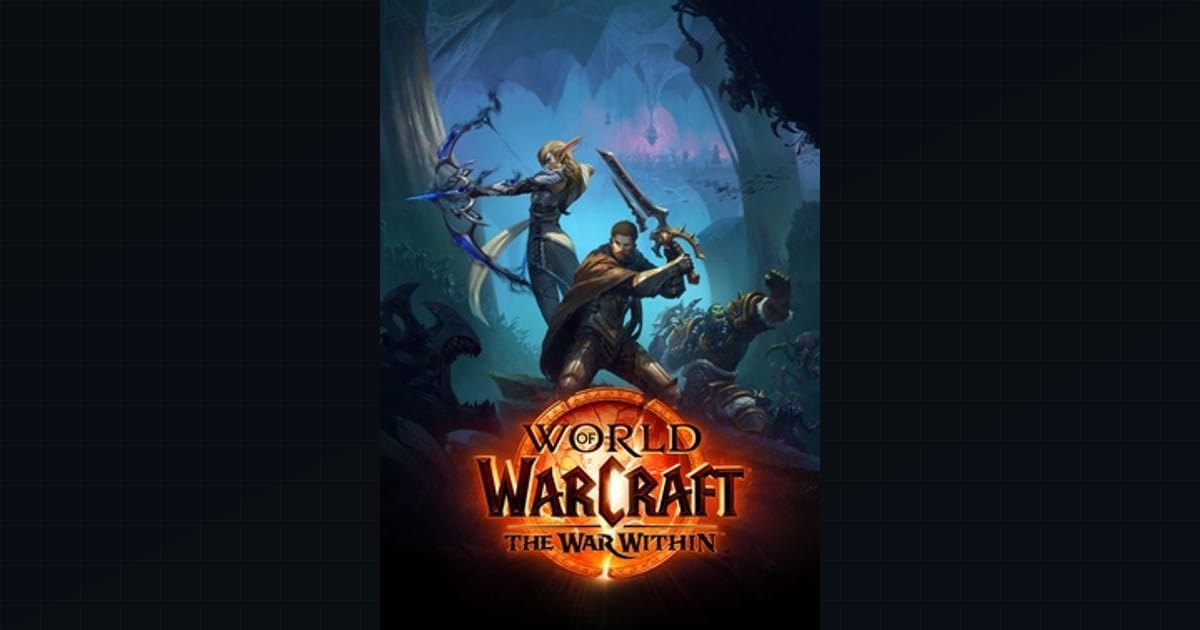
Blizzard Entertainment has published the final structural engineering notes for The War Within ahead of the global launch window. The update overhauls account progression via the Warband framework, allowing shared bank storage, reputation gains, and transmog collection across all characters on an account. As the franchise’s tenth expansion, it is also the one where the unit of progression quietly stops being a character and starts being the account itself.
What changed: Warband unifies bank, renown, and transmog account-wide; Delves add 1–5 player endgame feeding Great Vault. Why it matters: The account becomes the progression unit, collapsing the alt tax that drives lapses. Who should care: Active and lapsed WoW players, alt-heavy collectors, and guilds planning cross-factionfaction. An in-game group or nation players can align with or fight against, with its own goals and reputation system. rosters.
Account Progression & Delves
- Warband Architecture: Bank storage, renown tracks, and crafting materials are instantly unified across characters, eliminating redundant alt grinding.
- Bite-Sized Endgame (Delves): 1-to-5 player repeatable endgame instances scaled with companion AI (Brann Bronzebeard) offering Great Vault raid-tier reward track progression.
- Hero Talents: Class specialization trees receive evergreen secondary talent sub-trees designed to preserve rotation clarity while introducing role flavor.
Infrastructure Improvements
Server shardshard. A separate copy of a game world running on its own server; players on one shard don't share the world with another. capacity has been increased to support smooth cross-realm guild raiding without region lock friction. Cross-faction play is now default across all matchmade instance queues.
Why the Warband refactor matters more than the zones
For two decades the character was the atomic save object in World of Warcraft. Reputation, bank contents, transmog unlocks, crafting inventories — all of it lived inside a single toon’s save file, and the cost of switching mains was the cost of re-deriving all of it on a new character. That is the alt tax, and it is not a minor design quirk; it is the load-bearing wall of the entire retention model. Players who burn out on a main but face weeks of re-grinding to be useful on an alt tend to drift rather than resub. The Warband framework tears that wall out. Bank storage, renown tracks, and crafting materials are unified across the account the moment they are earned, and transmog collection — historically the single most punishing alt tax, because appearance unlocks were per-armor-type and per-character — moves to the account ledger.
This is not a quality-of-life patch. It is a redefinition of what a “main” is. Under Warband, your account is your character, and the individual toons are loadouts. That collapses the switching cost to near zero and reframes alt-making from a punishment you endure into the default way the game is meant to be played. For a twenty-year-old MMOMMO. Massively Multiplayer Online — a game that hosts very large numbers of players together in one shared, persistent world. whose biggest existential threat is lapsed players who can’t face the catch-up grind, that is the most important single decision in this expansion — more important than any zone or raid.
Delves: widening the endgame funnel without breaking the raid
The structural problem with WoW’s endgame has always been the funnel. At the top sits raid- and Mythic+-tier loot, gated behind group assembly, scheduling, and a competence floor that most of the player base never crosses. Below it sits a much larger audience that pays the same subscription and wants progression but cannot reliably field a fixed group on a fixed night. Delves are Blizzard’s answer to that gap: one-to-five-player repeatable instances, scaled in difficulty, with a companion AI — Brann Bronzebeard — filling empty party slots so a solo or duo player still gets a full-strength encounter. Critically, the reward track feeds the Great Vault at raid-tier progression, which means Delves are not a side mode with side loot. They are a third legitimate path to the same capstone rewards as raids and Mythic+.
That is the genuinely risky part. Every MMO that has ever added a parallel endgame track has had to answer the same question: does it supplement the existing modes or cannibalize them? If Delves are too rewarding, the raider population thins and the social substrate that makes raids work starts to erode. If they are too weak, they become another Maw-of-Souls-style chore players resent. Blizzard’s bet here is that the companion AI and the scaling difficulty let the mode serve the underserved majority without offering the hardcore a faster route than they already have. The companion AI doing the heavy lifting is the key design lever: it raises the floor for the solo player without raising the ceiling for the coordinated group, so the two audiences can share a reward table without competing for the same difficulty bracket.
Hero Talents and the lesson the studio finally learned
Hero Talents — evergreen secondary sub-trees layered onto each specialization — are the quietest item in the notes and the one that reveals the most about how Blizzard now thinks about class design. The explicit goal is to add role flavor “while preserving rotation clarity.” That phrase is doing a lot of work, because preserving rotation clarity is the exact thing WoW has spent three expansions failing at. The covenant system in Shadowlands bolted a second identity onto every class and then made players pay a tax to switch it; the Dragonflight talent tree refactor recovered flexibility but at the cost of build complexity that left casual players staring at a wall of nodes. Hero Talents, as described, are evergreen rather than seasonal and flavor-first rather than throughput-first, which is the design posture that says: we are done using the talent tree as the place where we make you relearn your class every patch.
The restraint matters. A sub-tree that is evergreen and role-flavored is a sub-tree the player can ignore without falling behind, which is the only way to add depth without adding a maintenance burden. If Blizzard holds that line, Hero Talents become the rare class-system addition that satisfies the flavor crowd without re-introducing the build anxiety that has driven casuals out of the game repeatedly.
The real signal: cross-faction matchmaking by default
The infrastructure line reads like housekeeping, but the second sentence is the real headline of the whole document. Cross-faction play is now the default across all matchmade instance queues. The Horde-vs-Alliance faction wall is the oldest social-engineering structure in the game — it predates the dungeon finder, predates cross-realm, predates the modern server architecture. Making cross-faction the default in matchmaking is an admission that the faction identity no longer outranks the friend group as the retention unit. Blizzard is not deleting factions, but it is removing them from the path of least resistance, which in practice is the same thing for anyone who isn’t roleplaying.
Pair that with the increased server shard capacity for cross-realm guild raiding and the throughline is consistent: the game is being reorganized around the social unit players actually use — the friend list and the guild — rather than the ones the original 2004 design assumed they would use. The War Within is, on paper, a content expansion. In its engineering notes it reads like an account-and-social architecture refactor with a content expansion attached. For a tenth expansion, that is exactly the right priority. The zones will be forgotten in a year; the Warband ledger and the cross-faction queue will define how the game is played for the next decade.
With a Q3 2026 launch window ahead, the first live test of the Warband refactor will be how quickly returning players consolidate their accounts in week one. After that, the number to watch is whether Delves hold their raid-tier reward parity without thinning the raiding population.
Next read
- For the class side of the expansion, see WoW The War Within — Hero Talent Trees & Spec Synergy Build Guide.
- Playing mostly solo through Delves? See Best MMO for Solo Players in 2026 — Progression & Endgame Comparison.
- All our War Within reports live on the World of Warcraft: The War Within coverage hub.