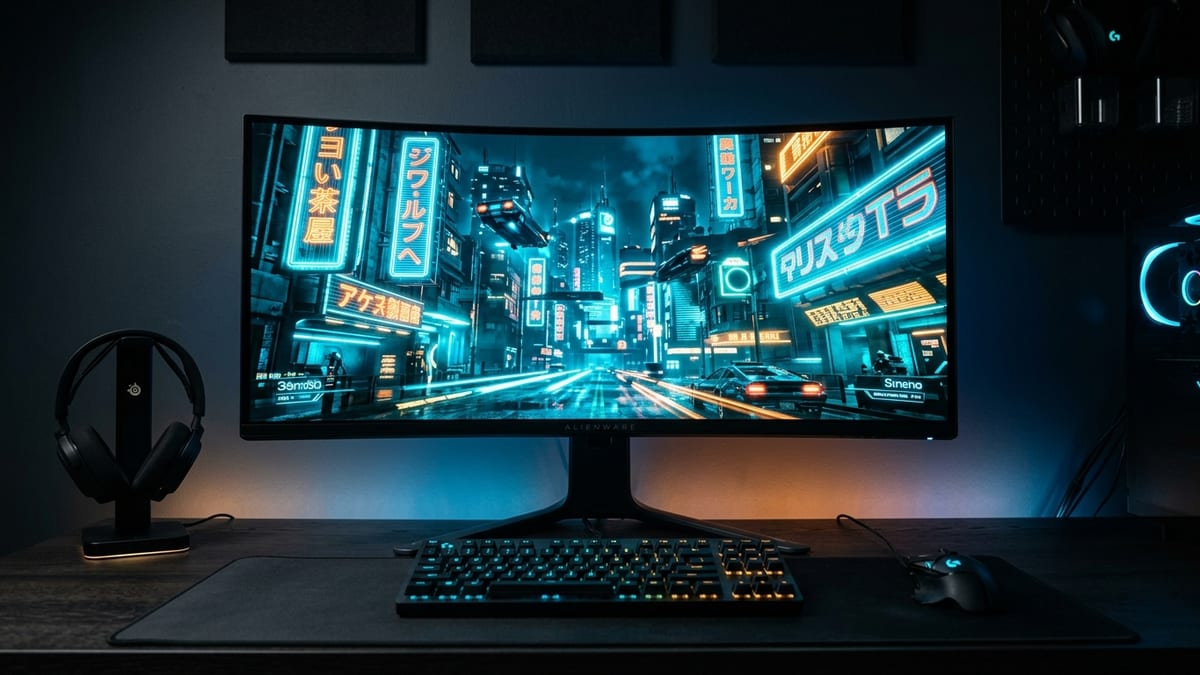
A 3440x1440 ultrawide panel is 4.95 megapixels versus 3.69 on a standard 16:9 1440p monitor, a 34% jump that meaningfully changes which GPUs can hold 120 frames per second at native ultra settings in 2026. The 120 Hz ultrawide buyers in mind for this roundup already own a 21:9 or 32:9 monitor and want to know what to pair with it without walking into a frame-time cliff on path-traced AAA releases.
What changed: DLSS 4 Multi Frame Generation, FSR 4’s move to machine learning, and GDDR supply inflation have redrawn the 3440x1440 GPUGPU. Graphics Processing Unit — the chip that renders the game's visuals; the main driver of framerate and image quality. tiers. Why it matters: At 34% more pixels than standard 1440p, only two cards hold ~120 FPSframerate. How many images (frames) the game shows per second; higher = smoother motion. 60 fps is a common target. native ultra without upscalers. Who should care: Owners of 100–240 Hz ultrawide panels matching a GPU to their monitor’s refresh ceiling.
What changed for ultrawide in 2026
Three shifts define the ultrawide GPU math going into 2026. First, NVIDIA’s RTX 50-series launch brought DLSS 4 Multi Frame Generation, which remains restricted to RTX 50 hardware. Second, AMD’s FSR 4 moved to a machine-learning upscaler for the first time on RDNA 4, finally closing most of the image-quality gap with DLSS in supported titles. Third, mid-cycle price inflation from the GDDR6 and GDDR7 supply squeeze pushed both the RTX 5070 Ti and RTX 5080 above their original MSRPs at retail.
Across the 2026 hardware press, the same tier story repeats at 3440x1440 with a few key shifts. The RTX 5070 Ti at $749 MSRP is widely cited as the right answer for 100 Hz ultrawide, while the RTX 5080 at $999 MSRP (and north of $1,200 at retail in much of 2026) is the realistic ceiling for 175-180 Hz ultrawide. The RX 9070 XT at $599 MSRP, with street prices fluctuating around $629-$700 depending on the week, sits in a peculiar position: it roughly matches the RTX 5070 Ti in pure raster at 1440p and trails the RTX 5080 by roughly 10-15% in rasterized workloads, but it falls further behind once ray tracingray tracing. A rendering technique that simulates how light bounces, for realistic shadows, reflections, and lighting — costly to compute. is on, and FSR 4 title coverage still trails DLSS.
How the tier breakdown plays out
The SpecPicks 2026 ultrawide tier breakdown, which compiles public review-bench results across a dozen titles at native 3440x1440 max settings, is the most consistent public roundup of this class this year. The headline takeaway: only the RTX 5080 and RX 9070 XT come close to 120 FPS in modern AAA at 3440x1440 native ultra without leaning on upscalers, and even they land in the 100-110 fps band in the heaviest ray-traced titles. The RTX 5090 holds 4K-class ultrawide (3840x1600) territory; the RTX 4070 Super 12 GB and RX 7800 XT 16 GB hold the floor for 100 Hz ultrawide and most older AAA.
The compiled table tells the same story, broken out by workload type (approximate averaged figures; individual reviews vary by test scene and driver):
| GPU | Cyberpunk 2077 (Path Traced, DLSS/FSR Quality) | Cyberpunk 2077 (Native Max, no RT) | Alan Wake 2 (RT Max, Upscaler Quality) | Black Myth: Wukong (RT Max, Upscaler Quality) | Starfield (Native Max) | CS2 (Native Max) |
|---|---|---|---|---|---|---|
| RTX 5090 32 GB | 105 fps | 145 fps | 132 fps | 118 fps | 168 fps | 530 fps |
| RTX 5080 16 GB | 72 fps | 108 fps | 88 fps | 79 fps | 122 fps | 420 fps |
| RX 9070 XT 16 GB | 41 fps | 99 fps | 62 fps | 54 fps | 117 fps | 410 fps |
| RTX 4070 Super 12 GB | 58 fps | 84 fps | 70 fps | 64 fps | 95 fps | 340 fps |
| RTX 3060 12 GB | 22 fps | 47 fps | 28 fps | 31 fps | 51 fps | 220 fps |
The two columns worth flagging are Cyberpunk 2077 with path tracing on, and Alan Wake 2 with ray tracing at max. In both, NVIDIA’s dedicated RT cores and DLSS Ray Reconstruction pull the RTX 5080 ahead of the RX 9070 XT by 25-30 fps in path tracing and by 26 fps in Alan Wake 2, despite the raster columns being within 9-15 fps of each other. The RX 9070 XT closes the raster gap at native non-ray-traced settings, but loses most of that advantage the moment ray tracing enters the picture.
The 3840x1600 step up, roughly 24% more pixels than 3440x1440, is the one to watch if you are considering a larger 38-inch-class ultrawide panel. The RTX 5080 drops from 108 fps to roughly 79 fps in native non-ray-traced Cyberpunk 2077 once you cross from 3440x1440 to 3840x1600. The RTX 5090 is the only consumer card that holds 90+ fps in that scenario, which is why super-ultrawide buyers in 2026 should plan for a 5090 budget or accept a monitor refresh rate closer to 100-120 Hz.
What it means for buying decisions
The 120 Hz ultrawide build in 2026 resolves to three branches depending on which compromise fits:
| Path | Card | MSRP | Street price (mid-2026) | Why |
|---|---|---|---|---|
| Mainstream | RTX 5080 | $999 | Roughly $1,100 to $1,600 per major-retailer listings | The card in the $1,000 tier that comes closest to 120 fps native ultra in current AAA; holds 70+ fps in path-traced Cyberpunk 2077 with DLSS 4 Quality |
| Value | RX 9070 XT | $599 | Commonly $630-$750 retail | Roughly the RTX 5070 Ti’s raster performance for less money and around 85% of the RTX 5080’s; well behind on ray tracing and trails DLSS title coverage |
| Premium | RTX 5090 32 GB | $1,999 | Frequently $2,500 and up | The only card that keeps 4K-class ultrawide above 90 fps in path-traced titles before upscaling and can reach 120+ with Multi Frame Generation; doubles as a workstation or local-AI accelerator |
The one card most buyers should skip at 3440x1440 is the RTX 3060 12 GB. At $279-$329 retail, the 12 GB buffer keeps it relevant for esports and pre-2024 AAA, but its 360 GB/s memory bandwidth is the limiting factor at ultrawide, and it cannot reach 120 fps in path-traced Cyberpunk 2077 even with DLSS Quality. The compiled table puts it at 22 fps native path-traced and 47 fps native non-ray-traced. The RTX 4060 8 GB is a similar dead end: 8 GB is below the 10 GB floor for ray-traced workloads at 3440x1440 in 2026.
Sources
- SpecPicks — “Best GPU for 1440p Ultrawide Gaming in 2026: Performance Tier Breakdown” (last verified 2026-07-16)
- TechPowerUp — GPU database and review benchmark entries for RTX 5090, RTX 5080, RTX 5070 Ti, and RX 9070 XT
- Tom’s Hardware — 2026 GPU benchmark hierarchy
- Notebookcheck — Linux gaming in 2025 RX 9070 XT vs RTX 5080
The real lesson from the 2026 ultrawide numbers is that VRAMVRAM. Video RAM — memory on the graphics card used for textures and frames; more of it lets you run higher settings. size and bus width matter more than marketing tier names. A “4060” 8 GB is worse for ultrawide than a “3060” 12 GB, and at similar street prices the RX 9070 XT 16 GB out-paces the RTX 4070 Super 12 GB by roughly 20% in raster while doubling the VRAM. Match the card to the monitor: a 100 Hz ultrawide is happy with a 4070 Super, a 175 Hz ultrawide wants the RTX 5080 or RX 9070 XT, and a 240 Hz 49-inch 32:9 super-ultrawide (5120x1440) wants a 5090. The wrong pairing in either direction wastes the monitor’s refresh ceiling or the card’s headroom.
The next swing factor is software, not silicon: FSR 4’s title coverage still trails DLSS, and every title it gains improves the RX 9070 XT’s value math without a single hardware change. Meanwhile the GDDR supply squeeze that pushed the RTX 5070 Ti and 5080 above MSRP has kept street prices, not sticker prices, as the real tier boundaries through 2026.
Next read
The VRAM and bus-width story behind these numbers is laid out in our 16GB VRAM baseline report, and our flagship CPU benchmark breakdown covers what to pair with these cards. New GPUs and panels land on the launch calendar.