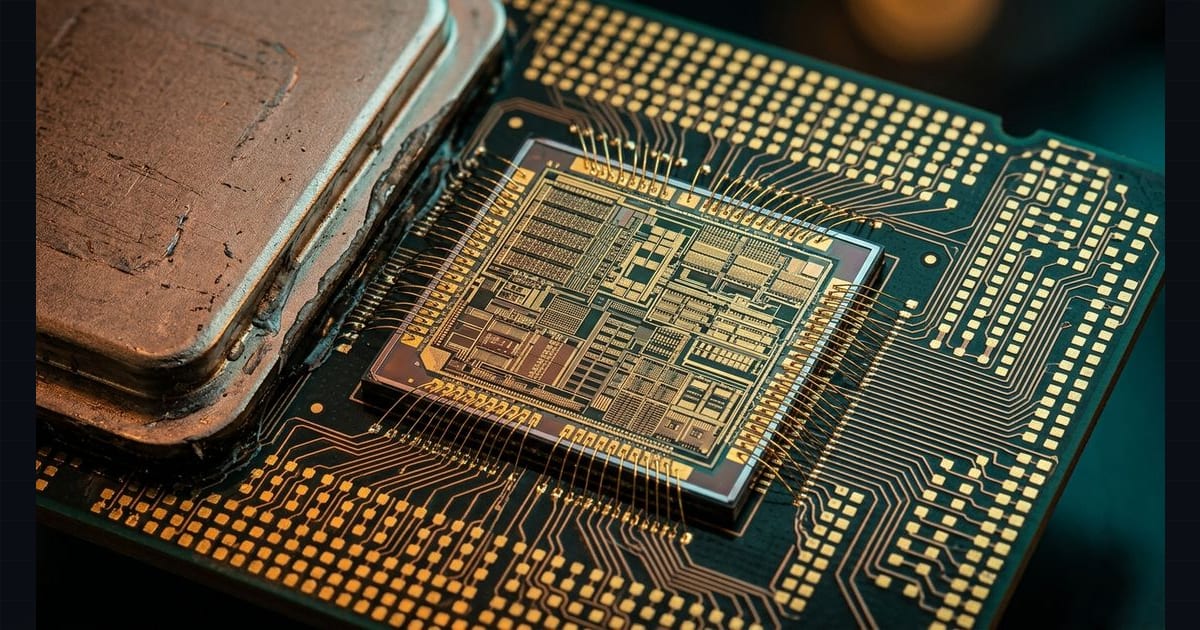
Processor selection remains the single most critical factor for maintaining smooth frame pacing in modern CPU-bound game engines. As game developers expand simulation fidelity, dynamic pathfinding, and physics calculations, CPU cache capacity and memory latency dictate whether a high-end graphics card can reach its full potential.
What it covers: Flagship CPU benchmarks — AMD’s 3D V-Cache3D V-Cache. AMD's stacked L3 cache that gives the CPU very fast access to data, notably boosting game framerates. versus Intel’s Arrow Lake for frametime stability. Why it matters: In CPU-bound RTSRTS. Real-Time Strategy — a strategy game where everyone plays at the same time, continuously, instead of taking turns., MMOMMO. Massively Multiplayer Online — a game that hosts very large numbers of players together in one shared, persistent world., and RPGRPG. Role-Playing Game — a game built around character progression, story, and player choices. engines, cache latency decides 1% lows, not clock speed. Who should pick this: Players building or upgrading a rig for simulation-heavy genres at any resolution.
This is the uncomfortable truth the GPUGPU. Graphics Processing Unit — the chip that renders the game's visuals; the main driver of framerate and image quality.-first marketing cycle tends to bury: in the genres this site covers — RTS, MMO, and systems-heavy RPGs — the graphics card is rarely the bottleneck at 1080p and 1440p. The bottleneck is how fast the CPU can feed the GPU work, and that is governed almost entirely by how often the processor has to wait on system memory. Every wait is a stall, and every stall shows up in your frametime graph as a spike.
1. The 3D V-Cache Architectural Advantage
AMD’s 3D V-Cache technology—featured in the Ryzen 7 9800X3D and Ryzen 7 7800X3D—stacks 64MB of high-speed L3 SRAM directly beneath the processor compute die. For gaming workloads, this massive 96MB total L3 cache pool transforms performance:
- Cache Hit Rates: Game engines retrieve execution instructions and entity positions directly from L3 cache over 90% of the time, avoiding latency penalties incurred when requesting data from system RAM.
- Frametime Consistency: In massive multi-unit RTS titles like Stormgate and Age of Mythology: Retold, 3D V-Cache eliminates micro-stutters during intense 4v4 clashes, delivering class-leading 1% low FPSframerate. How many images (frames) the game shows per second; higher = smoother motion. 60 fps is a common target. numbers.
- Thermal Efficiency: Modern 2nd-gen 3D V-Cache positioning places the cache layer below the CCD, allowing direct contact between the CPU cores and the integrated heat spreader (IHS) for improved heat dissipation and higher sustained boost clocks.
The mechanics here matter more than the megabyte count. A modern RTS frame involves thousands of entities, each with position, state, pathfinding, and targeting data living in memory. On a conventional 32MB-cache chip, the working set of an end-game Stormgate match overflows L3 constantly, and every overflow costs tens of nanoseconds of round-trip latency to DDR5DDR5. A generation of system RAM (memory); newer and faster than DDR4. — a delay multiplicative across thousands of entity updates per simulation tick. The X3D chips simply keep that working set on-die. That is why their advantage shows up hardest in 1% lows rather than average FPS: averages hide the stalls, but the worst-case frames are exactly where memory latency lives.
2. Intel Core Ultra & Arrow Lake Architecture
Intel’s Core Ultra (Arrow Lake) processors take a tile-based modular approach, utilizing TSMC N3B process nodes for compute tiles alongside dedicated Efficiency (E-cores) and Performance (P-cores):
- High-Frequency Memory Controllers: Intel platforms natively support ultra-high-frequency DDR5 CUDIMM memory (up to DDR5-9200), benefiting high-bandwidth workloads and video rendering.
- Power Draw Reductions: Package power consumption in gaming workloads dropped by over 30% compared to 14th Gen processors, drastically lowering VRM and cooler requirements.
- E-Core Task Offloading: Operating system background tasks (Discord, streaming software, browser tabs) run exclusively on E-cores, keeping P-cores completely unhindered for game thread execution.
Arrow Lake is a genuinely smarter design than the 14th Gen chips it replaced — the power reductions alone fix a real platform problem, turning mid-range air coolers and budget B-series motherboards back into viable options. But note where Intel’s wins land: memory bandwidth for rendering and encoding, power efficiency, and background-task hygiene. Those are productivity and quality-of-life wins. The raw bandwidth of DDR5-9200 does not fix the latency problem, because bandwidth and latency are different animals — a wider highway does not shorten the distance to memory. For CPU-bound game engines, that distinction is the entire ballgame.
3. CPU Recommendations for Specific Genres
| Genre | Example titles | Recommended CPU | Why |
|---|---|---|---|
| Complex RTS & Simulation | Civ VII, Stormgate | AMD Ryzen 7 9800X3D | Unmatched L3 cache capacity keeps turn processing times fast and frame rates rock-solid during end-game map sizes. |
| Dense MMO Raids | WoW: The War Within, FFXIV | AMD Ryzen 7 7800X3D / 9800X3D | 24-man raid encounters with dense spell effects scale exceptionally well with 3D V-Cache. |
| High-Resolution RPG Gaming | Path of Exile 2, Avowed, Fable | Intel Core Ultra 7 265K / AMD Ryzen 7 9700X | At 1440p and 4K GPU-bound resolutions, both platforms deliver maximum performance with minimal power draw. |
4. Why It Matters: Cache Has Replaced Clock Speed as the Gaming Metric
For two decades, CPU buying advice for gamers was simple: highest boost clock wins. That era is over. Simulation-heavy genres now allocate their frame budget to entity management, AI evaluation, and state synchronization — workloads dominated by pointer-chasing through large, irregular data structures. Pointer-chasing is the worst-case scenario for a CPU: unpredictable, un-parallelizable, and almost entirely memory-latency-bound. No amount of extra gigahertz fixes a cache miss, because the core spends those cycles waiting.
That reframing explains the otherwise confusing benchmark reality: the eight-core 9800X3D routinely outperforms chips with twice the cores and higher clocks in RTS and MMO titles, while the same chips reverse the standings in heavily threaded rendering workloads. Neither result is wrong. They are measuring different bottlenecks, and the genres that punish frametime spikes hardest are the ones where the cache die wins.
5. The Take: Buy the Cache Unless Your Resolution Says Otherwise
The honest recommendation splits cleanly on resolution and genre, not brand loyalty. If you play RTS, MMOs, or simulation games at 1080p/1440p — precisely the competitive and raid-focused audiences where frametime stability decides outcomes — the 9800X3D is the end of the argument. Its 1% lows in Stormgate clashes and dense War Within pulls are not marketing numbers; they are the frames you actually feel. The 7800X3D remains the value play of the decade for anyone on a tighter budget, delivering most of the same cache advantage on a now-discounted platform.
The Intel case is narrower but real. If you play primarily at 4K, where the GPU becomes the limiter and CPU differences compress to noise, the Core Ultra 7 265K matches AMD frame-for-frame while drawing dramatically less power, costing less to cool, and handing you a far better platform for streaming, capture, and content work on the side. Arrow Lake’s E-core offloading is also quietly the best quality-of-life feature on either platform — anyone who has watched a Discord overlay eat a raid boss frame knows why. What the 265K is not: the chip to buy for a 1080p competitive RTS rig. Know which player you are.
6. What It Signals: The Latency Era of CPU Design
Step back from the SKU table and a broader industry shift is visible. Both vendors have effectively conceded that general-purpose frequency scaling is exhausted for gaming — AMD responded by attacking latency with stacked SRAM, Intel by attacking efficiency and memory subsystem throughput with tiled chiplets and CUDIMM support. These are two different bets on the same diagnosis: the game engine’s data feed is the new frontier, not the core’s math throughput.
Expect the next hardware cycle to extend both bets. AMD’s stacked-cache approach has clear headroom — larger dies, cache on more cores — while Intel’s tile architecture is explicitly designed to drop in a similar cache tile if market pressure demands it. The practical signal for buyers: a 9800X3D purchased today sits on the correct side of the industry’s direction. Cache-forward silicon is not a gimmick generation; it is the new baseline the whole market is converging on. For CPU-bound gaming genres, that convergence is the best news the hardware market has delivered in years — finally, the spec sheet that matters is the one that fixes stutter instead of padding averages.
Between AMD’s stacked-cache headroom and Intel’s tile architecture leaving room for a cache tile of its own, the next hardware cycle will extend both bets rather than retreat from them. For anyone buying now, that means a cache-forward chip is the rare purchase that lands on the right side of where the market is heading.
Next read
Pairing a CPU with the right memory matters more than ever — see China’s DRAM Push: CXMT DDR5 and RAM Pricing for the memory-market side. On the GPU side of the same build, our 16GB VRAM baseline breakdown covers the other half of the bottleneck. New CPUs and boards are tracked on our launch calendar.