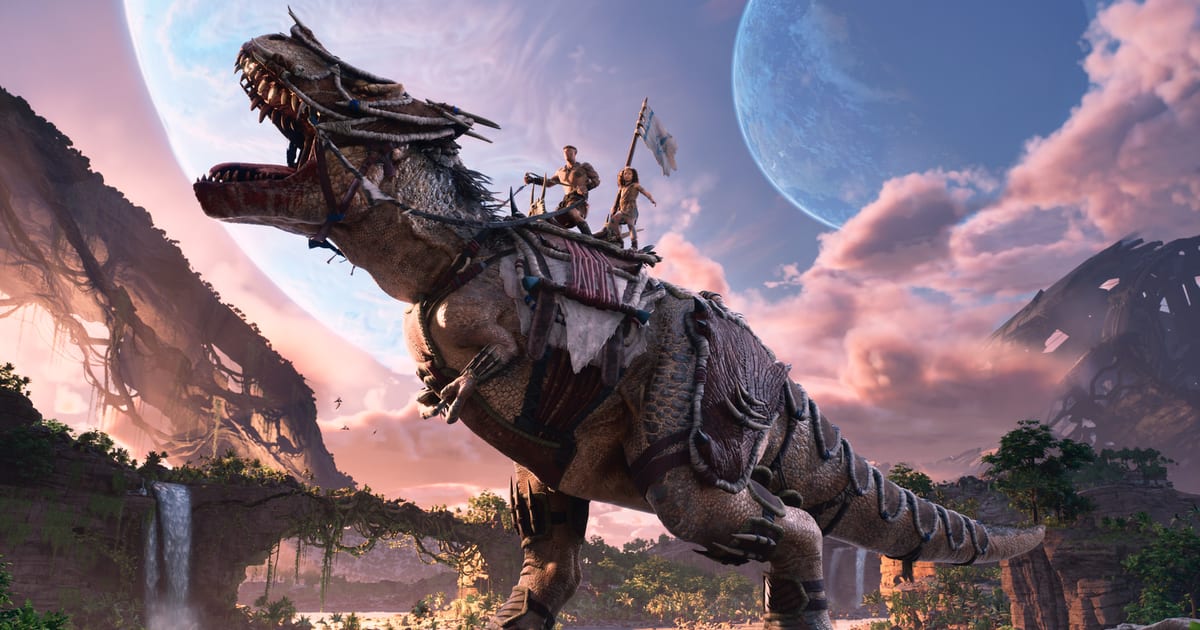
Ark 2 is the next-generation sequel to ARK: Survival Evolved, and after several release-window shifts it remains in development rather than on store shelves. Studio Wildcard has, however, publicly described a concrete set of design pillars for it. This primer covers what is confirmed about the engine, the survival mechanics, and how the sequel departs from the original game.
What is confirmed
The clearest picture of Ark 2 comes from Studio Wildcard’s own announcements and a mid-2025 interview with co-founders Jesse Rapczak and Jeremy Stieglitz. The headline facts are stable across those sources.
Ark 2 is built on Unreal EngineUnreal Engine. A widely-used commercial game engine from Epic Games; powers many large-studio (AAA) games. UE5 is the current generation. 5, moving the franchise off the older technology that powered ARK: Survival Evolved. The sequel is third-person only, a hard pivot from the first-person default of the original. It stars Vin Diesel as the protagonist Santiago and Auli’i Cravalho as his daughter Meeka, with a narrative built around a father-daughter bond and betrayal. Development is a partnership between Studio Wildcard and Grove Street Games.
The release window has moved repeatedly. After original targets in 2022, then 2023, then late 2024 all passed, Stieglitz told press in June 2025 that the team had a playable vertical slice but had paused full production to ship ARK: Survival Ascended, the Unreal Engine 5 remaster, as a way to master the new engine first. He estimated that turning that vertical slice into an Early Access release would take roughly 18 months of concentrated team focus, and suggested the game could reach players within about two years. Until that resource shift happens, no firm date should be treated as final.
The engine shift and what it enables
Unreal Engine 5 is not a cosmetic upgrade for Ark 2; it changes what the survival sandbox can actually do. Two technologies in particular matter.
Lumen, Unreal Engine 5’s fully dynamic global illumination system, is the reason Ark 2 can push a more atmospheric, less pre-baked world. Light bounces realistically off surfaces and produces believable reflections, which matters for a survival game that runs on day-night cycles, weather, and cave interiors. Nanite, the engine’s virtualized mesh streaming, lets the world carry far more geometric detail than Survival Evolved could, because high-detail assets stream in without the same memory cost.
ARK: Survival Ascended already demonstrated what the team can do with this toolchain on the existing Ark content. Ark 2 is the project meant to use that experience for all-new content rather than a remake.
Survival mechanics that change from ASE
Several core systems are explicitly redesigned relative to ARK: Survival Evolved.
Third-person traversal. Player movement has been rebuilt around free-climbing, mantling, parkour, sliding, and swinging, with inspirations named as Assassin’s Creed-style automatic parkour and Breath of the Wild-style climbing. In Survival Evolved, getting around the world was largely walking, flying on tames, and building ramps. Ark 2 makes the human body itself a traversal tool, which changes how bases, cliffs, and ruins are approached.
Souls-like melee combat. Human-scale combat borrows from the Souls genre: target-lock, blocks, dodges, light and heavy attacks, combos, staggers, and special attacks, all emphasizing player reflex and timing. Survival Evolved’s melee was comparatively simple animation-driven swings. Stieglitz has acknowledged that doing Souls-like combat in a multiplayer PvP context is genuinely hard, which is part of why the game has taken as long as it has.
Creature-scale combat with real impact. When you attack with a tamed creature, the attack is designed to hard-impact on the target rather than pass through it, with the victim’s flesh reacting at the hit location. The goal is to convey raw power, something Survival Evolved’s older combat never achieved convincingly.
Component-based item crafting. Instead of crafting a fixed named item, you assemble weapons and tools from distinct modules that change both appearance and function, with specific materials further altering the look. The claim from the studio is millions of possible combinations, which means gear identity is player-defined rather than recipe-defined.
Dynamic world events. Rather than a mostly static world with predictable spawns, Ark 2 runs a World Event system where scenarios occur independently of the player: watering-hole gatherings, wounded creatures, stampedes, herds, dens with parents and young, and tracking signs of advanced prey. Choosing to engage yields rewards or challenges. This is a clear departure from Survival Evolved’s largely spawn-driven ecology.
The Aratai, an opposing PvE force. Hostile NPCs called the Aratai hunt and attack players while riding their own tamed creatures, trying to drive human interlopers out. Stieglitz has described NPC antagonists as a confirmed pillar, adding a PvP-like threat layer even for players who never fight other humans.
What carries over and what does not
Some Survival Evolved fundamentals survive the transition. You still form a tribe, tame and breed creatures, build, and fight to the top of the food chain in a persistent online world. The cross-platform multiplayer ambition continues, and the franchise’s commitment to user-generated content is explicitly a launch requirement for Ark 2.
What does not carry over is the first-person camera, the older melee model, the static-spawn ecology, and the fixed recipe item system. The build system is also revamped, with the ability to save and share build templates, and a Creature Management system plus a proper World Map replace the looser tooling of the original.
Cross-platform modding
Studio Wildcard has called cross-platform user-generated content a must-have for Ark 2 at launch, enabled through official mod support by mod.io. The stated goal is that mods created on PC can be uploaded and made playable on Xbox, with everything from new creatures to new game types to new maps possible. Stieglitz has even floated the idea of weaving UGC into the experience so players encounter it without browsing menus, though that level of integration is aspirational rather than confirmed as a shipped feature.
What it means for returning and new players
For returning Survival Evolved players, the main adjustment is expectation. Ark 2 is not a bigger version of the game you already know. It is a third-person survival action game with Souls-influenced combat, a traversal system that rewards engaging with the terrain, and a world that generates its own events. Your tames still matter, but the moment-to-moment play is more active and more player-skill driven.
For new players, the primer is simpler: expect a survival sandbox, but one where your personal combat and movement skill carry more weight than they did in the genre’s earlier entries, and where the world is meant to feel less predictable. Given the open release window, the practical advice is to follow Studio Wildcard’s official channels for a date rather than anchoring on any third-party estimate.
A reasonable expectation to hold
Because Ark 2 has been delayed multiple times and the studio has openly described the production pause, the healthiest posture is to treat any specific date outside official channels as speculative. What is stable is the design intent: third-person traversal and Souls-influenced melee, an opposing PvE force in the Aratai, component-based crafting, dynamic world events, and cross-platform modding at launch. The Lost Colony expansion for Survival Ascended is positioned to set up Ark 2’s narrative stakes, so players who want to walk into the sequel’s story informed have a path to do that through the existing remaster rather than waiting idle.
The risk worth watching is scope. Studio Wildcard has said it does not want Ark 2 to feel a few years behind the curve at launch, which means the team is balancing ambition against a moving target. The upside for players is that the extra time is going into mechanics and tech rather than into shrinking the vision. For now, follow the official ARK site and the studio’s statements for a release window you can actually plan around.