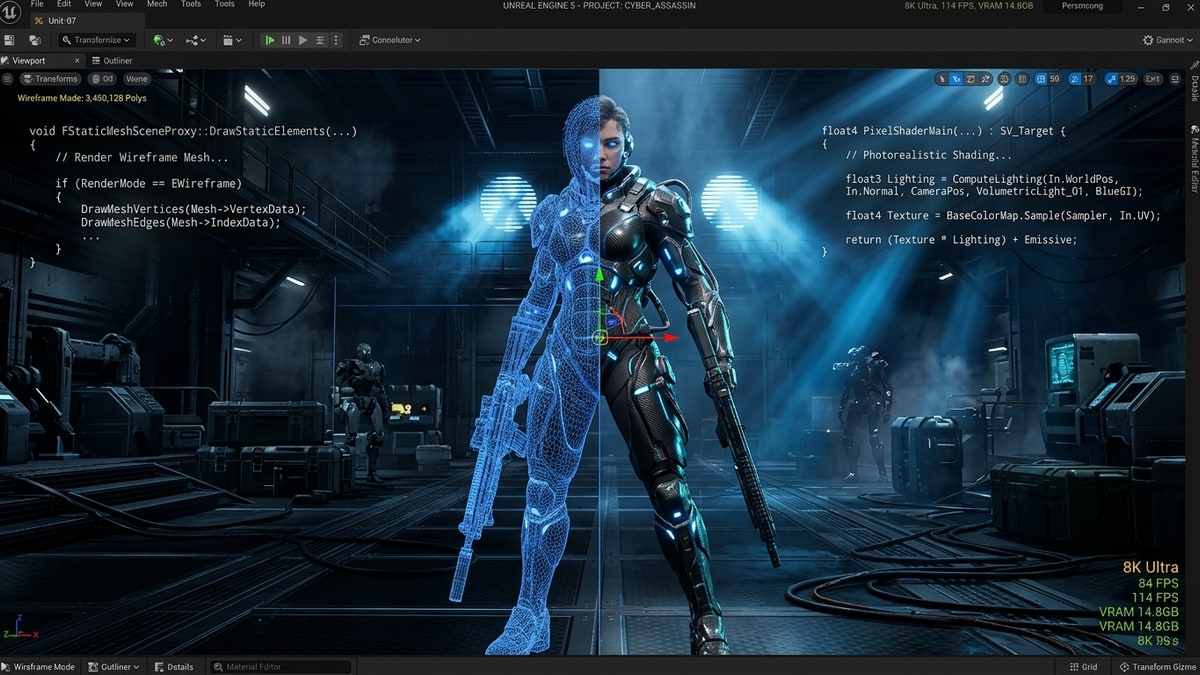
Unreal EngineUnreal Engine. A widely-used commercial game engine from Epic Games; powers many large-studio (AAA) games. UE5 is the current generation. 5 has spent the last several years consolidating into the default rendering foundation for a large slice of AAA development, from Halo’s campaign reset to Black Myth: Wukong, Kingdom Come: Deliverance 2, and a growing roster of strategy and survival titles. The two technologies doing the heaviest lifting — Nanite virtualized geometry and Lumen dynamic global illumination — are genuinely good at what they were designed for. The problem is that what they were designed for is not the same workload as a thousand-unit RTSRTS. Real-Time Strategy — a strategy game where everyone plays at the same time, continuously, instead of taking turns. battle or a densely simulated survival sandbox, and the gap between the marketing demos and the shipping games is now wide enough to quantify.
What it covers: What Nanite and Lumen actually cost — compute and VRAMVRAM. Video RAM — memory on the graphics card used for textures and frames; more of it lets you run higher settings. — in strategy, sim, and survival-scale scenes. Why it matters: UE5’s flagship systems were tuned for hero-camera content; a UE5 sticker does not guarantee demo-quality lighting at scale. Who should pick this: Players speccing hardware for UE5 titles, and anyone reading engine marketing against shipping-game reality.
What Nanite Actually Does
Nanite is a virtualized geometry system. Instead of an artist authoring multiple LOD (level-of-detail) meshes and the engine swapping between them based on distance, Nanite stores a single high-poly source mesh and streams clusters of triangles on demand, culling and refining them in a GPUGPU. Graphics Processing Unit — the chip that renders the game's visuals; the main driver of framerate and image quality.-driven pass. The draw-call and per-polygon cost that traditionally capped scene density is moved off the CPU and onto a compute pipeline that runs independent of the main render thread.
The win is concrete and measurable. Static meshes with millions of triangles — rock formations, cathedral interiors, distant cityscapes — render at frame rate without the artist time that LOD baking used to consume. The cost is GPU compute and, less visibly, memory: Nanite meshes store a compressed cluster representation plus a runtime BVH-like acceleration structure, and that footprint scales with source triangle count, not with what’s currently visible.
Where Nanite Wins
- Hero assets and environments. Single high-poly meshes that previously required days of LOD authoring now drop into a scene and “just work” at distance. Black Myth: Wukong’s temple and forest environments are the canonical case.
- Instanced clutter. Forests, rubble fields, and crowd scenes benefit because Nanite handles per-instance culling without manual mesh reduction.
- Cinematic and linear content. Tight camera control means the visible triangle budget stays predictable, which is the regime Nanite’s streaming model assumes.
Where Nanite Falls Over
Nanite’s weakness is not polygon count — it’s variety under scale. The system’s runtime cost grows with the number of distinct Nanite meshes in the working set, not just the triangles on screen. A scene with two hundred unique hero meshes each rendered once can cost more than a scene with one hero mesh instanced two hundred times, because the cluster streaming and visibility buffer machinery has to track each source independently.
For large-scale strategy and simulation games, this is the failure mode:
- RTS unit swarms. A Stormgate or Tempest Rising battle can field hundreds of distinct units simultaneously. Nanite is not optimized for “many unique small meshes viewed at a fixed mid-distance” — its sweet spot is either very close (hero detail) or very far (cluster collapse to a few pixels). The mid-band — units held at a fixed mid-distance with hundreds on screen at once — is where traditional instanced mesh rendering with a single baked LOD often outperforms Nanite’s visibility-buffer path.
- Dense simulation props. Survival and city-builder titles (Manor Lords, Once Human) stack thousands of interactable props — fences, carts, crops, debris — that need collision, not just rendering. Nanite does not accelerate physics or game logic; it only handles the draw. The Chaos physics cost of those props is unchanged, so adopting Nanite for them buys rendering headroom that the CPU simulation side cannot use.
- Foliage and destruction at scale. Nanite foliage exists but is compute-heavy; large-scale destruction (the kind Fractured Veil-style survival games want) regenerates cluster data on the fly, which is expensive enough that most shipped UE5 destruction either uses traditional fractured meshes or limits Nanite to the non-destructed state.
The practical result: strategy and simulation developers using UE5 frequently disable Nanite for gameplay-layer meshes and reserve it for terrain and static environment art, then hand-roll LODs for the simulation objects. The engine does not prevent the mixed approach, but it does not advertise it either.
What Lumen Actually Does
Lumen is UE5’s default global illumination and reflection system — a software- and hardware-ray-traced hybrid that updates indirect lighting in real time without baked lightmaps. Move a light, open a door, blow up a wall, and the bounce lighting re-resolves within frames rather than requiring a recompile of the lighting build.
The win is the obvious one advertised in every demo: dynamic time-of-day and destructible environments finally look correct without the baked-lightmap tax that locked previous-generation engines into fixed lighting states. Halo’s Project Foundry pivot leans on this directly, replacing Infinite’s fixed-time-of-day ring lighting with dynamic weather and day/night pacing.
Where Lumen Wins
- Single-hero and enclosed scenes. Interior spaces with a few dynamic lights resolve cleanly; the software ray-tracing path (distance-field tracing) is fast enough that hardware RT is optional.
- Hero camera work. Third-person and first-person games where the camera sees a bounded slice of the world get Lumen’s best behavior, because the irradiance cache only needs to update the visible frustum.
- Iterative lighting. Designers change lighting without waiting on a bake, which is a real production-speed gain.
Where Lumen Falls Over
Lumen’s cost is dominated by the surface cache — a screen-space representation of the scene’s radiance that the GI solver samples. That cache has finite resolution and finite update budget, and it degrades in two regimes that RTS and sim games hit constantly:
- Wide vistas with many light sources. An RTS map viewed from a top-down or pull-back camera exposes a huge surface area to the irradiance solver at once. Lumen’s cache has to cover all of it, and with dozens of dynamic lights (projectors, muzzle flashes, burning structures), the update budget gets spent on re-resolving rather than serving stable results. The visible artifact is light leaking and “swimming” indirect lighting on distant terrain.
- High-frequency geometry and foliage. Distance-field tracing assumes reasonably chunky geometry; thin structures (wire fences, grass, distant trees) produce noisy or incorrect bounce lighting. Shipped UE5 titles routinely fall back to a separate, cheaper GI path or cards/reflections for foliage-heavy scenes.
- Hardware RT cost at scale. When Lumen is set to its hardware ray-tracing tier (the setting that produces the cleanest results), BVH traversal cost scales with scene triangle count. In a dense sim scene that cost can exceed the rest of the frame, which is why most shipping UE5 games run Lumen on the software path and accept the artifacts.
The honest summary: Lumen is a contained-scene GI system. The moment the camera pulls back to expose a full battlefield or a large settlement, it either drops to the software path with visible artifacts or eats the frame budget on the hardware path. Strategy and survival developers who want clean wide-shot lighting still end up blending Lumen with manual light placement or falling back to a partially baked approach — the exact thing Lumen was supposed to eliminate.
The VRAM Tax
Both systems are memory-hungry, and the hunger compounds when they run together. On a 2026 AAA target with high-res texture packs enabled:
- Nanite working set. Cluster data and acceleration structures for a large open world can occupy a substantial chunk of VRAM even before textures are counted. Streaming helps the visible footprint but the engine keeps a sizable resident set for fast cut-in.
- Lumen surface cache and irradiance volumes. The surface cache, radiance probe atlas, and distance-field atlases add another meaningful slice of VRAM at high quality settings, more with hardware RT BVHs resident.
- Virtual Shadow Maps (VSMs). UE5’s default shadow system pairs with Nanite and Lumen and maintains a page-allocated shadow atlas that grows with screen resolution and light count — another consistent VRAM consumer that older shadow-map techniques did not have.
The combined effect is that a “standard” UE5 AAA title at 1440p with high settings now wants 12–16 GB of VRAM as a floor, with 4K and ultra texture packs pushing into 16–20 GB territory. Cards at 8 GB are effectively locked out of the high preset, and 12 GB cards survive only with texture streaming clamped. This is the same VRAM pressure documented in the broader 2026 GPU landscape: the bottleneck moved off shader count and onto memory footprint, and UE5 is one of the engines driving that move.
| Workload | Nanite fit | Lumen fit | Typical VRAM pressure |
|---|---|---|---|
| Linear hero campaign (close camera) | Excellent | Excellent | High (textures dominate) |
| Open-world RPGRPG. Role-Playing Game — a game built around character progression, story, and player choices. (mid camera, hero assets) | Good | Good with tuning | High |
| RTS / large-scale strategy (top-down, many units) | Poor for units | Poor (artifacts on wide shots) | Medium (geometry streaming) |
| Dense sim / survival (many props + sim) | Mixed (render-only benefit) | Mixed (foliage noise) | High |
| Fighting games (closed arena) | Excellent | Excellent | Low–Medium |
What This Means for Strategy and Sim Developers
The pattern across shipping UE5 strategy and sim titles is a partial adoption: Nanite and Lumen for the environment and hero-cinematic layers, traditional instanced rendering and hand-placed lighting for the gameplay and simulation layers. That is not a failure of the engine — it is the correct reading of what the systems were built for. UE5’s value proposition for a strategy studio is the asset pipeline, the editor, and the rendering headroom on the environment side, not a turnkey solution for thousand-unit battle lighting.
For players, the takeaway is simpler. A UE5 sticker on a strategy or survival game does not guarantee the demo-quality lighting in actual large-scale play. The engine’s two flagship systems are real and useful, but they were tuned for hero-camera content, and the bill comes due — in frame time and in VRAM — the moment a scene scales past what those systems were architected to hold.
Sources & further reading
- Epic Games — Unreal Engine 5 official documentation (Nanite, Lumen): https://dev.epicgames.com/documentation/unreal-engine/
- Epic Games — Unreal Engine 5 release notes and feature overview: https://www.unrealengine.com/en-US/unreal-engine-5
- Epic Games — “A First Look at Unreal Engine 5” (Nanite & Lumen reveal): https://www.unrealengine.com/en-US/blog/a-first-look-at-unreal-engine-5
- Digital Foundry — Unreal Engine 5 technical analyses (UE5 titles, Lumen/Nanite performance): https://www.eurogamer.net/digitalfoundry
- Epic Games Developer Community — Lumen and Nanite performance guidelines: https://dev.epicgames.com/community/unreal-engine/learning
- mneurix.quest — VRAM tiers and 2026 GPU memory requirements: https://mneurix.quest/genre/hardware
Next read
- For the memory budget these systems land in, see VRAM Tiers 2026: 1440p vs 4K Stuttering.
- For the survival-game consequences, see Ark 2 on Unreal Engine 5: What the Survival Mechanics Ask of the Hardware.
- For the studio-side view, see ARC Raiders on UE 5.7: The 1.45.0 Update.