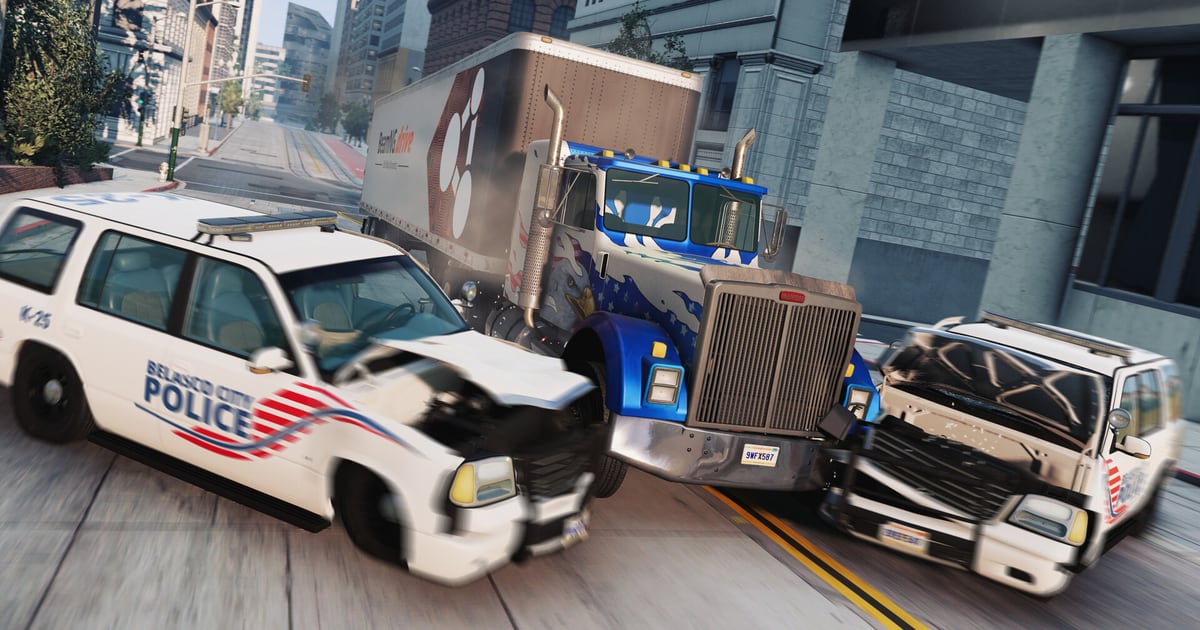
On 29 July 2026 BeamNG GmbH shipped version 0.39 of BeamNG.drive and described it, in the studio’s own words, as “the biggest update we’ve ever delivered”. The headline items were a rebuilt shadow and lighting stack, HDR output on two renderers, and a new default renderer on Windows. Eight weeks later the studio named the other half of the year’s plan: BeamNG.drive reaches PlayStation 5 on 19 October 2026, and the PC version moves to 0.40 at roughly the same time.
What changed: Version 0.39 (29 July 2026) overhauled shadows, added HDR output on Vulkan and Direct3D 12, replaced light falloff with an inverse-square model, and made Direct3D 12 the default renderer on Windows. BeamNG.drive launches on PS5 on 19 October 2026. Why it matters: The PS5 version arrives in Early Access with local split-screen and console upscaling, but without mods or VR at launch — the two features that define the PC version for many of its players. Who should care: PC players deciding whether to accept the framerateframerate. How many images (frames) the game shows per second; higher = smoother motion. 60 fps is a common target. cost of the new presets, and console players buying BeamNG for the first time on 19 October.
What v0.39 rewrote in the renderer
BeamNG’s feature post is unusually specific about what changed, which makes the update easier to audit than most graphics overhauls. Shadows were rebuilt for stability while driving and moving the camera, and the studio’s stated goal is that shadows “should no longer detach or float away from objects like wheels and car bodies”. The same pass fixed the VR path: shadows “should now align properly for both eyes in VR”. Ground-truth ambient occlusion quality was improved and auto exposure was added.
The lighting model changed underneath that. BeamNG says it “implemented physically correct light attenuation, replacing the old light falloff models with an inverse-square physical light model” — a change that alters how every light in the game falls off with distance, not just how it is drawn.
| v0.39 change | What BeamNG says it does |
|---|---|
| Shadows | Overhauled stability while driving and moving the camera; shadows “should no longer detach or float away from objects”; VR shadows realigned “for both eyes” |
| HDR output | Added “on Vulkan and Direct3D 12, for brighter highlights, wider color ranges, and improved display accuracy on HDR-capable monitors” |
| Light attenuation | Old light falloff models replaced with “an inverse-square physical light model” |
| Exposure and occlusion | Improved GTAO quality, plus auto exposure |
| Sky | Volumetric clouds, a physically-based night sky with Milky Way rendering and a constellation database “fully synchronized with latitude, longitude, date, and time of day”, and a multiple scattering sky model with spherical-harmonic ambient lighting |
| Vehicle lights | Realistic projected patterns per vehicle market and technology; “brightness, range, and color” set by bulb type and wattage, with materials moved to “realistic nits output values instead of the old emissive system” |
| Default renderer | Direct3D 12 “is the default BeamNG.drive renderer on Windows starting with version 0.39” |
The renderer line in that table comes from BeamNG’s own documentation rather than the patch post, and it carries the sharpest technical constraint. The D3D12 renderer requires Shader Model 6.0 or newer for texture streaming feedback and screen-space shadows, and BeamNG’s docs warn that older hardware may not support wave operations “even when Direct3D 12 is advertised”. Direct3D 11 survives only as “an obsolete fallback renderer” that “does not support texture streaming or features that require Shader Model 6”, and Direct3D 12 is Windows-only — native Linux still runs Vulkan.
HDR output is the one item in that list whose result depends on the display as much as the code. A renderer that now emits HDR is only half of the chain; the other half is how the panel clips the signal. The mechanics of that have not changed with this patch, and the HGiG and peak-nit calibration walkthrough covers the display side that BeamNG does not.
Where the frame budget went
BeamNG is direct that the visual jump was not free. The studio worked on memory management and says the benefits scale with the player’s hardware: if RAM and VRAMVRAM. Video RAM — memory on the graphics card used for textures and frames; more of it lets you run higher settings. already exceeded what the game needed, “memory optimizations won’t benefit you”; near the limits, “content that barely fit in memory, might now fit”; below the limits, “you may be able to load certain maps or vehicles you couldn’t load before”. The observable wins it lists are lower memory peaks during loading screens, after a map has loaded, when loading several maps in one session, and when spawning multiple vehicles.
Framerate is the separate, less comfortable part. BeamNG’s account is that previous releases fought extra quality with optimizations so framerate stayed similar, but “on this update however, the leap in visual quality is much greater than in previous updates”. It says it offset a lot of the original impact and still expects “better visuals to have an impact in framerate”.
The practical advice in the post is to lower settings rather than keep the old preset. “All of the default graphics presets will look better than before”, so a preset one step down from a player’s previous choice may now look equal or better; and for anyone already on the lowest preset, BeamNG’s hedge is that “the impact should be minimal, hopefully”.
Two hotfixes sharpened the renderer’s edge cases within nine days of release. On 31 July, 0.39.2 added an explicit D3D12 option to the launcher and changed the fallback threshold for GPUs below minimum spec: rather than checking for 6 GB of VRAM, the D3D11 fallback “now checks for 5.5GB of VRAM (instead of 6GB)”. On 7 August, 0.39.3 and 0.39.4 documented a driver-specific problem rather than a game bug: “Some D3D12 Intel drivers are causing excessive VRAM usage, which can lead to OOM and unsatisfactory performance”, with BeamNG’s temporary workaround being “please use Vulkan or D3D11”. The same hotfix extended Safe Mode’s DX11 fallback to cover GPUs with 4 GB of VRAM or less.
That is the same VRAM squeeze that has been pushing 8 GB cards off recommended-spec lists all year, which the 2026 minimum-spec analysis tracks across other releases. BeamNG’s documented floor is unchanged: 16 GB of RAM and a 6 GB GTX 1060 or RX 570 to start, 32 GB and an RTX 3060 or RX 6700 for 1080p, and 60 GB of storage.
The UI overhaul was console groundwork
The update’s second half is less visible in a screenshot and more relevant to 19 October. BeamNG rebuilt the Pause menu, renamed UI apps to HUD apps, reworked replay management, and ported both the Options menu and Photo Mode to Vue. Its stated motivation for the menu work is gamepad players: with the old system, “gamepad navigation in the menus ranged from annoying to virtually impossible”.
The 7 August hotfix list shows how much of that was still settling — controller-navigation fixes, thumbstick scrolling in the part selector, HUD apps no longer taking over the controller, gamepad steering fixes, and “Fixed broken markup in ‘Enable VR’ on non-Vulkan APIs”. In May the studio had already said the console work on controls and interface “will reach everyone playing on PC when v0.39 lands”.
Away from rendering, 0.39 added the Cherrier Ardente, “a new two-door coupe addition to the FCV platform” with FWD/AWD gasoline and diesel options plus RWD/AWD electric variants; more than 50 new achievements; an NGRC Rally Utah 2026 loop with “four special stages over 16.4 km and a total loop distance of 30 km”; and a widened aerodynamics system so that a moving vehicle influences the airflow around nearby vehicles through slipstreaming, bump drafting and side drafting. One trade-off is documented plainly: license plates now use “an entirely new render engine” that is faster and lighter on memory, and in exchange “we lost backwards compatibility with old license plate mods”.
What the PS5 version ships with on 19 October
BeamNG announced the PS5 date on 24 September 2026, four months after first confirming the platform. The PlayStation Store listing carries a release time of 10/19/2026 02:00 PM UTC, offline play, a 1-to-4 player count, and DualSense vibration and trigger effects.
| Confirmed for launch | Not confirmed |
|---|---|
| Release 19 October 2026, listed at 10/19/2026 02:00 PM UTC on the PlayStation Store | A PS5 price — absent from both the announcement and the store listing |
| Early Access on PlayStation, developed “concurrent with the PC version” | Frame-rate or resolution targets |
| Offline play, 1 to 4 players, DualSense vibration and trigger effects | Mods — “won’t be supported at launch” |
| Local split-screen, FSR 3 on base PS5, PSSR on PS5 Pro | VR — also not supported at launch |
| PC version 0.40 “around that date too” | Online multiplayer — the store listing shows offline play only |
The mod answer goes further than a launch-window delay. The press release states that “mod support for PlayStation will not be available at launch”, that timing and scope cannot be confirmed, and that “mod authoring tools, such as the World Editor, are not currently planned for PlayStation” at all. BeamNG’s own announcement frames the whole question the same way: “We are aiming for feature parity across platforms where possible in the long term, but we can’t confirm timing or scope just yet.”
Upscaling is the part where consoles may get ahead of a typical PC setup. The press release confirms FSR 3 on the base PS5 and PSSR on PS5 Pro, though the store listing I fetched does not carry a PS5 Pro Enhanced label. What PSSR does differently as a machine-learning upscaler — and where it still diverges from FSR — is covered in the PS5 Pro PSSR breakdown.
Online multiplayer stays off the table for now. The listing is offline-only, and in May the studio said official multiplayer “is real (but not here yet)”, with development “still far from what we’d call ready and likely won’t be for quite a while”. That post also confirmed the physics rate that the console version inherits — per CEO Thomas Fischer, the engine “updates at a rate of 2kHz — meaning the vehicle is being fully re-evaluated two thousand times every second” — alongside a thousand vehicle configurations and a dozen open-world maps.
What is still open
Three things are worth watching rather than expecting.
The 0.40 date. BeamNG’s wording is “expect Version 0.40 around that date too” — no day. The PS5 build is meant to move in step with the PC version, which is what makes the Early Access label meaningful rather than a formality.
The mod question. The press release separates playing community content from creating it: mod support is “being explored” with no timing, while authoring tools are “not currently planned”. Those are two different decisions, and only the second has been answered negatively.
A price. Neither the 24 September announcement nor the store listing I fetched states what the PS5 version costs. The PC release has no price problem to solve — on Steam it sits at “Overwhelmingly Positive” across 212,126 English reviews, which is demand the console version can only add to — but a review score is not a price. Until the store shows a number, there is none to quote.