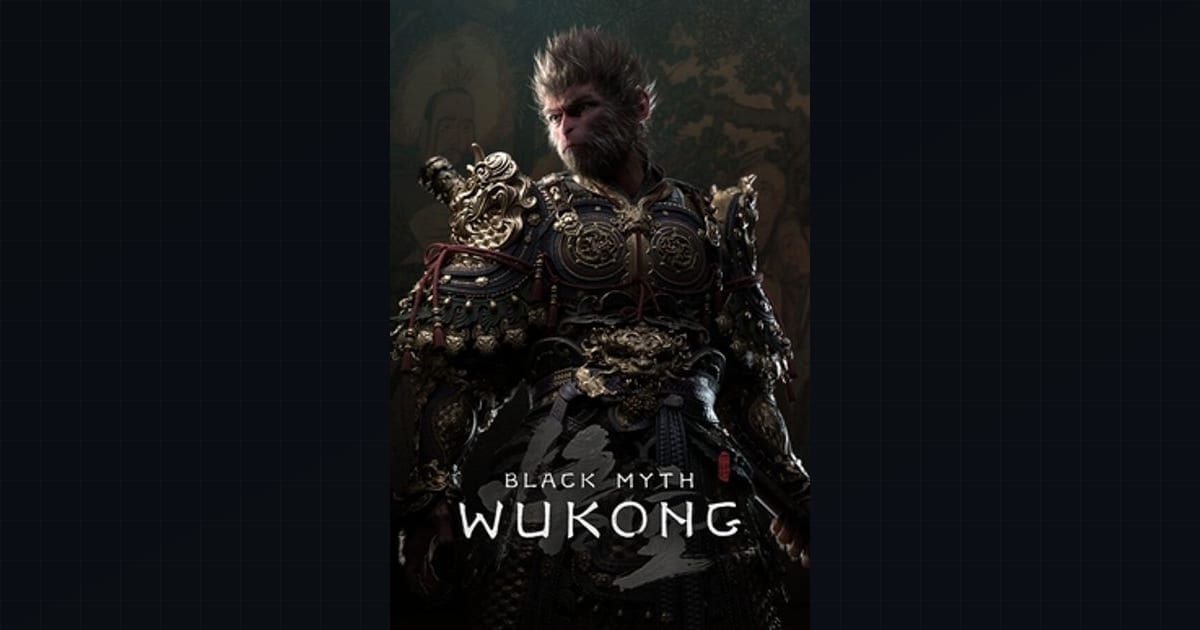
Black Myth: Wukong is a 2024 single-player action role-playing game developed and published by Chinese studio Game Science using Unreal EngineUnreal Engine. A widely-used commercial game engine from Epic Games; powers many large-studio (AAA) games. UE5 is the current generation. 5. Released for PlayStation 5 and Windows on August 20, 2024, and scheduled for Xbox Series X/S on August 20, 2025, the title sold 20 million units in its first month.
Development & Commercial Performance
Directed by Feng Ji, Black Myth: Wukong is the first installment in the Black Myth series. The narrative and setting are inspired by the classical Chinese novel Journey to the West. Players control the Destined One, a staff-wielding monkey seeking six relics corresponding to Sun Wukong’s six senses. The setting integrates real-world cultural and natural scenery, including the Kaiyuan Temple, Wulong Temple, and the Dazu Rock Carvings.
The commercial line here deserves to be stated plainly: 20 million units in one month puts Game Science’s debut in the company of the largest single launches in the history of the medium. That is not a niche success story. It is a studio’s first ever shipped game selling at a pace that established AAA franchises with decades of brand equity routinely fail to match. Positioning it as the first installment of a Black Myth series, before the first entry even cleared two years on the market, tells you the publisher’s internal read on the numbers was not cautious.
The choice of source material is equally strategic. Journey to the West is the most broadly recognized story in Chinese culture and functionally unknown as serious source material in Western AAA. That is a two-sided market: a domestic audience with a century-deep attachment to the fiction, and an international audience for whom Sun Wukong’s six senses and six relics are genuinely novel terrain. Game Science shipped a game that is simultaneously the most familiar fantasy in its home market and one of the least familiar ones abroad.
Combat Mechanics
The game operates from a third-person perspective and incorporates elements of the Soulslike subgenre. Combat centers on a staff that extends and shrinks, utilizing smash, pillar, and thrust stances. Resource management dictates engagement: landing light attacks and well-timed dodges builds Focus, enabling heavy attacks. Stamina is depleted by sprinting, dodging, and attacking.
The mechanical identity is more distinctive than the Soulslike label suggests. The stance system — smash, pillar, thrust — is functionally a weapon-switch system attached to a single weapon, letting the player change combat geometry mid-fight rather than mid-loadout. Extending and shrinking the staff is not flavor; pillar stance literally changes attack elevation, and thrust changes reach. This is a moveset about controlling space, not just trading damage.
The Focus economy is the sharper design decision. In FromSoft’s lineage, offense and defense are competing claims on the same stamina bar, so passivity is often the safe optimum. Wukong separates them: stamina still constrains dodging and sprinting, but your offense builds Focus through aggression — light attacks and well-timed dodges feeding the resource that pays for heavy attacks. The incentive structure reads “play fast and forward to unlock your biggest hit.” That single inversion changes the feel of boss encounters from endurance tests into momentum games, and it is the strongest mechanical argument that this is its own subgenre and not a coat of Souls paint.
Abilities & Equipment
Spells are divided into mysticism, alteration, strand, and transformations. With the exception of transformations, spells consume mana and have cooldowns. Transformations allow the protagonist to shapeshift into creatures with unique movesets and health pools, active until health or might is depleted. Additionally, spirits captured from defeated yaoguai chiefs and equipped vessels provide passive bonuses and active skills fueled by qi.
The build-craft surface here is deeper than the linear level design would have you expect. Transformations deserve particular attention: they grant an entirely separate moveset and health pool, which makes them an extra life in practice — a resource you choose to spend rather than a punish you receive. That is a generous piece of design in a hard game, and it changes how losing a fight feels. The spirit system, where defeated yaoguai chiefs yield capturable abilities, adds a collection-driven progression axis on top of gear, so killing a miniboss rewards you with a mechanical verb, not just a stat bump.
Progression & Structure
Structured into six chapters across distinct locations, the game follows mostly linear progression interspersed with expansive areas. Keeper’s shrines serve as checkpoints. The difficulty cannot be manually adjusted. Skill points, known as sparks, can be freely reallocated to adjust playstyle. Completing a playthrough unlocks a New Game Plus mode and a separate boss battle mode.
The structural choices hang together as a coherent philosophy. Fixed difficulty plus free respecs of sparks means the game refuses to get easier, but is willing to let you get different. Struggling with a boss is not a prompt to lower a slider; it is a prompt to rebuild. That pairing pushes players to actually engage with the ability system instead of grinding past it, and it normalizes respeccing as a first-class tool rather than a hidden exploit. The six-chapter, mostly linear structure with keeper’s shrines keeps the focus tight — this is a game about mastery of encounters and bosses, not open-world sprawl — and the deliberate inclusion of a standalone boss battle mode on completion acknowledges that bosses were always the product.
Why It Matters
The 20-million first month is the headline, but the structural fact underneath it is that a non-Japanese, non-Western studio has now shipped a top-tier action RPGRPG. Role-Playing Game — a game built around character progression, story, and player choices. that competes at the genre’s highest level on its first attempt. The genre’s assumption of incumbency — that Souls-like mechanical literacy is the province of a handful of Japanese studios and a few Western imitators — no longer holds. Game Science did not just sell in volume; it shipped combat with original mechanical ideas, which is the harder part to fake.
The cultural export dimension is equally material. Embedding the Kaiyuan Temple, Wulong Temple, and the Dazu Rock Carvings into a game of this reach turns real Chinese heritage sites into destinations for a global audience that largely had never seen them rendered at this fidelity. That is soft power executed through level design, and no Western or Japanese studio was positioned to do it.
The Take
Black Myth: Wukong succeeds because it is confidently itself. It borrows the Soulslike’s discipline — stamina, checkpoints, difficult bosses — and then deliberately rejects the genre’s most passive incentive loop in favor of a momentum-driven Focus system with stance-based spatial control. Fixed difficulty plus free respecs is a designer saying “the game is what it is; adapt your build,” and it holds up as a design statement. The year-later Xbox Series X/S window (August 20, 2025) is a blunt reminder that platform timing still lags engineering reality, but it also gave Game Science a second launch moment to ride.
What It Signals
Watch the pipeline, not just this title. A debut from a first-time studio moving 20 million units in a month demonstrates that large-scale, technically ambitious single-player games from China can dominate globally at retail, not only in free-to-play and mobile. That has implications for where AAA capital flows, where UE5-era development talent clusters, and which mythologies become the source material for the next decade of action RPGs. Black Myth being announced as a series, on the back of six chapters, a boss mode, and a respec-friendly metagame built for replay, says Game Science already knows what it has — and the rest of the industry now has to plan around it.