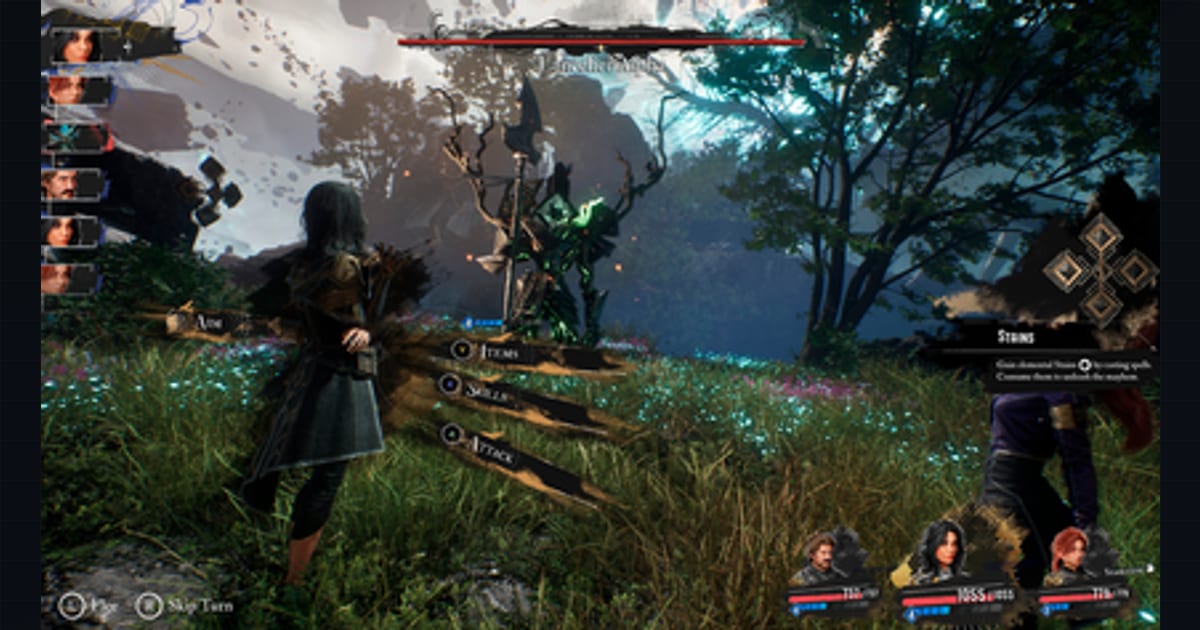
Once the credits finish in Clair Obscur: Expedition 33, Sandfall Interactive’s turn-based RPGRPG. Role-Playing Game — a game built around character progression, story, and player choices. does not simply return you to the menu. A post-campaign New Game+ option opens, and a single final decision between two protagonists determines how the story concludes. Understanding how that second cycle unlocks, what it keeps, and what the two endings settle—and leave unresolved—helps players plan their first run and any return trip through Lumière.
What changed
Clair Obscur: Expedition 33 arrived on April 24, 2025, and the official site lists it as available now across PC and consoles. The game is described there as a turn-based RPG with real-time mechanics, set in a Belle Époque-inspired world where the Expedition sets out to stop the Paintress. Post-launch support has stayed free so far: the “Thank You” update of December 2025 added a photo mode, new cosmetics, and quality-of-life improvements, and the first-anniversary patch of April 2026 added commemorative haircuts for the full party alongside minor fixes. Through all of that, the core New Game+ structure and the two endings have remained part of the release build from day one.
New Game+ is not a separate expansion; it is unlocked by completing the main story. The mode lets players restart the campaign while retaining character progression and equipment, with enemy scaling and one new cycle-exclusive reward. The endings, in turn, revolve around the third-act revelation that the world exists inside a canvas painted from grief, and the choice between preserving or destroying that painted world. Both outcomes reframe the central conflict from stopping a villain to deciding whether grief should be escaped or confronted.
How it works
Unlocking New Game+
To begin New Game+, you must defeat the final boss and watch the credits. After returning to the main menu, selecting “Continue” reloads the save at the Expedition flag immediately before the final confrontation. From there, you can travel to any Rest Point and choose the “New Game+” option that appears in the menu. The game warns you that doing so starts a fresh cycle at higher difficulty.
The mode functions as a standard second cycle rather than a separate difficulty tier. Key carryover rules, reported by post-launch guides and verified by community testing, are as follows:
- You keep: character levels and stats, inventory items including Pictos, weapons, Lumina, and outfits.
- You lose: main and side quest progress, quest items, relationship levels, and collectibles such as journals and music records.
- What scales: enemies and found weapons/Pictos are stronger in the new cycle, so the retained gear is matched against tougher encounters.
Starting New Game+ overwrites your completed campaign save, so any loose ends—collectibles, optional bosses, relationship scenes—should be finished before confirming the new cycle.
The two endings
After the final boss in Lumière, the story places the player at a binary choice: fight the final duel as Maelle, or fight it as Verso. Whichever character you control determines which ending plays. The duel is a one-on-one encounter that echoes the prologue duel between Maelle and Gustave; it is more of a scripted confrontation than a demanding boss fight, so most players will reach the cutscene regardless of build.
Maelle’s ending — “A Life to Paint” Choosing Maelle means choosing to preserve the Canvas. Maelle defeats Verso, and the painted inhabitants of the world continue to exist. A later scene shows Maelle in a crowded Lumière, attending a concert where a repainted Verso appears on stage. Her eyes are stained with blue and silver chroma, mirroring the Paintress’s condition earlier in the story. The ending keeps the painted companions alive, but it implies Maelle has taken her mother’s place as the new Paintress, continuing the cycle of grief rather than breaking it. What it resolves is the immediate survival of the Expedition’s friends; what it leaves open is whether Maelle can avoid the same isolation that consumed Aline.
Verso’s ending — “A Life to Love” Choosing Verso means choosing to destroy the Canvas. Verso defeats Maelle, and the painted world fades. He frees the last remnant of the real Verso’s soul and sends Alicia/Maelle back to the grieving Dessendre family in the real world. The epilogue shows the family at Verso’s grave; after her parents and sister leave, Alicia briefly sees the apparitions of her painted companions before they vanish. The ending accepts loss and encourages the family to grieve together rather than hide inside a painting. What it resolves is the Dessendres’ real-world trauma; what it sacrifices is every relationship the player built inside the painted world.
Lead writer Jennifer Svedberg-Yen has stated in interviews that the studio has no canon ending and does not intend to pick one. Both endings are intentionally bittersweet, and the choice is left to the player’s perspective on whether the painted world’s inhabitants are real enough to deserve preservation.
Because the game reloads you to the point just before the final fight, you can also use a manual save to view both endings without committing to a full second playthrough. That makes the first campaign a useful sandbox for the choice itself, while New Game+ remains the route for players who want to replay the entire journey with retained power.
Build path
For players entering New Game+, the most concrete planning target is the Baguette weapon, a cycle-exclusive item available from the Boulangerie in Lumière after reuniting with Sophie. To obtain it you need Festival Tokens, which can be collected during the prologue’s gommage festival. You can earn three tokens per playthrough, and you need five tokens total to buy the weapon for every party member. That means tokens must be carried across at least two cycles unless you are only equipping a subset of the cast. The Baguette is acquired at maximum weapon level, deals Void damage, and carries an unusual set of passive effects: it kills its wielder at battle start, revives them once per battle at full health, and guarantees they act first in combat. That combination makes it more of a novelty set piece than a reliable main weapon.
Because relationship levels and collectibles reset, players who want records, journals, or the maximum relationship achievements should complete those goals in the first run rather than assuming they will persist. Retained Pictos and Lumina make combat faster, but the lost quest state means map exploration still needs to be repeated. If you are aiming for the achievement tied to reaching relationship level seven with Maelle, for example, it is most efficiently done in the first cycle because the relationship track begins again in New Game+; note also that one dialogue choice in her final relationship scene can lock the achievement out for that playthrough entirely, so save beforehand.
Because Pictos and Lumina are retained, a second cycle is a good opportunity to experiment with builds that were too expensive to assemble earlier. The Baguette weapon is the clearest mechanical prize, but players can also use retained Lumina upgrades, weapons, and Pictos to push alternate characters to endgame strength. A practical New Game+ route therefore looks like this:
- Finish the main story and any optional content you care about in the first cycle.
- Save Festival Tokens instead of spending them all in the prologue if you want the Baguette quickly.
- Start New Game+ from a Rest Point after the credits.
- Use retained levels and gear to rush back to key side areas, then decide whether to view the alternate ending by reloading near the final choice.
What it means
New Game+ and the ending choice work together to give the game its replay structure. The first run is about discovery; the second run is about mastery and seeing the other outcome. Because there is no canon ending, neither choice is framed as the “correct” one. Maelle’s ending saves the people the player has grown attached to but traps her in the same grief that created the Canvas; Verso’s ending accepts mourning but erases those same companions. The design invites a second playthrough not simply for power progression, but to sit with the other side of a question the game refuses to answer definitively.
For players preparing a second cycle, the main takeaway is that progression is partial: power and inventory carry over, but story, relationships, and collectibles do not. The final duel itself is not a difficult mechanical check, so the choice can be made on narrative grounds rather than build strength. Plan the first run for completion, treat New Game+ as a chance to experience the alternate ending, and save Festival Tokens if you want the cycle-exclusive reward.