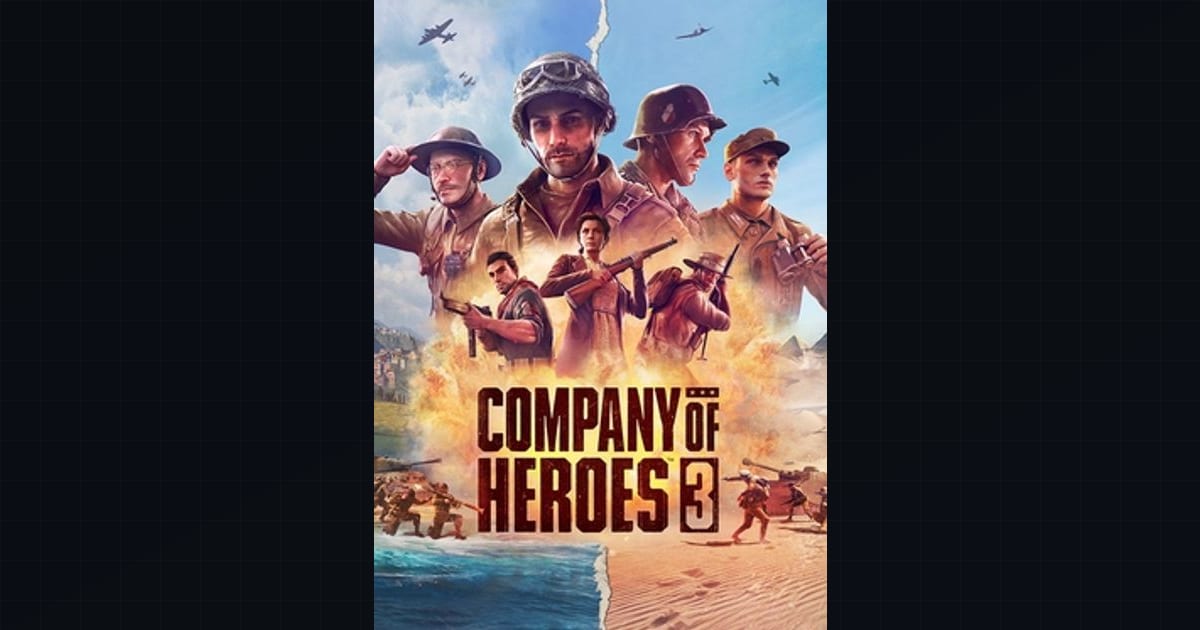
Company of Heroes 3 is a real-time strategy game developed by Relic Entertainment and published by Sega. Set in the Italian and North African theaters of World War II, it released for Windows on February 23, 2023, followed by PlayStation 5 and Xbox Series X/S versions on May 30, 2023. It is the first mainline entry in the franchise in nearly a decade, and its release doubles as a stress test for whether a hardcore PC RTSRTS. Real-Time Strategy — a strategy game where everyone plays at the same time, continuously, instead of taking turns. can still find a mainstream audience on modern consoles.
Core Mechanical Updates
The sequel to Company of Heroes 2 introduces the Tactical Pause system, allowing players to halt a battle and queue commands before resuming real-time action. The destruction system has also seen improvements, offering granular damage such as individual tiles and bricks crumbling from buildings. Set in the Mediterranean, the maps provide verticality for tactical positioning. Players control Allied Forces in Italy and Axis forces in North Africa, with commander interactions affecting the dynamic narrative. Italian Partisans function as allied NPCs that can be utilized on the map or called into battles.
Development & Release
Relic Entertainment developed the title using the Essence Engine 5.0. The development team recruited modders and competitive players to form a player council during preproduction to decide on mechanics and setting, ultimately choosing the Mediterranean theater over the Pacific. The game was announced in July 2021 and initially targeted a November 17, 2022 release before being delayed. Console versions were revealed at The Game Awards 2022.
Reception
According to Metacritic, the PC and Xbox Series X versions received “generally favorable” reviews with aggregate scores of 81/100 and 79/100, respectively. The PlayStation 5 version received “mixed or average” reviews, scoring 70/100. Critics offered varying perspectives on the campaigns. PC Gamer reported issues with the Italian campaign’s AI aggressiveness and subcommander implementation, while Polygon praised the Tactical Pause system for making the game more approachable. The game was nominated for “Best Sim / Strategy Game” at The Game Awards 2023.
Why the Tactical Pause Is the Load-Bearing Feature
The single most consequential decision in Company of Heroes 3’s design is the Tactical Pause, and its significance is largely misread when it’s framed as a beginner crutch. What it actually does is decouple the RTS genre’s two historically fused skill axes — information intake and action throughput (APM) — and let players trade one for the other. For twenty-plus years, RTS difficulty has been gated behind how fast you can issue orders under real-time pressure; Tactical Pause shifts that burden onto judgment instead. You survey, you sequence, you commit. That is a quiet structural rewrite of the genre’s skill ceiling, not just its floor.
The reason it matters commercially is the console port. A twin-stick gamepad cannot match a mouse-and-keyboard command rate, and previous console RTS attempts — from Halo Wars to the original Company of Heroes ports — either simplified the simulation or shipped a compromised input layer. Tactical Pause is the bridge that lets Relic keep the simulation deep and ship to PS5 and Xbox without reducing squad counts or collapsing the terrain system. Polygon’s praise that it makes the game “more approachable” is the surface read; the deeper read is that it is the design primitive that made the multiplatform release viable at all.
The Destruction Engine and the Essence 5.0 Bet
Company of Heroes has always been the RTS franchise where cover and terrain destruction are not decoration but the core tactical loop. Essence Engine 5.0’s granular damage — individual tiles and bricks detaching from structures — is the technical continuation of that thesis, and it interacts directly with the Mediterranean setting’s verticality. Elevation and partial cover collapse create a state space that changes mid-match as a building you were using as a firing position loses a wall and exposes your squad. That is dynamic line-of-sight and dynamic cover in the same simulation, and it’s the reason CoH3’s battles feel less like board-state puzzles and more like terrain that reacts to you.
The bet Relic is making here is expensive: high-fidelity destruction is GPUGPU. Graphics Processing Unit — the chip that renders the game's visuals; the main driver of framerate and image quality.-and-CPU heavy, it’s hard to network deterministically in multiplayer, and it puts a floor on the minimum spec. The payoff is a tactical readability that few competing RTS titles can match — you can see why you lost a firefight by reading the craters and collapsed walls afterward. For an audience trained on slower, more legible tactics games, that visual feedback loop is a real retention hook, and it’s the part of the game the Metacritic scores least capture.
What the Player Council Signals About RTS Development
Relic’s recruitment of modders and competitive players into a formal “player council” during preproduction is worth more attention than it got at launch. This is the genre’s answer to the live-service playbook: instead of iterating post-launch on telemetry, Relic front-loaded its most invested stakeholders into the setting and mechanics decision — the Mediterranean over the Pacific, the pause system, the campaign structure. The signal to the rest of the genre is that RTS design has become high-risk enough that studios want de-risking through community consensus before committing production budget.
The trade-off is real, and it shows in the reception. A player council optimizes for the existing hardcore, which can ossify a design around competitive preferences that don’t serve the single-player audience — exactly the tension PC Gamer flagged in the Italian campaign’s AI aggressiveness and subcommander implementation. The dynamic campaign narrative, commander interactions, and Partisan NPCs are aimed squarely at the player who wants a war rather than a match, and the friction between those two audiences is what gives CoH3 its uneven critical texture (PC 81, Xbox 79, PS5 70). The game is trying to be two products at once, and the player council pulled one way while the console audience pulled the other.
The Take
Company of Heroes 3 is best understood not as a sequel but as a franchise survival strategy executed in public. The decade-long gap since CoH2, the console launch, the Tactical Pause, and the player council are all moves toward the same goal: proving that a simulation-heavy RTS can still justify a modern AAA budget by expanding its reachable audience without dumbing down its core. The Metacritic spread — solid on PC and Xbox, weaker on PS5 — and the campaign AI criticism are the predictable cost of that ambition. But the underlying design primitives, particularly pause-as-input-decoupler and destruction-as-readable-feedback, are the ones the rest of the RTS genre is going to borrow from over the next decade. The nomination at The Game Awards 2023 is less an accolade than a confirmation that, in a thin field, Relic is still setting the technical agenda.