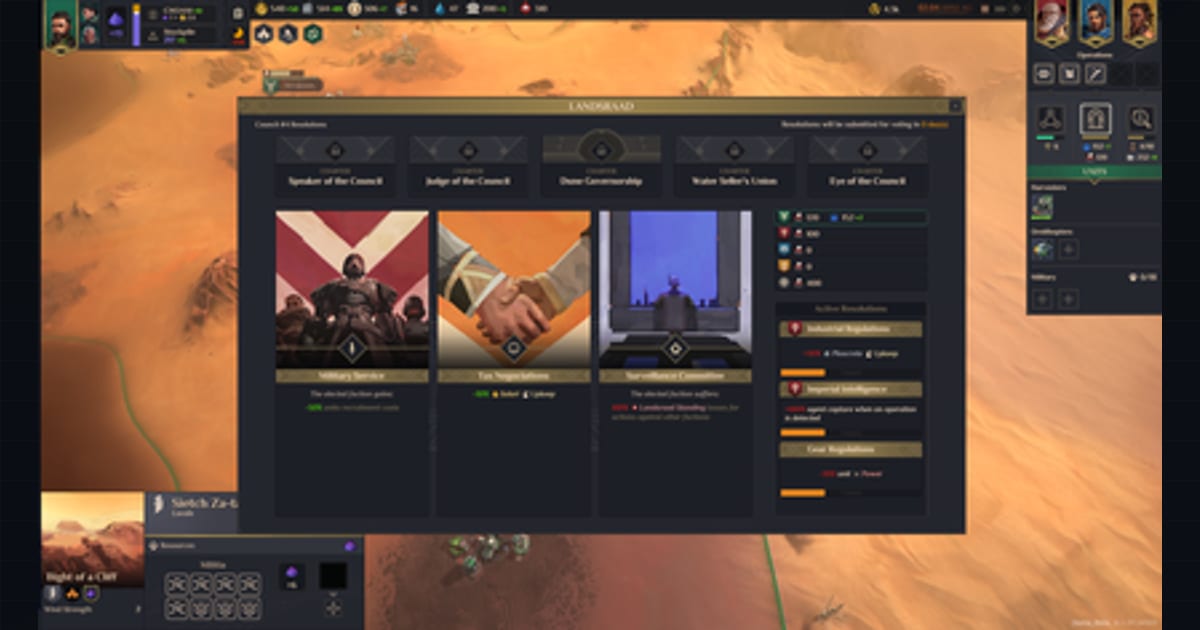
Shiro Games and Funcom have deployed a major patch for Dune: Spice Wars, expanding the strategic depth of Conquest Mode with factionfaction. An in-game group or nation players can align with or fight against, with its own goals and reputation system.-specific Hero units and updated Landsraad voting cycles. The update lands at an inflection point for the title, which has spent its post-launch lifecycle quietly refining a hybrid real-time 4X4X. eXplore, eXpand, eXploit, eXterminate — a grand-strategy subgenre about building a civilization over a long arc. formula that few competitors dare attempt. Where the base game leaned heavily on asymmetric faction design and econo-political snowballing, this patch pushes toward a more legible, character-driven battlefield — the kind of shift that matters less for any single hero than for what it implies about the design team’s priorities.
Tactical & Political Overhauls
- Hero Units: Factions can deploy specialized operational commanders (such as Duncan Idaho or Glossu Rabban) featuring active tactical skills and regional buffs.
- Spice Tax Mechanics: Dynamic market pricing governs spice exchange rates, forcing players to balance imperial tax obligations against CHOAM stock buyouts.
- Deep Desert Navigation: Worm sign detectors and airfield supply lines reduce attrition damage when marching armies across open sand sectors.
Balance & Multiplayer Updates
Ranked 4-player free-for-all lobbies now include spectator tools and automated pause management during critical Landsraad resolutions.
Why It Matters: Heroes as Decision Density
The headline mechanical change is the introduction of Hero units, and it is the one with the longest tail. Dune: Spice Wars has always struggled with a readability problem inherited from the real-time 4X niche: the map is dense, the economy is dense, and the political layer is dense, but the tactical layer — where players actually watch a battle resolve — can feel like an afterthought compared to the deliberate, hex-by-hex pacing of a turn-based 4X. Dropping named commanders with active abilities onto that layer does two things at once.
First, it gives the player a focal point. A Duncan Idaho with a timed combat buff or a Rabban with a regional suppression aura converts an otherwise abstract clash of stat blocks into something with a cast, a cooldown rotation, and a moment-to-moment decision. That is the same trick the RTSRTS. Real-Time Strategy — a strategy game where everyone plays at the same time, continuously, instead of taking turns. genre has relied on since Warcraft III distilled hero-centric micro out of the StarCraft formula, and it is overdue in a 4X that runs in real time. Second, it raises the skill ceiling without raising the floor: a casual player can leave the hero on auto-assist and still benefit from the passive regional buff, while a competitive player now has a micro target worth contesting. For a game whose ranked ecosystem is still maturing, that kind of optional depth is the cheapest way to widen the audience without dumbing down the simulation.
The choice of heroes is also narratively load-bearing. Idaho and Rabban are not interchangeable legendaries — they carry factional posture. Deploying Rabban as Harkonnen reads as a brute-force governance tool; deploying Idaho as Atreides reads as a precision instrument. The fact that the patch pairs them in the same bullet point is a quiet signal that Shiro is thinking about heroes as expressions of faction identity rather than a generic “cool unit” layer stapled on top.
The Take: The Economy Patch Was the Real Patch
If the heroes are the marketing hook, the spice tax and CHOAM mechanics are the patch that actually changes how the game is played. Dune: Spice Wars is, at its core, a game about converting a single volatile resource into leverage across four domains — military, political, economic, and territorial. The base game’s economy was functional but somewhat static: spice had a price, you sold spice, you bought things. Introducing dynamic market pricing and an explicit tax obligation against CHOAM buyouts turns the economy from a passive faucet into a pressure system.
The design consequence is that timing now matters at the macro scale, not just the micro scale. If the imperial tax cycles on a predictable cadence, players are forced to decide whether to liquidate spice into stock buyouts now (banking long-term dividend income) or hoard it to cover an upcoming tax hit (preserving short-term liquidity). That is a genuine treasury-management decision, and it is the kind of system that separates a 4X with flavor from a 4X with systems that actually bite. The risk, as always with dynamic pricing, is that the model oscillates too violently and turns the optimal play into a rote buy-low/sell-high loop; the reward, if the tuning holds, is that two players running the same faction can diverge sharply on economic doctrine alone.
What It Signals: Conquest Mode Is Becoming the Real Game
The framing of this patch as a “Conquest Mode” overhaul is worth taking literally. Conquest Mode — the modifier-driven, replayable campaign layer — has historically been Dune: Spice Wars’ answer to the post-victory slog that kills most 4X runs. By routing the new heroes, the spice tax, and the deep-desert navigation systems through Conquest rather than only the scripted campaign, Shiro is treating Conquest as the primary container for the game’s strategic content, not a side mode.
That is a meaningful architectural choice. It implies the team has accepted that the scripted narrative campaign, however faithful to Herbert, is not where the replay value lives for this audience — and that the roguelike-flavored modifier stack is. The deep-desert additions (worm sign detectors, airfield supply lines) reinforce this: they are systems that exist to make traversal across a procedurally variable map less punishing, which is a Conquest-scale problem, not a hand-authored-map problem. Expect future patches to keep stacking modifiers here rather than expanding the linear campaign.
Context: Where RTS-4X Hybrids Stand
It is hard to evaluate a Dune: Spice Wars patch in isolation because the real-time 4X subgenre is so thinly populated. Northgard, Shiro’s previous title, proved the studio could ship a real-time 4X that didn’t collapse under its own complexity; Spice Wars is the bet that the same chassis can carry a politically heavier license. This patch is conservative in the best sense — it does not rewrite the core loop, it layers legibility (heroes), pressure (spice tax), and survivability (desert logistics) onto a loop that already works. The spectator and pause-management additions to ranked play are the tell that the team is now optimizing for an audience that wants to watch this game, not just play it — which is the precondition for any RTS-adjacent title to outlive its launch cohort. Whether the tuning survives a few thousand ranked hours is an open question, but the direction is unambiguous: more character, more economic friction, and a Conquest layer being treated as the product.