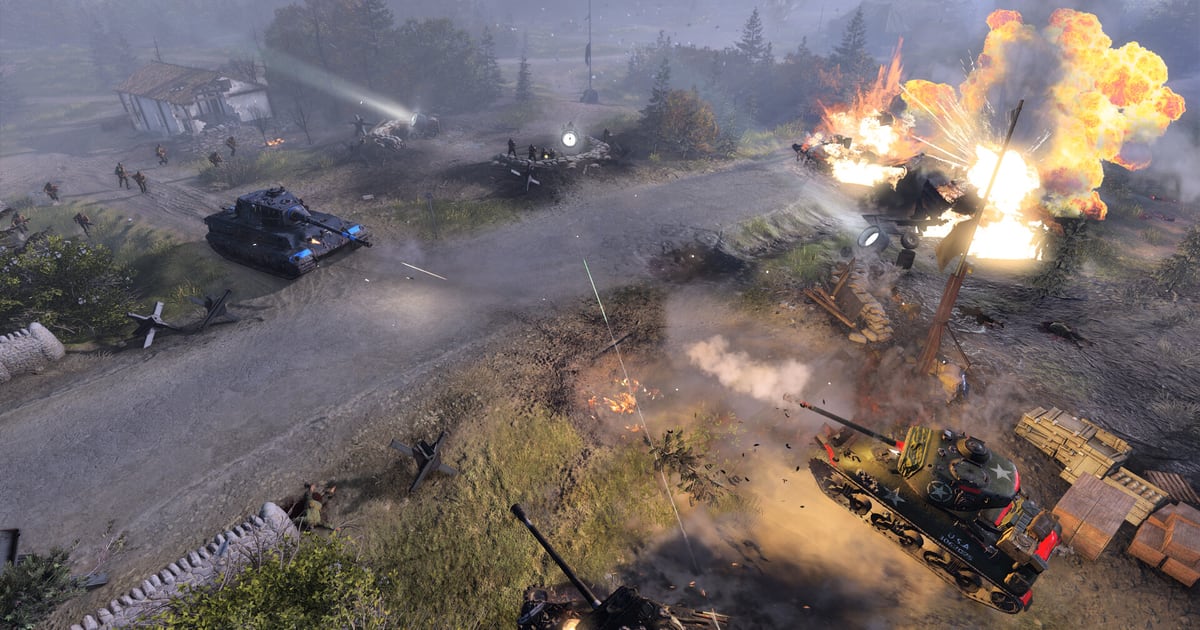
Company of Heroes 3 ships four factions and does not tell you which one to play. The store page promises “four unique multiplayer & co-op factions” and “all-new international Battlegroups” and stops there. Nothing in what Relic publishes — store page, patch notes, Battlegroup briefs — nominates a starting army, and this piece will not invent one.
What the studio does publish is unusually useful: patch notes with the reasons attached. Read enough of them and each army’s shape stops being a matter of taste — the notes say what Wehrmacht’s early game is built on, why DAK’s light vehicles keep getting health back, and where US Forces’ power is deliberately locked away. This piece sorts the four by the first decision each one puts in front of you.
This site’s 3.0 gameplay and multiplayer preview covers what the anniversary patch changes; this one is about which army you should be learning when it arrives.
What this covers: what each of Company of Heroes 3’s four factions is built around, taken from Relic’s own patch notes and Battlegroup briefs, plus the first decision each army forces on a new player. Why it matters: the 3.0 update lands 5 November 2026 with a multiplayer economy rework, an artillery rebalance and changes to vehicle massing, so learning an army’s actual shape is worth more than memorising a build order that expires next week. Who should care: anyone who owns the game and has not picked a main, and anyone returning for the 20th-anniversary update who last played a different factionfaction. An in-game group or nation players can align with or fight against, with its own goals and reputation system..
The floor is the same for all four
Faction choice is the second question, not the first. The 2.5.0 notes (29 July 2026) set out the shared layer plainly: “Our main target this update is to make infantry positioning more rewarding.” They then did it mechanically — heavy cover object armour went from 25 to 35, the damage penalty for automatic rifles and LMGs against heavy and garrison cover went from 40% to 50%, and a suppressed squad now only recovers at the out-of-combat rate if nothing is shooting at it.
Every one of the four armies therefore asks the same thing in the first five minutes: put squads behind cover that will still exist in ten minutes, and do not stand in the open while a Heavy Machine Gun has line of sight. The Steam page points the same way — flanking to expose side armour, infantry breaching to clear garrisons, elevation feeding the game’s True Sight system.
The 20th-anniversary material arrives on 5 November. What follows assumes the current live build, 2.5.6 — a hot fix for “an exploit that brought Final Stand perks into multiplayer matches” — not the build shipping next week.
The four armies at a glance
| Faction | What the notes say it is built around | First decision it puts in front of you | Documented weak spot |
|---|---|---|---|
| US Forces | Support Center upgrades, the Tank Depot, air support, halftrack conversions | Where the fuel goes: support-centre upgrades now or the Tank Depot | Relic locked several Support Center upgrades behind the Tank Depot to stop early power spikes, so you cannot buy your way to strength |
| Wehrmacht | Pioneers supporting Grenadiers, Infanterie Kompanie and Officer Quarters, team weapons, light vehicles | When to commit to Officer Quarters — and whether the window is still worth it | The 2.5.0 notes describe the faction as lacking “their own combat capable ultra-light unit” in team games |
| British Forces | Three separate training upgrades and sections expected to fight from cover | Which training track to fund first — each one costs manpower and fuel | Royal Engineers are a “light combat role that greatly tapers off past the early-game due to its close-range nature” |
| Deutsches Afrikakorps | Light vehicles by design, an Armory pick order, a Panzergrenadier core | Committing to vehicles and living with an Armory sequence | Relic keeps trimming its tempo tools, most visibly the removed Panzerjäger call-in |
US Forces: the army you fund, not the army you rush
US Forces is the faction whose power is most obviously bought in a menu. The 2.5.0 notes name the pieces: a Support Center carrying upgrades such as Survival Training, Double Sortie, Rapid Repairs and the M1918 Browning Automatic Rifles, a Tank Depot further up, and a Mechanized Support Center variant the notes credit with armour and veterancy bonuses. Halftracks convert between roles — one patch note covers an M3 75mm AT Halftrack’s barrage being interrupted by “a conversion to a different halftrack type like the M16 Motor Carriage”.
The design intent is explicit. Relic moved several Support Center upgrades behind the Tank Depot “to reduce the power of strategies that focused on getting powerful upgrades early and creating more incentives to reach the Tank Depot,” and put the BAR back behind the Support Center “to allow for more un-upgraded infantry play in the early game”. On this army the early game is meant to be fought with plain infantry, and the payoff is a building.
Air power has been rationed too. The 2.4.0 notes added a 60-second cooldown on all attack runs when the Air Support Center finishes, and put every Air Support Center ability on an immediate 10-second recharge whenever one is used, “to reduce the number of off maps being dropped at once which could overload the opponent.”
Pick US Forces if you like deciding what your army becomes and are comfortable spending the opening working towards a structure; the cost is that a plan-less opening has nothing to fall back on. The faction’s Dare & Destroy Battlegroup, Free French, reads in the notes as “robust defenses and stalling tactics” built on French Rifle Sections, concrete Bastions and Tourelle defenses, Railway Artillery and the Char B1 Heavy Tank.
Wehrmacht: set up, then take the window
Wehrmacht’s identity in Relic’s notes is a starting pair plus a timing. Pioneers exist to “support Grenadiers in the early game”, the Infanterie Kompanie dropped from 100 to 80 manpower in 2.5.0, and the Officer Quarters upgrade was pushed from 25 to 35 fuel and from 45 to 60 seconds of research — to lessen “the impact of the timing push Wehrmacht can do in the early game and give their opponent more time to respond”, while giving the faction “slightly more manpower and combat effectiveness for their starting units”.
That is a faction defined by a schedule. You build the infantry core, you decide when the window opens, and the opponent now has measurably longer to see it coming.
The army’s second half is team weapons and the units that combo with them. The 2.4.0 notes describe the MG 42 change as one “meant to allow the MG 42 to better deter vehicles and combo with other units such as Grenadiers, vehicles or anti-tank guns”, and the same patch reworked the Grenadier Breakthrough Package’s veterancy into direct-combat bonuses. Around that sit the Pak 40 and LG 40 with Ambush Camouflage, the Flak 30, the Nebelwerfer 42, and light vehicles whose costs and armour Relic keeps adjusting.
The documented hole is the early vehicle answer. When 2.5.0 raised Heavy Machine Gun penetration, one stated aim was to help “factions like the Wehrmacht in team games where they lack their own combat capable ultra-light unit” — so the soft counter is a well-placed HMG, not a chase. The Siegesiege. A timed, large-scale attack on a settlement — attackers try to destroy it, defenders try to hold it. Breaker Battlegroup is the thematic match: “siegeworks and specialist units to break enemy fortifications”, with Flame Halftracks, Siege Specialists and the Sturmtiger.
British Forces: three bills, one fuel income
British Forces is the faction with the clearest budgeting question. Rather than a single upgrade centre, the notes track three training upgrades — Infantry Training, Team Weapon Training and Light Vehicle Training — and Relic has repriced all three. Team Weapon Training went from 150 manpower and 25 fuel to 200 manpower and 30 fuel, Infantry Training’s experience grant fell from 800 to 600, and Light Vehicle Training’s ability recharge bonus fell from 25% to 15%.
Read as a set, those upgrades tell you what the army expects you to field: infantry, team weapons, or light vehicles, and you cannot fund all three at once with any urgency. That suits a player who enjoys deciding which arm of an army gets the money this match, and frustrates anyone who wants one obvious opener.
The infantry side is built around holding ground rather than closing. Foot Guards had their close and mid-range effectiveness raised “to allow the unit to cause a little bit more damage at range if they are forced to fight from cover”, and Royal Engineers are described as a light combat role that tapers past the early game because of its close-range nature. On vehicles, the M3 Grant was repriced down to 20 unlock fuel to reflect a “more specialized role at brawling with opposing medium tanks with some Anti-Infantry firepower”, and the Sherman VC Firefly lost frontal armour (185 to 160) so a closing medium tank actually threatens it.
The Special Service Battlegroup is the army’s aggressive edge: “elite raiding forces to deny resources and harass the enemy where least expected”, built on raiding vehicles, Commandos and Snipers, with Scorched Earth “to drain the enemy of their vital resources”. It is the opposite of the Firefly plan, and both are British.
Deutsches Afrikakorps: the vehicle faction, on purpose
Of the four, DAK is the one whose identity Relic has stated most directly. The 2.4.0 notes say it in a sentence: “We want DAK to still be able to play heavy on light vehicles compared to the other factions, rather than the best option generally being massed infantry.”
The mechanics follow the sentence. DAK combat light vehicles — the notes list the Carro, L6/40, Flakvierling Halftrack and 8 rad — had their Veterancy 1 acceleration bonuses replaced with +40 health, so a vehicle that survives long enough to level gets tougher while a rebuilt one is exposed again. The Armory is a pick order rather than a shopping list, and 2.5.0 rewrote its layout partly to curb “Panzergrenadier heavy builds which have become a staple for the faction”, adding Improved Base Logistics so the Light Support Kompanie heals nearby infantry at 3.2 health per second and the Panzer Armee Kommand repairs nearby vehicles at 6 health per second.
The other half of the same patch is a warning about how the faction is balanced. Relic removed the Panzerjäger call-in because it “gave the Afrikakorps too much tempo, allowing them to dictate the early-to-mid game by getting a mobile Anti-Tank unit without a build-time”, replacing it with 250 call-ins carrying Panzerpioneers or an MG 34 team.
So DAK asks for vehicle micro earlier and more continuously than the others, and it is the faction most likely to feel wrong to someone who wants to win with infantry. Its Elite Forces Battlegroup leans all the way in: veteran infantry and vehicles led by the Command 8Rad Armored Car, Ace Stuka Squadrons and the Tiger Ace Heavy Tank.
Picking by the mistake you already make
A cleaner way to choose than any ranking: match the army to the error you expect to repeat.
- If you lose squads in the open, British Forces punishes that least — its bonuses aim at units that fight from cover, and its training tracks reward patience.
- If you forget abilities and off-map support, US Forces will make you feel it; its support abilities were given shared cooldowns because they were being stacked.
- If you float fuel without a plan, US Forces gates power behind the Tank Depot and British Forces splits it across three training upgrades.
- If you let vehicles sit idle, DAK is the honest test: its light vehicles gain health with veterancy.
Two practical notes on Battlegroups, where most of a faction’s flavour lives. Since 2.5.0 they are chosen from a lobby dropdown, with “full Battlegroup tech trees” readable through a More Info option, so you can read a doctrine before committing. Picks inside a tree cost Command Points, and Relic adjusts those costs (one 2.5.0 note drops an Advanced Tourelle pick from 3 to 2). The four doctrines above arrived with the Dare & Destroy DLC, so treat them as optional rather than as the definition of each army.
What 5 November changes, and what it does not
The 3.0 update is dated and its contents are public. Relic calls it “the biggest update to the game since release”, and the multiplayer summary is what matters for faction choice: “a major rework to the economy, a rebalance of artillery, changes to reduce the prevalence of massing vehicles, and a stronger emphasis on the importance of positioning.” One existing Battlegroup is being reworked and others adjusted, the A.I. gets new combat-assessment logic, and the update adds five new maps plus refreshes of three existing ones.
An economy rework is the most disruptive kind of patch for advice like this, which is why the sections above describe what each army is built around and not what to build first. A faction whose income model changes keeps its roster; a build order does not survive. The 3.0 preview promises “changes to the in-game economy, balance, veterancy, Battlegroups, and more”, and Relic is running a Balance Fireside Chat livestream on 5 November.
This piece assumes 2.5.6 and treats everything after 5 November as directional. If you are choosing a main this week, choose the army whose decisions you find interesting, then re-read the 3.0 notes for its economy before you build a habit.
Where to practise the choice
The lobby lists Skirmish, Co-op vs A.I., Quick Match and Custom Games, and 2.5.0 added a detail worth knowing: A.I. Battlegroup slots can be left empty to force the computer onto a specific Battlegroup, a cheap way to rehearse one matchup instead of a faction in the abstract. The single-player campaign still offers the optional Full Tactical Pause, which lets you plan without a clock.
Two paid options, without overselling either. Final Stand is a standalone wave-defence product at $29.99, with 12 waves, an Endless Mode, “8 difficulty levels from newcomer to veteran” and a Battlegroup you assemble from randomised picks between waves; it teaches unit names under pressure, not multiplayer build orders, and 3.0 adds a three-player mode and a new Battleground to it. Operation Torch, due 25 November 2026, is a 15-mission campaign following the US 34th Infantry Division, priced later according to Relic — the closest thing to a guided tour of US Forces.