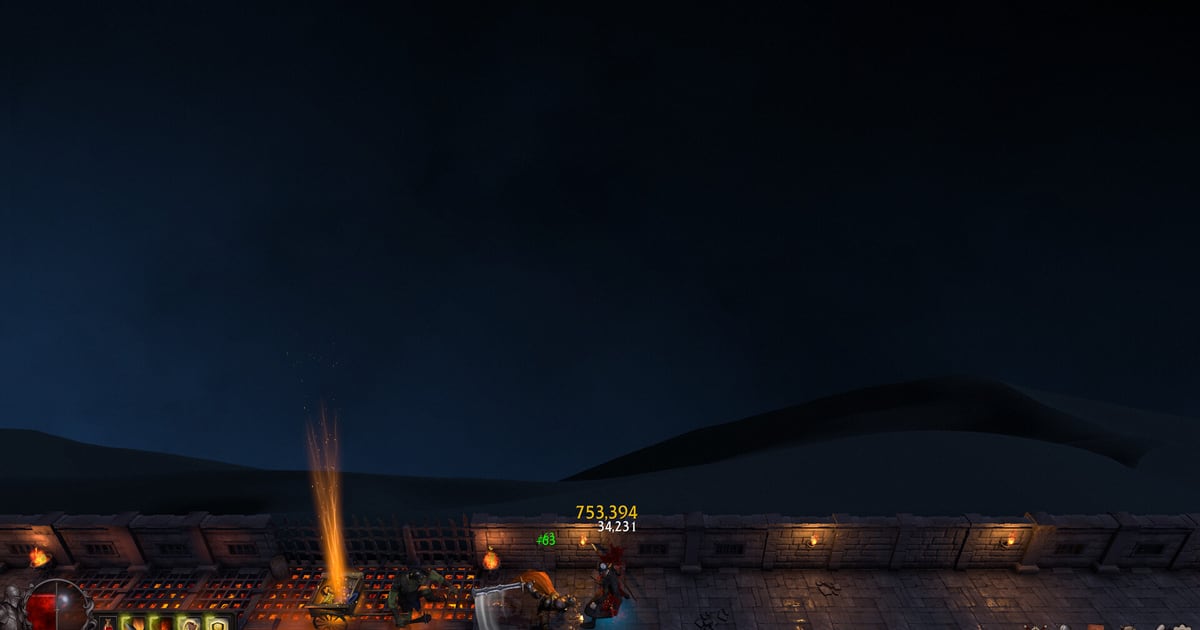
Deskrawl: Idle ARPGARPG. Action RPG — an RPG with real-time combat rather than turn-based fights. is an idle action RPGRPG. Role-Playing Game — a game built around character progression, story, and player choices. that plays in a strip along the bottom of your desktop. The hero fights through the regions of Atheron without you, picks up loot, captures enemies as minions and returns to town to trade, craft and upgrade. First Day Games released it on Steam for Windows on 28 September 2026 at $6.99, and the three weeks since have produced patches rather than expansions.
What changed: Patch 1.0.2b caps damage reduction at 90% and cooldown reduction at 80%, and raises Divine drops from Mythic Treasure Chests by roughly seven times. Why it matters: Both changes answer the same complaint — an endgame where defensive stacking removed the risk and the top-tier drops were too rare to plan around. Who should care: Anyone building toward Inferno and the Mythic Rift, and anyone judging whether an idle ARPG is worth leaving running.
The launch build, in the store’s own terms
The store page sells five systems, and they are the bones of the whole loop. Under “Desktop Idle ARPG” it describes a roster of heroes, each with its own playstyle, and mixing gear, minions and abilities toward a build. “Own Minions” is the same page’s promise that enemies — “even Bosses” — can be captured: minions haul the loot cart so the grind never stops, some granting passive buffs and others unleashing abilities. “Town Progression” stocks resources to grow the town “from a quiet outpost into a thriving hub”, unlocking new NPCs and services. “Trading” covers equipment, materials and minions moved through the Steam Market. “Mythic Realms” is the challenge layer: “ultimate challenges, timed trials, and escalating difficulty tiers”, with better rewards the deeper you go.
The Steam listing carries Single-player, Steam Achievements, Steam Cloud, Steam Leaderboards, Family Sharing and a third-party EULA, and tags itself Action, Adventure, Casual, Indie and RPG. Its review summary reads “Mostly Positive (397) — 74% of the 397 user reviews for this game are positive.”
The wiki’s numbers fill in the shape underneath that copy: four heroes — Warrior, Sorcerer, Hunter and Monk — each with 14 abilities made of 4 Basic Attacks, 4 Strong Attacks and 6 Specials, plus a talent tree and its own rune sets. The level cap is 70, with Paragon unlocking at 70. There are three difficulties, Normal, Nightmare and Inferno; clearing the final boss on one unlocks the next, and the wiki notes difficulty can only be changed in town. Across the game it counts 56 abilities, 209 pieces of equipment, 67 minions, 62 enemies and 11 regions.
The systems that carry the endgame
Two systems do the heaviest lifting after the campaign, and both have been rebuilt in place rather than replaced.
Rune transmutation arrived with 1.0.2 at the Alchemists: nine runes of one rarity become one random rune, drawn only from runes your class can use. The posted chances are 50% for nine Uncommon runes to produce a Rare, 15% for nine Rares to produce a Legendary, 50% for nine Legendaries to produce a Rune Set rune, and a guaranteed Rune Set rune from nine Set runes. Uncommon-to-Rare was the awkward one, and 1.0.3 raised it to 100%. The same pair of patches added the rune library: 32 Legendary “(Grand)” runes in 1.0.1, one per Rare skill rune and eight per class, then 24 new rune types in 1.0.2, each in a Rare and a Grand version, for 48 new runes.
Equipment Enlightenment is the other. A +10 item can be Enlightened twice, and each Enlightenment raises every stat on the item by 5%. AFK Meta records the cost: Enlightened I takes 1 Consecration Stone and 2,000,000 gold, Enlightened II takes two stones and 4,000,000 gold, and both always succeed. The stone, like the tradable Gold Bar — which sells to merchants for 2,500,000 gold — drops from the Mythic Rift boss, with the Gold Bar also falling from the ten world bosses on Inferno at 0.07% per fight and from fishing at Veldak Sky Lake and Cinder Lake.
Three weeks of patches, not features
| Date (2026) | Version | Headline |
|---|---|---|
| 28 Sep | Hot Fix | Steam-connection fix; Online Mode becomes the default for new characters |
| 29 Sep | 1.0.0g | Loot gets an even chance per equipment slot; about 130 MB less RAM |
| 1 Oct | 1.0.0h | Four Hunter abilities hit harder; eight Hunter talents retuned |
| 3 Oct | 1.0.0i | Four Monk abilities hit harder; Flare’s splash radius 2 → 2.5 |
| 6 Oct | 1.0.1 | 32 Grand runes, the Gold Bar, Equipment Enlightenment, Mythic Rift enrage from tier 75 |
| 9 Oct | 1.0.2 | Rune transmutation, 48 new runes, a cheaper Mythic Rift, gem stacks 50 → 99 |
| 10 Oct | 1.0.2a | Rune transmutation switched on; Dizzy now slows attack speed as well |
| 13 Oct | 1.0.2b | Damage reduction capped at 90%, cooldown reduction at 80%, Divine drops raised |
| 15 Oct | 1.0.3 | 12 Legendaries and 2 Divines added; the Monk talent tree reworked |
Those dates follow the studio’s own publication days as catalogued by AFK Meta. Where the Steam community hub shows one of them a day earlier — 1.0.2b is listed as 12 October there — it is the same post displayed in US local time: SteamDB stamps that note 13 October 2026 at 00:09 UTC.
The Mythic Rift is the clearest thread running through the list. In 1.0.1 it moved to a Skull of Inferno entry cost and gained an enrage timer from tier 75, after which the boss becomes Enraged once 15 minutes have passed. In 1.0.2 the entry cost dropped to 3 Skull of Inferno, the tier experience bonus went from +1.5% to +3% per tier, and AFK Meta records the boss rolling loot four times instead of three. None of that is a new mode. It is the same mode being made cheaper to enter and worth entering.
What 1.0.2b changed to the numbers
| Change | Before | After |
|---|---|---|
| Damage reduction, general and per damage type | could reach 100% | capped at 90%, each type counted separately |
| Cooldown reduction | capped at 85% | capped at 80%; no ability below 20% of its cooldown |
| Divine items from Mythic Treasure Chests | base rate | “about 7 times as often as before” |
| Zahir’s Luck Wheel spin | 10,000 gold | 12,500 gold |
| Hunter Multishot cooldown | 0.75 s | 0.6 s, and 0.6 s standing still instead of 1 s |
| Hunter Shockwave range | 1 | 4.5 |
| +9 and +10 shoulder upgrades | 1 Demon’s Skull | 1 Cinderlord Horns |
| Attack Speed, Crit and Dodge flasks | 1 Demon’s Skull | Ogre Heart, Manticore Venom Sac, Werewolf Pelt |
| Hunter traps | a new trap cleared the ones already down | each trap runs its own 12 seconds |
| Black Mist drops (1.0.3) | 0.25% of Legendary drops | 0.32% |
| Set rune drops (1.0.3) | 0.7% of rune drops | 0.9% |
The cooldown detail is the one that catches builds off guard. AFK Meta’s reading of the note is that the 80% cap also covers an ability’s own cooldown bonuses from talents, so no ability can sit below a fifth of its listed cooldown, while effects that simply subtract seconds from a cooldown are not counted against it. On the defensive side, the note caps the general damage-reduction stat and each damage-type reduction — Physical, Fire, Cold, Lightning, Poison and Arcane — separately at 90%, where previously they could be pushed to 100%.
Two smaller entries are worth reading together. Werewolf Pelts were added as a drop from the Bloodmoon Werewolf, at 20% per kill in Kings Woods 7 according to AFK Meta. The studio’s note says they have no use yet and to save them. AFK Meta points out that the Flask of the Wind recipe already asks for one — so the material landed with a use before the note admitted one. The other item is the Lucky Wheel: a skip-animation option, and a spin that costs 12,500 gold instead of 10,000.
October’s roadmap is one paragraph and a picture
The post titled “October Roadmap!” went up on 13 October 2026, just over two weeks after launch. Its text is a single paragraph: “Hey heroes, really appreciate everyone’s feedbacks for the past 2 weeks since launch! We know the game still has many flaws and we’re working really hard every day to make the game better. A lot more to come in October, here is an overview!” The overview itself is published as an image, not as text, so nothing further in it can be checked from the page.
That leaves the shipping record — the table above — as the only roadmap the studio has actually documented in words. It is a real one. Nine posts in eighteen days, three of them touching endgame economy, two of them capping a defensive or cooldown stat. For a build that launched on 28 September, that is the studio answering feedback in public rather than publishing a feature calendar.
Where the launch settled
Steam lists thirteen supported languages, with interface and subtitles in English, French, German, Spanish, Japanese and more. The system requirements are modest in the way a desktop-strip game should be: minimum is Windows 10 64-bit with an Intel Core i3, 4 GB of RAM, a GeForce GT 730 or Radeon R7 240 and 5 GB of storage; recommended raises that to a Core i5, 16 GB of RAM, a GTX 660 or R9 270 and 10 GB. SteamPeaks records a 1.82 GB install and a $6.99 price.
Two review numbers disagree, and it is worth knowing which one you are reading. The Steam store page shows Mostly Positive at 74% of 397 reviews; SteamPeaks, sampling the same store metadata on 16 October, reports Mixed at 56.1% across 2.6K reviews, with a “recent Mixed” figure of 58%. The store page is Steam’s own aggregate for the region it served; the tracker is reading the store’s review percentage field as it moved through October, and SteamPeaks’ own change log shows that percentage stepping down by a point at a time through the month.
The concurrent-player picture from the same tracker is steadier than the reviews: a launch peak of 48,222 and roughly 43,265 playing when it sampled at 12:52 UTC on 16 October, about 90% of that peak. Those are one tracker’s timestamped samples, not an official figure.
If you are coming to the genre from a bigger game, the vocabulary is the part that trips people up first — DPS, EHP and the terms build guides skip is the short version — and Deskrawl’s endgame asks the same questions its siblings’ maps, monoliths and pits do: how cheap is entry, how fast is the loot, and how long before the numbers move again.