Castlevania returns to a fixed 2D plane today. Castlevania: Belmont’s Curse launches on October 15, 2026 for PlayStation 5, Nintendo Switch, Xbox Series X|S, and PC (Xbox on PC and Steam), Konami’s launch announcement states, with the game developed jointly by KONAMI, Evil Empire, and Motion Twin. The series, which Konami dates to a 1986 debut, marks its 40th anniversary in September 2026.
What this covers: How the Vampire Killer whip works as a movement tool and a timed attack, how defeated bosses become Arcana tarot spells, and what separates the launch editions. Why it matters: Belmont’s Curse is a 2D action-exploration entry built on two systems — whip traversal and the boss-sealed Arcana deck — that a new player has to learn before anything else clicks. Who should care: Day-one buyers on any platform, and anyone choosing between the Standard and Midnight editions.
A 1499 Paris, 23 Years After Dracula’s Curse
Konami’s official site sets the story in 1499, when Paris “is engulfed in flames as monstrous creatures suddenly emerge from the shadows.” Trevor Belmont, the hero who defeated Dracula, ventures into the burning streets with his daughter, Rose Belmont, and the legendary holy whip, the Vampire Killer. The press release dates the events 23 years after Castlevania III: Dracula’s Curse and makes Rose the protagonist rather than a returning hero.
Konami’s own framing calls the game a “2D action-exploration” title, and the PlayStation store listing files it under role-playing and action. The press release describes the loop plainly: “Exploration lies at the heart of the adventure, rewarding those who venture beyond the beaten path to uncover hidden secrets, powerful upgrades and the many mysteries that lurk within Dracula’s sinister castle.”
The platform spread is broad but not uniform. The Switch release is a native build rather than a cloud version, and Konami’s spec sheet lists it at 30 fpsframerate. How many images (frames) the game shows per second; higher = smoother motion. 60 fps is a common target. against 60 fps on the other platforms. Switch also gets the smaller installs — 4 GB for the Standard Edition and 6 GB for the Midnight Edition — against 8 GB and 10 GB elsewhere. Every version carries an ESRB Teen rating.
The Whip Is a Movement Tool Before It Is a Weapon
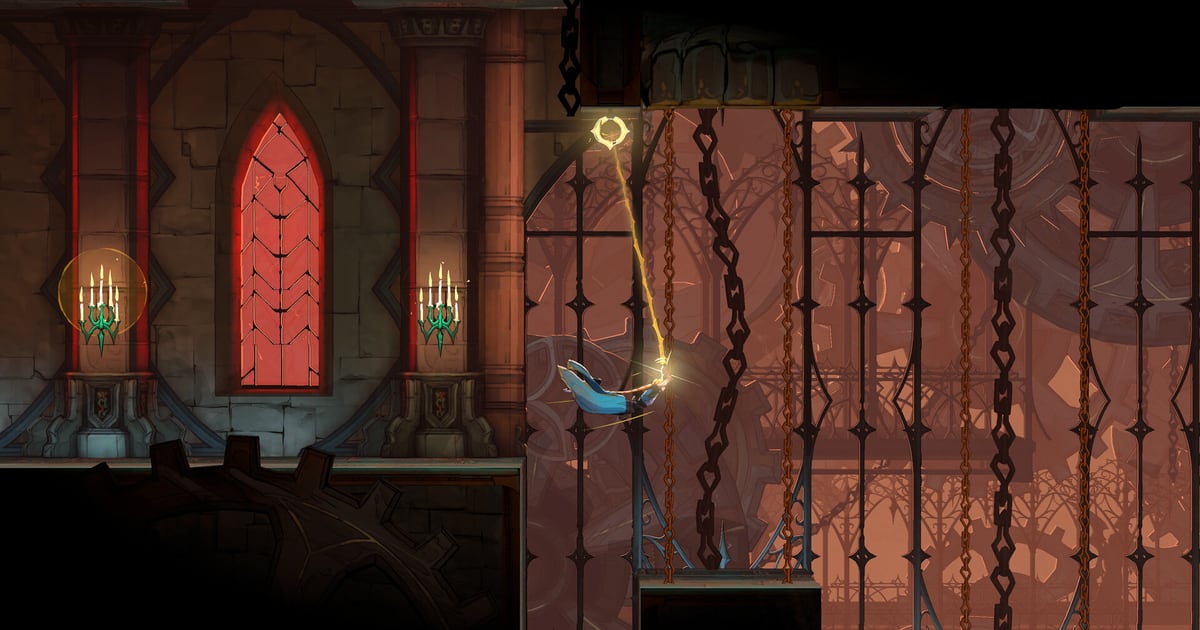
Konami’s system breakdown splits the game into four parts: whip action, bosses and Arcana, weapons, and what it calls the Castlevania spirit. The whip leads because it does two jobs. Cracking it lets Rose move like a trapeze artist, swinging from anchors to reach ledges she cannot jump to; it also pulls her toward enemies to close distance. Only then does it become a damage tool.
Polygon’s launch-day guide makes the distinction sharper. The whip Rose receives after defeating The Fallen, the game’s first boss, “isn’t a weapon, but a tool that can buff your attacks with all weapons,” used mainly to swing from anchors or pull toward enemies. Its signature offensive use is the whip attack: press the throw command and, before the whip connects, press the attack button. Time both correctly and Rose propels herself into a buffed strike with a different animation and a yellow aura; take too long and she performs a normal move followed by a backward jump.
That timing window is short, and it is tied to progression. Polygon notes that one Work of Mercy for the Fallen’s Holy Cross arcana requires killing 10 enemies with a whip attack, and that the whip itself does not count toward the separate task of collecting three whip-type weapons. The recommended practice targets are the stationary skeleton archers on the Paris Streets map and the floating spirits in the Holy Innocents’ Cemetery.
The same “movement before damage” logic shows up across the 2D action-exploration shelf. If you are coming to Belmont’s Curse straight from another timing-heavy title, our Nine Sols parry guide breaks down how frame-perfect defensive windows reshape a metroidvania’s combat rhythm.
How Bosses Become Arcana
Arcana are the second pillar. Konami’s site says bosses — including Death, Medusa, and Carmilla, plus new foes such as Joan of Arc — are sealed into Rose’s tarot cards once defeated, “turning them into Arcana.” Each card grants a spell and, for some, a unique special action.
ComicBook.com’s launch-day breakdown adds the framing Konami leaves out: the cards were “gifted to Rose Belmont by her mother after her death,” and each one “is reflective of a boss’ power.” It also states that Dracula is the only obvious boss without an Arcana, even in New Game Plus. Because the card set is tied to boss kills rather than to story branches, the two sources together describe a progression layer that fills in as you clear the map.
The cards are not a flat list of upgrades. ComicBook.com reports that every Arcana carries one to three Works of Mercy — side tasks that ask you to use that card’s spell in a specific way, from killing a set number of enemies to finding hidden locations or specific weapon types. Completing one “gives you a choice to permanently enhance the associated Arcana,” so the same card can be built in different directions depending on which tasks you finish first.
Works of Mercy, Blessings, and Gifts
Polygon’s guide spells out the loop that connects the two: “Arcanas are spells that cost mana, and you can upgrade them by spending Blessing points, which are earned from Works of Mercy tasks.” In practice, that means the whip attack you drilled earlier is not busywork — it is income for one specific card. The Fallen’s Holy Cross, for example, wants three whip-type weapons found, five enemies killed with a single cross, and 10 enemies killed with a whip attack.
This is where the two headline systems interlock. The whip gates traversal and feeds the whip-attack task; the Arcana deck converts that effort into stronger spells. A player who treats the whip as a weapon and ignores the traversal use will still finish the story, but the Work-of-Mercy economy rewards using it the way the designers built it.
The Launch-Day Arcana Lineup
The spell names and mana costs below come from ComicBook.com’s launch-day breakdown; Konami’s official site confirms the bosses named in its Arcana description, and Polygon independently names the Fallen and the Holy Cross. Treat the list as a starting orientation rather than a full drop table — ComicBook.com frames its own entries as spoilery.
| Boss | Arcana card | Spell | Mana cost |
|---|---|---|---|
| The Fallen | The Fallen | Holy Cross | Low |
| Joan of Arc | The Warrior | Infernal Pyre | 80 |
| Medusa | The Prophetess | Petrifying Gaze | 75 |
| Carmilla | The Occultist | Blood Spikes | 50 |
| Death | The Shadow | Soul Harvest | 60 |
| Isaac | The Zealot | Chronomantic Dive | 50 |
| King Arthur | The Brittle King | Stained-Shield Glass | 100 |
The spread suggests the deck is meant to be rotated by encounter rather than locked in. ComicBook.com describes Holy Cross as a boomerang-style throw that hits again on the return trip, and Stained-Shield Glass as a shield that absorbs a hit and then sprays glass outward — expensive at 100 mana, but the only card on the list built around taking a hit on purpose.
What Ships in Each Edition
Konami’s launch announcement lays out three editions. The Midnight versions add a sound-and-art gallery and two alternate costumes over the base game, and the relic item is a single in-game bonus rather than a separate mode.
| Edition | What is included |
|---|---|
| Digital Standard | Main game; the Alucard Style costume as a pre-order bonus |
| Digital Midnight | Main game, a Digital Sound & Art Gallery of 71 tracks, the Trevor Style and Sypha Style costumes, and the Family’s Grace relic; Alucard Style costume as a pre-order bonus |
| Physical Midnight | The same gallery, costumes, and relic as the digital Midnight Edition; the Alucard Style costume comes as an early-purchase bonus |
One detail worth flagging: the official site logged a “Known Issues Notice” on October 14, 2026, the day before launch, and a demo was announced on September 20, 2026. Konami’s page lists those entries but does not summarize their contents, so it is not possible to say from the official material alone what the notice covers.
Performers and Presentation
The soundtrack is one of the few named credits Konami front-loads. The press release states that “an atmospheric soundtrack composed by Daniel ASADI” accompanies the journey. The official spec sheet also lists Japanese and English audio, with text localised into Japanese, English, German, French, Italian, Spanish (Spain), Brazilian Portuguese, Russian, Chinese (Traditional), Chinese (Simplified), and Korean.
On the console side, the PlayStation store page lists single-player offline play with Remote Play supported, and 10 built-in accessibility features, including controller remapping, playable-without-motion-controls, subtitle support for the main story, and the ability to pause during gameplay or cinematics.
Reading the Launch
Belmont’s Curse arrives with its systems already legible: a whip that is a traversal tool first, a boss-sealed Arcana deck that upgrades through tasks rather than a menu purchase, and three editions that differ by gallery content and costumes more than by gameplay. For a newcomer, the practical order is to learn the whip attack before chasing cards, then let the Works of Mercy decide which Arcana to deepen.
If you are weighing whether this kind of action-led structure suits you, our ARPG primer compares how the year’s biggest action-role-playing loops differ. Both are useful context before you commit a save file to a forty-hour map.