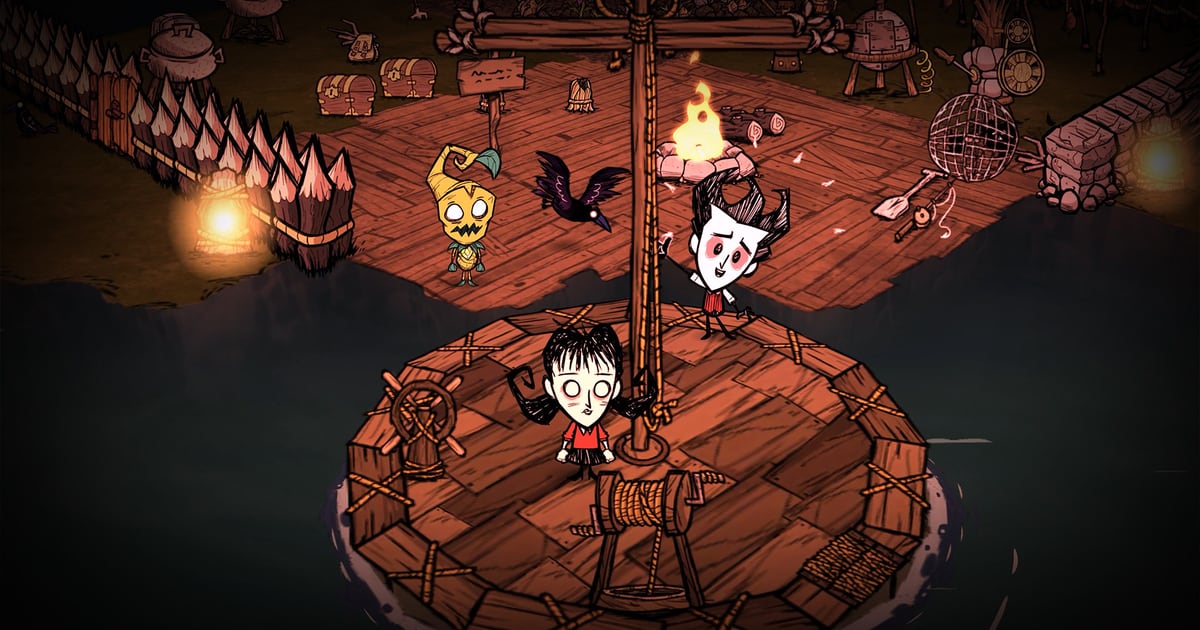
Don’t Starve Together is a game about a calendar. The first year you die to Winter because there was no Thermal Stone in your inventory. The second you die to a Summer wildfire because you built a wooden base in a pine forest. The third you die in Spring because the rain dropped your perceived temperature 30 degrees while you held a slippery axe. All three deaths are scheduling errors, and all three are preventable in the season before.
What this covers: the four seasons as four different problems — the hazard each one runs, the item that answers it, what stops working while it runs — plus which characters delete a failure mode and which food is gone before you eat it. Why it matters: seasonal preparation is the only part of DST that punishes you a full season in advance. Getting it wrong costs a world, not a fight. Who should care: players heading into their first Winter, groups splitting character picks before a world, and anyone returning after a long break who needs to know which patch their old habits assume.
The version this guide assumes
This is written against the live PC branch as of 29 October 2026: the From Beyond — Cursed Confrontation Part 2 update, which Klei’s 22 October post says shipped on Steam, Xbox and PlayStation, plus Hotfix 760944, posted on 29 October. Klei’s post also says the update reaches Nintendo Switch “a short while after completing the Nintendo certification process”, so Switch runs one step behind.
That matters less than it would in most live-service games, because the 29 October hotfix did not touch seasonal mechanics. Its changelog is event content and bug fixes: spooky Pigman, Merm and Bunnyman variants, burnable Leaf Piles, and an Enchanted Witch’s Broom that now grants immunity to slipping, sinkholes and ground Ickers while flying. Hallowed Nights 2026 is live on top of the normal calendar, which is what confuses a returning player: a costume and a broom are event layers, not a fifth season, and the cold still kills you in them. The Steam listing showed €5.09, down 66% from €14.99, when checked on 2026-10-29 — a promotional figure that will move.
How Together differs from solo. Base Don’t Starve runs two seasons, Summer and Winter; Autumn and Spring arrive with Reign of Giants, and DST ships all four on top of almost all of that DLC’s content, plus nineteen playable characters with abilities reworked for multiplayer. The structural difference is death: a dead player becomes a ghost, and resurrection through a Telltale Heart or the Florid Postern costs 25% of maximum health per resurrection, capping at 75% — leaving you at a quarter of your bar. A Booster Shot gives 25% back. Every ghost also drains 3.3 sanity per minute from each living player, cap 10 per minute. A solo death ends a run; a multiplayer death keeps taxing the team.
The year as four different problems
| Season | Default length | What it kills you with | Seasonal giant | What stops working |
|---|---|---|---|---|
| Autumn | 20 days | Nothing directly | Bearger | Nothing |
| Winter | 15–16 days | Freezing, below 0° | Deerclops | Plant regrowth, bees, ponds, farms |
| Spring | 20 days | Wetness, lightning, frog rain | Moose/Goose | Drying racks, tracks, rabbit holes |
| Summer | 15–16 days | Overheating, wildfires | Dragonfly (static, desert) | Wilted plants, anything flammable |
The wiki’s own season-length table gives a Default column of 20 days for Spring and Autumn and 15 for Summer and Winter; the individual Summer and Winter pages say 16 for those two. Treat the harsh seasons as 15 to 16 days and the mild ones as 20 — the discrepancy is unresolved on the wiki and changes no decision below. The table’s defaults add up to a year of about seventy days.
Autumn is the only default starting season in DST — Reign of Giants gives you a 50% chance of starting in Spring, but Together does not roll for it. So the standard opening is twenty mild days with a Bearger somewhere in them, and everything you do in them is a purchase against Winter. The five axes that split the genre covers why that fixed calendar makes DST unusual among survival-craft games.
Autumn: the season that pays for the other three
Two jobs, in order.
A Thermal Stone before the first cold night. The wiki’s Winter page is blunt: make one before Winter and heat it before exploring. Freezing is not a slow bleed you can walk off — below 0° the character takes 1.25 health per second, with an ice-crust warning at 5°. In the open, unwarmed, body temperature falls at roughly 1° per second, so the gap between “I’ll head back soon” and death is minutes of walking. The standard loadout is that stone plus a Winter Hat, logs and grass.
One deliberate reading of the map. Autumn is when you find the desert, the Deciduous Forest and Mosaic biomes where Winter’s Loot Stash spawns, and a cave entrance. Nights and dusk are much longer in Winter and sanity drains during both, which is the real mechanism behind most “the dark got me” deaths — and none of that exploring is possible once the season that needs it has begun.
One trap worth naming because it eats whole runs: a Forest set piece can spawn a chest next to a Thermal Measurer and an Ice Box, holding an Ice Staff, a Winter Hat and a Breezy Vest. Opening it starts Winter immediately. Opening the same chest during Winter is harmless free loot; hammering it drops its loot and still fires the trap.
Winter: the audit
Winter asks one question — can you leave the fire long enough to do anything? — and answers it with an insulation formula the wiki publishes. Its insulated rate is -30 / (30 + total_insulation). Wilson with a Puffy Vest, a Beefalo Hat and a full beard reaches 615 points of insulation, a drop of one degree every 21.5 seconds instead of one per second. His beard adds insulation, Webber’s does too, and in DST Woodie’s does as well; the Werebeaver form has additional insulation on top.
Winter is also generous with supplies, if you banked them. Perishables spoil 25% slower, and Ice does not melt at all while the world temperature is at or below 0°. A Bee Box can be harvested with no retaliation because the bees never leave the hive, and honey already inside does not begin to spoil until you take it out. Ten to twenty Drying Racks turn the rabbits and birds that still spawn into Small Jerky at 10 sanity each — the cheapest fix for the long-night sanity problem.
What Winter takes away: Berry Bushes, Saplings, Grass Tufts, Reeds and Cave Lichen regrow “extremely slowly… to the point that they seem to stop completely”, farms will not grow for most of the season, ponds freeze (walkable, unfishable), and butterflies stop spawning. What replaces them is the season’s real content: MacTusk’s walrus party, Pengulls nesting around Mini Glaciers, Blue Hounds in hound waves, and Deerclops, which spawns and targets nearby structures before turning on players. In DST the Loot Stash also spawns in the Deciduous Forest or Mosaic, and unlocking it with a Deer Antler spawns Klaus — an optional boss you do not want to summon by accident on day 24.
Spring: the wet season
Spring’s hazard is not damage, it is a stat penalty with a long tail. The Wetness meter does nothing until it hits 35, at which point items become less efficient, worn items drain 6 sanity per minute, held tools and weapons become slippery and drain another 6, and you start to freeze. At full wetness the character perceives ambient temperature as 30 degrees lower, at half wetness 15 lower — which is how people freeze to death in the mild season.
The answers are water resistance and shelter. Gear resistance is cumulative: at 100% you stop getting wet and existing wetness drains away. Standing under a tree cuts buildup by 35%. Rain also makes fire fuel less efficient, makes lightning much more frequent, and stops meat drying on a rack outright — a Spring base that runs on jerky is a base that starves.
Spring’s other changes erode routines: Rabbit Holes collapse, Lureplants spawn in explored areas, Mini Glaciers start melting, maximum enemy chase time and range rise 33%, and rain seeps into the caves so the underground is wet all season with a slower meter but higher sanity loss. The upside is real: trees reach their next growth stage 25% faster, non-food plants regrow 25% faster, and mushrooms regenerate more often. It is the season to farm, if you can stay dry doing it.
Summer: the heat bill
Summer inverts Winter’s math. Overheating warns at 65° and starts damaging at 70°, for 1.25 health per second — the same rate as freezing, which is why the two seasons feel like one problem in different clothes. Body temperature ranges from -20° to 90° in DST, so there is a lot of room above the damage line and no warning but the screen tint.
The second hazard is fire. Anything flammable can smolder and ignite, so a wooden base is a gamble, and the wiki names the answer: the Ice Flingomatic is extremely useful for surviving in a base in Summer. Two Thermal Stones in an Ice Box is the cheap version — cool them, carry them. Summer also runs the food clock the other way: perishables spoil 25% faster, and plants wilt until fertilised.
DST changes the giant here. In Reign of Giants, Dragonfly wanders toward the player looking for things to burn; in Together she is a static boss in one of the deserts. The Antlion takes over as seasonal pressure: it spawns in the Oasis desert once it has not rained for a day and, if not traded with, sends sinkholes and cave-ins at the surface. Caves avoid wildfires entirely — the wiki notes they do not occur underground — but the Antlion makes that less of a free answer than it used to be, and the wiki now rates the sandstorm base higher.
Character picks that delete a failure mode
Nineteen characters is too many to rank, but five remove an entire category of death rather than making one easier. A pick that halves a hazard stacks with a teammate’s; a pick that deletes one does not need to.
| Character | Failure mode removed | What it costs you |
|---|---|---|
| Wilson | Cold exposure — beard insulation, with the 615-point ceiling | No combat or economy perk |
| WX-78 | Spoilage — the wiki says the stale and spoiled food penalties do not apply to them | Rain damage, and Spring is rain |
| Willow | Darkness and emergency heat — the Lighter gives a little heat and can set surroundings alight | DST lists her as fond of fire but hating the cold |
| Webber | Cold exposure and food access — an insulating beard, plus spider friendship as meat | Being a monster closes some safer roads |
| Woodie | Cold exposure twice — beard insulation plus extra insulation as a Werebeaver | The transformations are a curse to manage |
Two anti-picks belong here. Wickerbottom has insomnia and a delicate stomach, and the wiki quantifies it: stale food gives her a third of the hunger and a quarter of the health, spoiled food a sixth. She is the character most punished by a Summer spoil rate; WX-78 is the least. For WX-78 in Spring the fix is specific: an Umbrella plus any hat offering at least 10% rain protection, such as a Straw Hat, fully shields them from rain damage.
What expires on you
| Resource | Base behaviour | Seasonal modifier |
|---|---|---|
| Perishable food | Fresh → Stale → Spoiled → Rot | 25% faster in Summer, 25% slower in Winter |
| Ice | Melts in three days outside storage | Never melts in an Ice Box or at or below 0° |
| Berry Bushes, Saplings, Grass Tufts, Reeds | Regrow on a cycle | Effectively stop in Winter; 25% faster in Spring |
| Farms and crops | Grow on a timer | Stop in Winter; wilt in Summer until fertilised |
| Meat on a Drying Rack | Dries over time | Will not dry at all while it is raining |
Two mechanics beat the clock rather than racing it. Cooking on a fire or in a Crock Pot halves the current spoilage — food at 80% freshness becomes 90% fresh — and Crock Pot food and Drying Rack meat do not begin to spoil until picked up. So cook late and pick up late; do not stockpile on day one. The non-spoiling exceptions are few: Tallbird Eggs, raw and cooked Mandrakes, the Deerclops Eyeball, the Guardian’s Horn, Glommer’s Goop and Jellybeans. Honey does spoil, contrary to the real-world expectation the wiki itself flags.
Year two and three: what actually changes
Nothing in the season rules changes; your margin does. Year one, Autumn goes entirely into preparing for Winter. Year two you have an Ice Box, a Flingomatic, drying racks in double figures and a route to the desert, so Autumn’s twenty days go into the Caves and Ruins instead. Year three the calendar stops being a threat and the giants become the schedule: Bearger in Autumn, Deerclops in Winter, Moose/Goose in Spring, and in Summer either Dragonfly at her fixed desert spawn or the Antlion trade.
The one thing that does not ease is death. Because resurrection stacks a 25% maximum-health penalty per death up to 75%, a group that treats resurrection as cheap ends the season at a quarter health, and Booster Shots give back only 25% each — invisible in solo play, decisive in a group.
Where the current content sits: Cursed Confrontation Part 2 continues the Shadow arc after the Keystone is taken to the Ancient Gateway, adds early-game rare spawns (Hound Batilisk, Rock Master) with unique loot, adds lore interactions with the Odd Skeleton in the caves, and speeds up loading between Forest and Caves. That last one has a seasonal use: cave sheltering is the standard Summer answer, and the trip in is now faster.