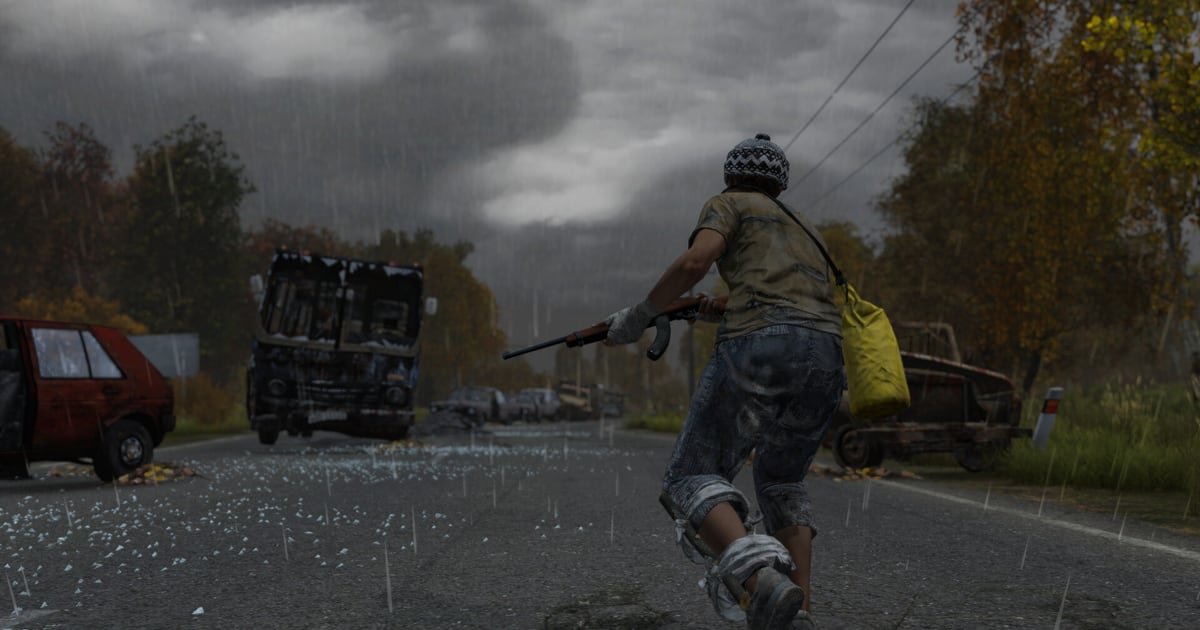
DayZ’s 1.30 update landed on 15 October 2026 with a full wipe across all platforms, alongside the Badlands expansion. Bohemia Interactive says more than 325,500 Badlands units were bought across all platforms in week one, and that DayZ hit a peak of more than 435,500 concurrent players during the launch period. More survivors in the same square kilometres changes what a sensible first day looks like: the popular routes are more crowded, the water is still where it always was, and a base you build in hour three is a base somebody else finds in hour four.
Our roadmap piece on Road to Badlands, the SCR-17 and 1.30 covers what shipped and what it changed. This guide starts after that. You are in the game on a 1.30 server, and the first 24 hours come down to three decisions in a fixed order: water, route, base. Only the third one can cost you more than it earns.
What this covers: the first day of a 1.30 life as a decision tree — why hydration outranks hunger, how to pick a route that avoids the crowded loot, and the point where a base becomes a liability. Why it matters: 1.30 shipped with a full wipe and a launch Bohemia says peaked above 435,500 concurrent players, so the early map is simultaneously empty of bases and full of people. Who should care: returning players who last played before the 1.29 loot pass, and anyone who has lost a base and wants to know whether to rebuild it.
The version this guide assumes
Everything below assumes 1.30 stable on PC as of 28 October 2026. Bohemia’s 28 October post says the first 1.30 patch was already out the week before, that a hotfix aimed at crashes and “other Badlands-related problems” was due to enter Experimental on Thursday 29 October, and that a Stable release would follow the following week. So treat this as advice for the build you are on now, and re-check anything that depends on a specific number once that hotfix goes Stable. Bohemia publishes build strings on its forums; those patch-notes pages are not reachable from here, so this guide refers to 1.30 and to the patch cadence rather than to a build number it cannot verify.
The map set is four official terrains. Chernarus and Livonia come with the base game; Sakhal and Nasdara are paid DLC, per the wiki’s map index. Nasdara is 267 km² by Bohemia’s own figure, the largest terrain it says it has built for DayZ. Badlands shipped “across all platforms” and the Halloween event that began on 26 October ran on Steam, PlayStation and Xbox — but the store page this guide’s platform field comes from is the PC entry, so the frontmatter says PC.
Decision one: water before food
The received wisdom is that you should drink first. The arithmetic explains why, and it is not because water drains faster — it does not. Both stats start a life at 600 out of a 5,000 maximum, both begin causing health damage below 300, and both drain at identical rates. Measured from a fresh spawn to the damage line, the two clocks are the same.
| Pace | Water lost per minute | Minutes from 600 to the 300 damage line |
|---|---|---|
| Idle | 0.60 – 1.20 | 250 – 500 |
| Walking | 6 – 12 | 25 – 50 |
| Jogging | 18 – 36 | 8 – 17 |
| Sprinting | 36 – 72 | 4 – 8 |
The wiki notes the drain rate is highest at a full stat and lowest near zero, so early in a life you are on the fast side of those ranges. Four to eight minutes of sprinting is the whole water budget of a new character. That single line reorders the first hour: sprinting is for reaching water, not for reaching loot.
Water comes first because of where it is, not how fast it goes. Every water source the wiki lists is a fixed feature of the map — water pumps, springs, troughs, and ponds, rivers and lakes. Pumps are the useful ones: found in towns, cities and villages, dispensing an infinite supply that is always clean at 65 ml per drinking action. Everything else needs boiling before you drink it. Food, by contrast, walks with you. An apple is 125 kcal and 50 ml of water, spawns at the base of apple trees, is rated very common, and can already be in a new character’s inventory. Food also spoils, and the wiki notes it spoils faster in your inventory than in a tent.
Two more mechanics make the ordering stricter than “drink when thirsty”:
- Blood regeneration is gated on water. The wiki’s blood-regen table gives 0.150 per second when water is between 300 and 599 even with high energy, and 0.300 per second only once water and energy are both at 600 or above. A character at 300 water heals at half rate no matter how much food is in the bag.
- Heat multiplies the problem. At very hot ambient temperatures the wiki adds 0.40 water loss per second on top of metabolism. On Nasdara that is the difference between a comfortable afternoon and a medical emergency: heat stroke begins accumulating thermal bias at yellow heat comfort whenever hydration is below 1,000, and the wiki’s prevention line is to hold hydration at 3,500 or above to stop progression at that heat level. Stage four is health damage and possible unconsciousness.
The practical rules that fall out of this:
- Carry a container before you carry a second weapon. Sipping 65 ml at a time is slow, and a bottle is the only way to move water inland.
- Drink at every pump you pass, not only when the icon drops. You are topping up a buffer you will need two kilometres later.
- Wash bloodied hands at the pump. The wiki flags unclean hands there as a route to salmonellosis or poisoning — the water is clean, your hands are not.
- Boil anything that did not come out of a pump, and arrive at contested ground full rather than at 300 with no healing margin.
Decision two: a route that skips the hot zones
Route planning changed in 1.29 because loot placement changed. Bohemia said the adjustment was meant to slow play down and to put “more importance … on how you loot areas early after you spawn”, and warned that “rather than having a choice of firearms, players might have to work with what they find”, with vests and helmets made rarer. Some firearms now spawn exclusively around farms, and NBC items turn up outside the medical and high-tier military locations that used to hold them. The full patch story is in the roadmap article; what matters here is the consequence: the loot you want is spread across more kinds of building than it used to be, and the obvious destinations are still the obvious destinations.
Chernarus gives you a usable ladder. Five towns sit on the coast — Berezino, Chernogorsk, Elektrozavodsk, Solnechny and Svetloyarsk — with Krasnostav, Novodmitrovsk, Novaya Petrovka, Severograd, Stary Sobor and Zelenogorsk inland. Bohemia names hunting camps and military bases as the usual gun locations, and the store page lists dynamic events (train crashes, abandoned military convoys, PvP hotspots) plus contaminated zones needing a full NBC suit.
| Tier | Examples on Chernarus | What draws people | Realistic risk |
|---|---|---|---|
| Coastal towns | Berezino, Chernogorsk, Elektrozavodsk, Solnechny, Svetloyarsk | Dense buildings, pumps in the street, easy food | Highest early foot traffic |
| Inland towns | Krasnostav, Novodmitrovsk, Novaya Petrovka, Severograd, Stary Sobor, Zelenogorsk | Pumps, houses, distance from the coast | Thinner traffic, longer dry stretches |
| Farms and hunting camps | 1.29’s farm-only firearm spawns, hunting camps | Guns at predictable kinds of building | Predictable ambush points |
| Military bases and dynamic events | Convoys, helicopter crash sites, train crashes | Top-tier loot | The place everyone else also routed to |
The rule that matters more than any specific location: run the middle band and run it twice. The first pass is for capacity — a bag, a water container, a cutting tool, food — because capacity is what converts the second pass into value. The second pass is where a gun is worth picking up. Rushing the military tier with a starter kit is the most common way to lose a fresh character, and 1.30 gives you no reason to: the wipe reset every stash, so nothing at the top of the map is a prize a group has not also noticed.
Two server mechanics constrain the route. World items persist on their home server and do not travel unless they are on your character, and switching servers costs a 90-second timer before you spawn. Both punish “I will just hop somewhere quieter”, so choose the route before you commit.
On Nasdara the logic inverts, and this is worth internalising before you buy the DLC. Bohemia’s launch post says the region’s scarcity of water will make heatstroke and silicosis “all the more difficult to manage”, and that water is needed “not only to stay hydrated, but also to cool down and rinse sand from your eyes after getting caught in a sandstorm”. Wells and irrigation tunnels are among the rebuildable structures in the map’s near-5,000 restoration sites. So the first route on Nasdara is a water map, not a loot map: link wells, hold 3,500 hydration, and treat every sandstorm as a water bill.
Decision three: when the base stops paying
A base is the only decision on this list that can lose you a weekend. It is worth costing before you build, and the wiki’s numbers make that possible.
| Item | Cost in materials | Notes |
|---|---|---|
| One fence section | 2 wooden logs, 18 planks (5 more logs), 36 nails | 7 logs and 18 planks per wall length |
| Tools to build it | Shovel, field shovel or pickaxe; hammer or hatchet | One of each is enough |
| Gate conversion | Metal wire plus pliers | Turns a fence into a door |
| Combination lock | 3-disc lock = 1,000 combinations; 4-disc = 10,000 | Lockable, breakable |
| Fence lifespan | 45 days, per the wiki’s fence entry | The upkeep clock |
That price is per section, and a base is many sections. The defensive value is thinner than the cost suggests: the wiki states plainly that explosives, weapons and tools can damage a fence and its parts, and calls that “one of the primary methods for base raiding”. Locks are the same story — a lock-picked door is a fast way in, and weapons or sustained punching can break a lock. A four-disc combination lock is 10,000 guesses, enough to stop a passer-by and not enough to stop someone who decides to stay. The 1.30 Code Lock raises that bar, but Bohemia’s dev blog ties its upkeep to a charged V9 battery that automatically disengages the lock when it runs out — see the Road to Badlands piece for how that system works.
Four questions decide whether the base is an asset or a liability:
- Do you have more loot than you can carry? Below that line, a hidden mound — a container buried with a shovel, hoe or pickaxe, described by the wiki as almost completely hidden but for a slight change in the ground — does the storage job without announcing a location. An improvised shelter gives 100 cargo slots in a 10x10 grid and far less attention. Tents are slower to spoil food in than your inventory, which is a reason to own a container even if you never build a wall.
- Can you be there when it is hit? The store page’s own figure is up to 60 players per server. A base is one of 60 potential targets, and you are offline for most of the day.
- Does your server’s rule set give a base meaning? Official servers are Bohemia-maintained, run the vanilla experience without mods or heavy loot manipulation, and share one character across the official hive. Community servers run their own private shardshard. A separate copy of a game world running on its own server; players on one shard don't share the world with another. where, in the wiki’s words, an admin can do whatever they want with the database, including mods. If base raiding is the thing you want to be protected from, that protection is a server rule, not a wall — and official servers have no admin to appeal to.
- Is your water within a walk? A base 400 metres from a pump is a home. A base an hour from water is a chore that eats the session it was built for.
Nasdara changes the base question in your favour, with a caveat. Bohemia’s rebuilding dev blog says there are over 5,000 rebuildable houses in roughly 20 variants, that restoration is optional and partial — block one entrance, fit a door and windows in another, stop there — and that durability depends on the materials you use, with wood, brick and mortar, and sheet metal all viable. Rubble cleared from a ruined house yields building materials, and houses further from the cities are deliberately more damaged: harder to restore, better placed for a base. The caveat is the same one the blog raises: the more destroyed the house, the more material it costs, so a rural site trades your time for its location.
One last piece of timing. Bohemia confirmed the full wipe in the same post that announced 1.30’s release, on 15 October, so anyone who had spent the autumn stockpiling on a 1.29 server lost it without notice. A base built in the week before a wipe is a write-off; a base built in the week after one sits on ground nobody has claimed yet.
What this guide cannot confirm
- The Stable date of the 1.30 crash hotfix. Bohemia said it would follow the Experimental release “next week” in its 28 October post; that is intent, not a date.
- Any build string. Bohemia’s forum patch notes were not reachable while writing this, so no version number beyond 1.30 is asserted.
- The material quantities for restoring a Nasdara house. The dev blog describes the system and material types but publishes no per-house costs.
- Whether rebuilding extends beyond Nasdara. Every Bohemia source describes it as a Badlands feature.
- Whether the wiki’s 45-day fence lifespan reflects the 1.30 build. It is the only figure available, quoted as the wiki states it.