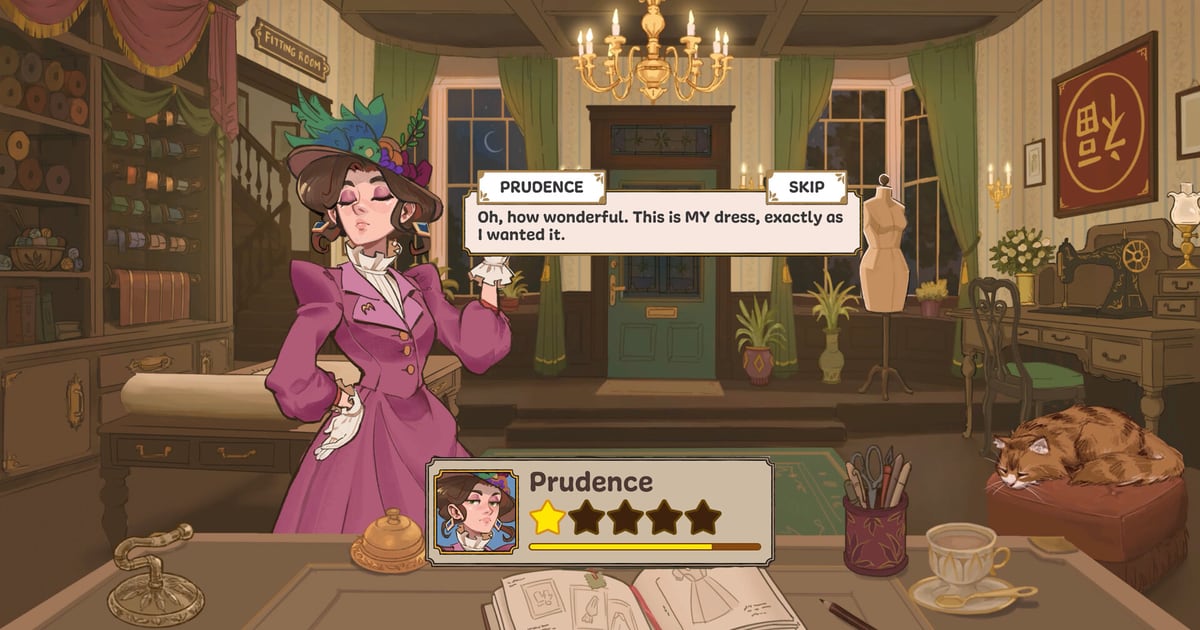
Dressmaker released on 21 September 2026 for Windows and Mac at $14.99, and three patch posts have followed it: Build 403 on 22 September, Build 410 on 24 September and Build 443 on 14 October. This guide reads those posts against the store page’s own description of the pattern-and-cutting loop to answer a question the notes never ask directly — which of the decisions a dress passes through can be taken back, and which cannot. There is no other Dressmaker coverage on this site to restate; the closest neighbour in the archive is a shop-loop primer for a different game, Probably Stolen’s cyberpunk shopkeep, and its economy questions are not these.
Every mechanic below is attributed to the page that states it. Where the notes are silent — and on the question of undoing a cut they are silent — the gap is named rather than filled. All advice assumes Build 443 (14 October 2026), the newest patch note on the game’s Steam news feed at the time of writing.
What this covers: the three stages where Dressmaker commits a decision — pattern layout at the cutting table, fabric choice per panel, and trim on an assembled dress — and what the store page and Build 443 say about each. Why it matters: Build 443 re-weighted how colour and fabric-type requirements are scored and changed how existing trim sits, so dresses made before 14 October can read differently now. Fabric lost at the cutting table is the one cost no page read here offers to undo. Who should care: anyone six weeks into a save wondering whether an old dress needs re-cutting, and anyone starting today who would rather learn the cutting room’s rules from a guide than from a misclick.
The stages, and what each one commits
| Stage | Where it happens | What the sources state | Changed by Build 443 |
|---|---|---|---|
| Pattern layout, grain-aligned or bias-cut | Pattern stage, before the fabric is cut | The store page: “Whether your pattern is aligned to the grain or cut on bias, how you choose to arrange and cut out your fabric is what appears on the final dress” | Not mentioned |
| Fabric assignment per panel | Cutting room | The store page: “Take full control over what fabric to use for each panel of your garment” | Scoring for fabric-type and colour requirements re-weighted toward small components |
| Fabric consumption while cutting | Cutting room, scissors | Build 443: scissors now discard only when the “discard fabric” button is clicked, after someone “lost 5m of velvet from that misclick” | Yes — discard made deliberate |
| Trim placement on the finished dress | Mannequin scene | Build 443: improved placement “especially around edges”, and a default tilt offset fixed on certain trims | Yes — existing trim can sit slightly differently |
| Requirement scoring for colour and fabric type | Whole dress | Build 443: area share was raw, now small components “are given a boost” | Yes — past scores may display differently |
Two of those rows are reversible in the ordinary sense: trim can be pushed around the mannequin, and a requirement score is recalculated rather than spent. The cutting table is not one of them.
The cutting table is where fabric stops being fungible
The store page’s loop is a chain of custody: buy fabric, design in the sketchbook, “arrange and cut out your dress pattern, preview them on a mannequin and sew them together.” Each step hands the next less freedom than it had, and the cutting room is the handover. Once velvet has been cut into panels, the notes treat it as spent.
Build 443 is the patch that made that boundary visible, and it did so by admitting an accident. The line reads: “The scissors can now only discard fabric when the ‘discard fabric’ button was clicked. Sorry to that person who lost 5m of velvet from that misclick.” The fix moves destruction behind an explicit button, which tells you what the developers think the cutting room’s failure mode is — not a bad cut, but a cut you did not mean to make. Nothing in Build 443, Build 410, Build 403 or the store page describes an undo for a cut panel; the same patch adds “a button to grab all panel pieces from the cutting room”, which is a tool for moving pieces, not for un-cutting them. Treat the cutting table as the one screen where a wrong click costs stock.
The rest of Build 443’s cutting-room work is navigation rather than policy: drag-pan and mousewheel pan, tooltips on the room’s buttons, a fix to the “flashbang” glitch, and a fix so that leaving mid-scissor-animation no longer leaves the scissors broken. The room got easier to read, and the destructive action got harder to trigger by accident.
Grain, bias, and the per-panel bill
The store page is unusually direct about where the design lives. Grain alignment versus bias cutting is named as a choice that shows up in the finished dress, and fabric assignment is explicitly per panel rather than per dress. That is the whole of the official description. Across the store page and Builds 403, 410 and 443 there is no explanation of what a bias cut does to drape, no table of which silhouette wants which, and no statement that connects the cut to a price, a customer reaction or a requirement score. If a guide tells you bias cutting raises a dress’s value, ask it for the source; it is not on any of the four pages.
What Build 443 does document is a change to how the game judges the fabric you picked. In the notes’ own words, colour and fabric type “was calculated as a raw % of area of each panel relative to the total area of fabric used in the dress. Now, panels on small components (e.g. the collar or sleeves) are given a boost, so that those also make a meaningful difference. This seems to conform much closer to most players’ intuitive expectations, but unfortunately means that your past dresses’ scores might now show slightly differently. Tags were already calculated in this way.”
Three practical consequences follow, and only three:
- Small panels now count for more than their area. A collar or a sleeve pair is a small share of a dress’s surface, and before Build 443 that is roughly how much it counted. The notes do not state the size of the boost, so the direction is documented and the magnitude is not.
- Tags never had this problem. The notes say tags were already calculated with the small-component weighting, which is why the change targets the colour and fabric-type requirements specifically.
- Old dresses are not re-scored in your favour, just differently. A dress that cleared a requirement on area share alone can display a different number now. The note does not promise that any particular dress improved.
So the per-panel decision that Build 443 rewards is not “use expensive fabric everywhere” — it is “spend the fabric the customer asked for where the game now looks”. If a commission wants a colour or a fibre type, putting it on the collar and cuffs is no longer a rounding error.
Trim is the part the patch moved under you
Trim and accessories are the decisions the notes describe as revisitable after the dress is sewn, and Build 443 is also the patch that changed the rules of editing trim. The developer’s framing is worth quoting because it sets the expectation honestly: “I think 99% of players won’t notice a difference for 99% of existing dresses, so sorry if you are a part of that particular 1%.” And: “You might notice certain pieces of trim just sitting or folding ever-so-slightly differently. In general, trim should be smoother, easier to place, and less glitchy, but this comes at the cost that old dresses that have trim can be slightly off.”
The specific cause is named: certain trims shipped with a default tilt offset, “meaning that they clip if not adjusted. This is especially apparent with e.g. the ivory looping lace.” The fix removes the offset — so any dress where you had already compensated by hand is now over-corrected, and the notes say so plainly: “if you had adjusted tilt on some trim, those might now be ever-so-slightly off.”
The placement tools added in the same patch are the practical answer to that:
| Build 443 addition | What it changes in practice |
|---|---|
| “Fast Trim Placement” option | Repeated clicking, and it is described as an accessibility option as well as a speed one |
| Selection by end node, extend by clicking again, selection persists after placement | Re-selecting a trim for every segment |
| Duplicate-trim button | Rebuilding a piece at the same height, size and tilt by hand |
| Drag-to-rotate the mannequin while placing trim | Backing out of placement to turn the form |
| Trim can be lowered to negative heights | Trim can now sit below the surface; the notes offer no use case for it |
| Holding Control shifts the rotation frame to the accessory’s, not the mannequin’s | Micro-adjustments that fought the mannequin’s axes |
| Fixed trim breaking on complex geometry (sleeve cuffs, bows, stays) | The clipping that made cuffs “the most technically challenging” spot |
The notes add that trim around sleeve cuffs “can be especially frustrating” and that work on that interaction is ongoing, so the cuff is still the spot the developers single out as the frustrating one — it is just no longer the place where the geometry breaks.
A defensible order of work in a new save
None of this is a build order; it is the sequence in which the documented tools arrive, so that each one is used before the decision it protects.
- Page the sketchbook before accepting anything. Build 443’s tutorial notes point out that you can page it to see your other open commissions — a thing the note says players commonly miss.
- Click component names, don’t guess. Build 410 shipped UX work “to show that the component names are clickable in sketchbook”, and Build 443 added item-selection hints behind them; Build 410 also added an inventory hover hint showing where a panel goes on the mannequin.
- Ring the bell to bring the next customer. Build 403’s notes state that you now need to ring the bell to summon the next customer.
- Check the thread colour before sewing. Build 410 added the ability to change thread colour by clicking the spools in the sewing scene — a decision the base description does not mention.
- Clear the cutting room in one action. Build 443’s grab-all-panel-pieces button exists because clicking each piece is the slow path; the discard button is the only way to lose fabric now.
- Score the requirement on the small panels. Given the re-weighting above, the collar, cuffs and sleeves are where a named colour or fibre type earns its keep.
- Place trim last, and check pre-patch trim first. Between the tilt fix and the geometry fix, trim on a dress made before 14 October is the item most likely to need a look.
One shop-side bug is worth knowing about because it is already fixed: Build 403 lists “Fix for failed commissions not giving money (if the character accepts the commission, you should be paid)”. If a commission paid nothing in the first days, that was the defect, not a hidden reputation penalty. The store page still describes the intended loop — “Turn in your dresses to your customers to gain both reputation and coin” — and no page read here states a reputation threshold, a coin value or a satisfaction formula.
What the notes do not answer
- Whether a cut can be undone. Not described in Build 403, 410, 443 or the store page. The only documented protection is the discard button.
- What grain or bias does mechanically. The store page says the choice appears in the final dress; no page read here states an effect on price, score or customer reaction.
- The size of the small-component boost. Build 443 states the change of method, not the multiplier.
- Controller support. Build 443 calls control rebinding, gamepad and Steam Deck support “a high priority for us and something we hope to get to soon”, and explains the order of work: nail the UX first. The 21 September launch post lists controller support, transparent fabrics that were not in the launch build, an online challenge mode with voting, and mobile and Switch ports as planned, with no dates.
- Crashes. Build 443 reports performance work and says some players still hit crashes or stutters; the developer notes that for many, uninstalling “OMEN gaming hub” solved it. That is their support observation, not a diagnosis.
The state of the game you are buying into
Steam’s app-details feed read $14.99 with 18,585 recommendations counted when this was written, on Windows and Mac, tagged Casual and Simulation by the store rather than anything cozier. The launch post is candid about the operation behind it — the 1 October post describes a team with “only about 1.5 programmers” fielding enough bug reports to push the developers out of their own Discord — and Build 443 reads like what that team said it would do: tutorial, controls and UX first, content second, with new skirts, cotton prints, laces, silks and trims folded in and unlocked retroactively if you are already past their campaign point.
For a dressmaker, that ordering is the useful part. The cutting room’s rules are now documented in a way they were not on 21 September, the destructive action sits behind a button, and the two things the patch could not preserve — old trim tilt and old requirement scores — are checkable in a minute per dress.