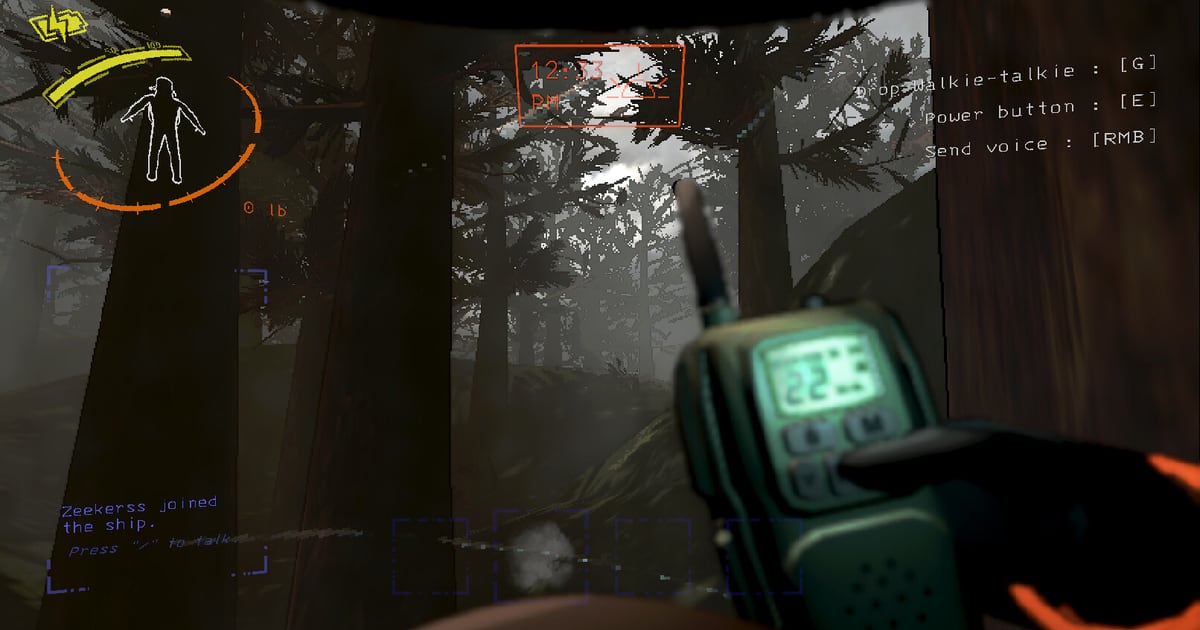
Lethal Company has one developer, and that developer posts rarely. Version 80, “The Blooming Update”, left beta on 5 April 2026, and when this article was checked on 2 November 2026 it was still the newest item in Zeekerss’s Steam announcement feed — no V81, no hotfix, no interim note.
That makes V80 the build every new crew is playing, and its patch log the only primary description of the game a first quota now meets. This piece reads that log in the order a run touches it. We have already published a three-way chooser that prices Lethal Company against R.E.P.O. and Phasmophobia, and it uses V80’s utility slot only as evidence in a purchase decision. This piece starts where that one ends: the game is bought ($9.99 in Early Access), and the question is what changed inside a run and what the log refuses to explain.
What this covers: the live Version 80 build, read against Zeekerss’s own patch log — the utility slot, three new forest-moon creatures, the reworked March exterior, the Kidnapper Fox rules, and the spawn and sight changes that touch an early quota. Why it matters: V80 altered the shop-versus-scrap maths, the number of species a day can throw at you, and how far a Forest Keeper can see. Advice written before April 2026 describes a different game. Who should care: crews inside their first few quotas, returning players, and anyone told “just buy a shovel” by a guide older than this build.
Which build this advice assumes
Everything below describes Version 80, shipped 5 April 2026. The Beta post that preceded it on 30 March 2026 says the update “isn’t quite as content-heavy as it is feature-focused”, and frames the scope in one sentence: “Where V70 was mostly just for the costly snow moons, this update focuses on the forest moons, and I also hope it makes the game better for newcomers.”
A player starting today inherits the forest-moon pass, not the snow-moon one, and the Beta post names newcomers as part of its audience. The V80 release post says of what comes next: “Version 85 should hopefully come soon and be much more ‘content-focused’”. No date appears in the log, so none appears here. At one check on 2 November 2026 Steam reported 1,125 people in game against a store review total of 412,133 — a snapshot of one polling, not a trend.
What V80 changed, in the order a run meets it
The patch log is long and mostly bug fixes. Nine items change decisions a new crew makes:
| In-run moment | What the log says V80 changed | What it changes for a first quota |
|---|---|---|
| Opening a new save | “Starting a new file now sets a random seed initially, instead of always defaulting to zero” | First-quota furniture is no longer the same furniture every save |
| First shop visit | “Added the utility slot, which can only be used for (most) non-scrap, shop-purchased items” | A bought tool has its own home instead of competing with loot |
| Choosing a weapon | “Shovels are excluded.” | The shovel still costs a scrap slot |
| Walking in the dark | “Slightly lowered night vision range to make the dark more dangerous without a light source” | A light source stops being optional |
| Entering a forest moon | Three new creatures, “native to the three forest moons (though two of them can be found elsewhere)” | The outdoor species set is not the one you learned indoors |
| Reading a moon’s threat | “Added a diversity meter to some moons which limits the amount of unique species that can spawn in a single day” | Those days throw a narrower mix at you |
| Meeting weeds | Fox rules tightened; “Weeds will never begin growing nearby the ship, though they can spread to the ship” | The ship is a safe start, not a permanent island |
| Hauling scrap inside | New factory rooms; mineshaft cave pockets; “Scrap can now spawn at the end of normal hallways” | Routes worth walking get longer |
| Falling in water | “Increased time it takes to drown by about a second” | Water still kills, marginally later |
The utility slot is a shop change disguised as quality of life
The line worth reading twice is Zeekerss’s own explanation, filed under the utility-slot entry:
“While I liked the strategic tradeoff of having to use a scrap slot to hold tools, it meant that most players opted out of using items all-together.”
That is a design reversal, stated plainly. A purchased tool used to compete with a piece of scrap in the same inventory, and the log says players resolved that competition by not buying tools. V80 removes the competition by giving purchased non-scrap items a dedicated spot.
Three consequences follow, and only three, because the log names nothing else. The remaining cost of a tool is now cash and the risk of dying while holding it, not the loot you fail to carry. The shovel exception preserves the old tradeoff for the item most crews treat as a weapon. And a tool you buy and never equip is a pure loss — an argument for buying the thing you will actually press the button for.
What the log does not give is a slot count, a price, an eligibility list beyond the shovel exclusion, or a rule for a purchased tool whose holder dies. This article asserts none of those. The store page’s tool list — “lights, shovels, walkie talkies, stun grenades, or boomboxes” — is store copy, not a rule.
Three creatures the log names but refuses to describe
V80 adds Backwater Gunkfish, Feiopars and Cadaver Bloom, and the log gives three pieces of information about them: their names, that they are “native to the three forest moons”, and that “two of them can be found elsewhere”.
There is no behaviour, no damage figure, no counterplay, no line about which is a threat at range and which on contact. That silence is the largest hole in the patch, and it is the hole guides fill with invention. The honest instruction is the one the store page gives and the log never contradicts: “scanning any creature you find to add them to your bestiary.” The bestiary entry is the only documentation that exists for these three.
The log does say something structural about where they live. The diversity meter exists “to keep from overwhelming new players especially”, and was added for a forward-looking reason: “This is to prepare for adding more creatures.” Paired with “Added proper foliage to the forest moons” and the March rework, the outdoor layer is now denser than most written advice assumes. Note also that the log says “a diversity meter to some moons”, not all, and does not say which — so no reader can infer that any particular moon is capped.
The Kidnapper Fox returns with four changed rules
The log’s first line on the fox is “Readded the Kidnapper Fox” — the only clue it had been out of the game, with no explanation of when or why. What follows is four rules, each narrowing the danger:
“The fox is now more afraid to leave its territory and more accurately determines the size of its territory.” “The fox cannot spawn at the very beginning of the day.” “Weeds will never begin growing nearby the ship, though they can spread to the ship from the place where they started.” “The Vain Shrouds are more rare than before. However, the weeds will always begin growing on the current moon if you repeatedly ‘savescum’ by disconnecting while not in orbit.”
Read as a set, they move the fox from a roaming hazard to a localised one: territory-bound, better at knowing where its territory ends, absent in the opening minutes, and no longer able to start weed growth beside your ship. The fourth rule is the interesting one, because it is a targeted anti-exploit measure — the log does not merely make shrouds rarer, it says the weeds will always appear on the current moon if you disconnect repeatedly outside orbit, converting a reroll habit into a penalty. No growth rate, weedkiller price or aggression figure appears in the log.
March, foliage, and the frame-rate work a weak laptop notices
The first line of the patch log is “Completely reworked March’s exterior”. The technical enabler is stated openly: the game “switched to a version of the game’s main shader that renders in a single rendering pass (more performant) and allows the usage of foliage and better terrain”, with credit to “members of the modding community”.
Three performance items are directly actionable:
- Distance culling indoors — “only rooms near you are rendered”, which matters most in large interiors.
- Indoor lights now have “basic ‘indirect’ lighting. This can be toggled off in the settings.”
- A pixel-resolution setting that “should save GPUGPU. Graphics Processing Unit — the chip that renders the game's visuals; the main driver of framerate and image quality. performance significantly if needed. This is also fun.”
Two accessibility options shipped alongside: disabling head-bobbing when running and jumping, and toggle-to-sprint. If one machine has been holding your group to short sessions, those are the levers in this build.
Combat and traversal changes that touch an early quota
Forest Keepers can be avoided more reliably. The log fixed a case where a Keeper could be “charged up” by almost seeing one player and then use that charge on another. It also states: “Crouching or standing still or just walking is now more effective on Forest Keepers when at a distance, and past a certain, far distance they cannot see you at all.” The distance itself is not quantified.
Old Birds are more dangerous to structures and more useful as terrain. They “can now break bridges when walking on them as well as Forest Keepers”, can be “stood on while moving”, and scrap can be placed “on their heads”. The log also made it so Old Birds cannot “spawn from thin air”.
Coilheads push less. The distance at which a stopped Coilhead will not enable its collision was increased, “to prevent Coilheads from pushing players through walls”.
Player bodies now block each other. “Running into your fellow employees will shove them aside; if both employees are running at each other, they will both collide. Crouching or carrying heavy scrap makes you harder to get around.”
That last change is what a first quota feels most often: four people hauling one heavy object through one doorway is now a collision problem as well as a scheduling problem.
Spawn rules changed, and the log says so provisionally
Challenge Moons now have fixed creature order: randomness was fixed “so that creatures will always spawn in the same order on Challenge Moons”, and extra spawns that would normally open up when a creature dies now wait “until the determined spawn order has been finished”.
Indoor spawn curves changed shape: they “now round up as well as down when determining the number of creatures to spawn”, with spawn levels “all adjusted down slightly by the same amount to compensate”. Then, in parentheses, the developer’s own hedge, kept here rather than resolved: “(This might require rebalancing or I may revert it.)” Because of that sentence, no article can promise a spawn count in V80 — only that the curve represents each moon’s definition more accurately after a uniform downward adjustment, and that the developer expects to revisit it.
What the log does not answer
| Question a new crew asks | What the V80 log provides |
|---|---|
| Which three moons are “the forest moons”? | March, Vow and Adamance are all named; the log never says which three are ‘the forest moons’ |
| Does a walkie-talkie fit the utility slot? | “most” non-scrap shop-purchased items, shovels excluded — the rest is unstated |
| How much does the utility slot hold? | Nothing |
| What do the three new creatures do? | Names and habitat only |
| How far can a Forest Keeper see you? | “a certain, far distance” — no number |
| How fast do Vain Shroud weeds spread? | Not stated |
| When is V85? | “should hopefully come soon” |
A first-quota plan that follows the log
Each step traces to a line above, and none needs a number the sources do not provide.
- Treat the first quota’s furniture as random. The seed change kills the old same-furniture-every-save assumption, so the shop’s first offer cannot be pre-planned.
- Buy one tool you will use, and equip it. The utility slot exists because players stopped using items; the log’s own diagnosis is that inventory cost killed the purchase. Do not repeat it with a tool you will never press.
- Remember the shovel’s cost. It is the named exception, so it remains the one purchase competing with loot.
- Bring a light. Night vision range was lowered deliberately, “to make the dark more dangerous without a light source”.
- Learn the outdoor species set too. Three new creatures live on the forest moons, and the bestiary is where their documentation lives.
- Read the ship as a relative safe zone. Weeds cannot start beside it, and they can reach it from where they started.
- Expect a narrower species mix on some moons. The diversity meter caps unique species per day on moons the log declines to list.
- Route the interior as a longer walk. Scrap now spawns at the end of normal hallways, and new rooms and mineshaft pockets stretch the distance to the last object worth carrying.
- Do not treat water as a quick reset. Drowning takes about a second longer.
- On Challenge Moons, learn the order. Fixed spawn order turns a memorised route into an advantage the pre-V80 build could not offer.
The through-line is that V80 moved the interesting decisions earlier: what you buy, what you carry and which door you use now matter in the first two minutes of a day rather than in the shop at its end, and the log is candid that the systems underneath were rebuilt rather than added to. The four rules that change a returning player’s habits most are the utility slot, the shovel exception, the lowered night vision and the shove.
The game-level comparison this piece deliberately does not restate — how Lethal Company, R.E.P.O. and Phasmophobia each price a group’s failure — is in our three-way chooser. For what the third game in that comparison has scheduled next, our Phasmophobia Crimson Eye and Unity 6 breakdown covers the engine move.