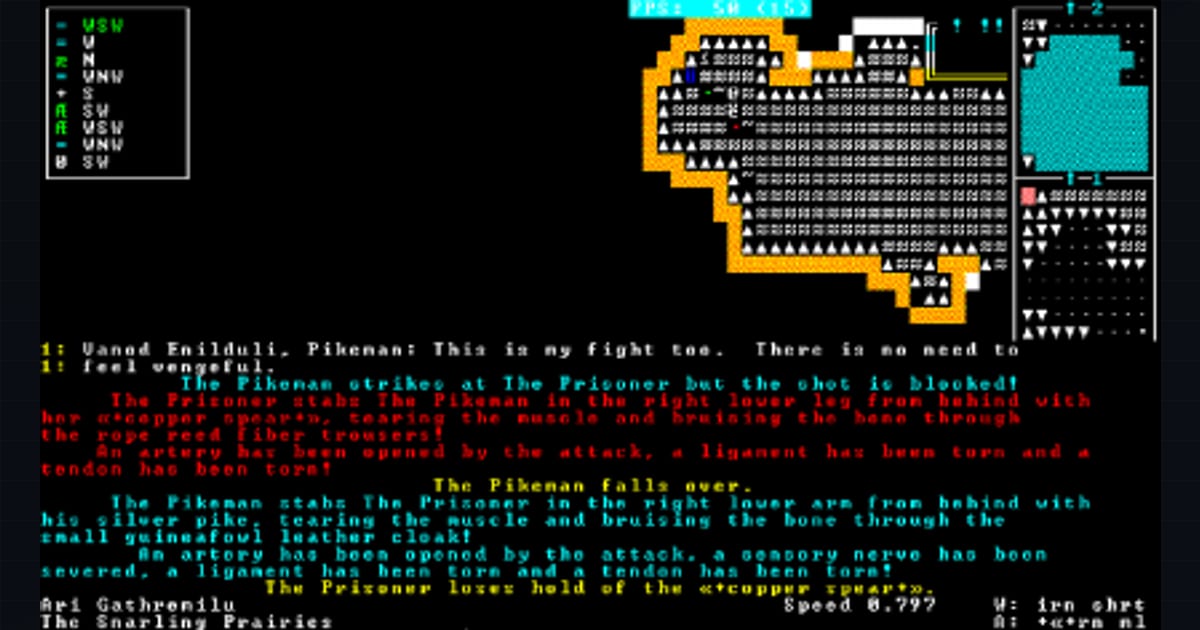
Dwarf Fortress simulates every citizen’s emotional life in granular detail. A fortress that looks prosperous on the surface can rot from within if its dwarves accumulate stress, lose access to the things they need, and spiral into depression or violence. The Steam release keeps this simulation intact while surfacing the relevant data in readable panels — stress state, active thoughts, and unmet needs are all visible if you know where to look. This guide covers how the underlying systems work and what interventions actually move the needle.
What it covers: How thoughts, stress, and needs work under the hood — and which interventions actually help. Why it matters: A fortress rots from within; the Steam panels surface the data but not the fixes. Who should pick this: Players whose dwarves are spiraling into depression or violence.
How the Thought System Works
Every dwarf generates thoughts in response to events. Sleeping in a high-quality bedroom, eating a well-prepared meal, finishing a craft, socializing, or praying all produce positive thoughts. Sleeping on the floor, eating unprepared food, being rained on, seeing a corpse, losing a friend, or being kept from a need produce negative ones.
Each thought has two properties:
- Stress value — a positive or negative contribution to the dwarf’s running stress total. A great meal might contribute a small positive; witnessing a friend’s violent death contributes a large negative.
- Duration — thoughts persist for a limited window, then expire. A dwarf is not permanently marked by a single bad event; the problem is the rate of negative thoughts exceeding the rate of positive ones.
The cumulative result is the dwarf’s stress level, which the UI represents as a state label and, on most builds, a color-coded indicator. Dwarves track their own totals; you see the aggregate when you inspect them.
Stress States and Their Effects
While exact threshold numbers are not exposed in the UI and have shifted across versions, the behavioral states are consistent:
| State (approx.) | Behavior | Fortress impact |
|---|---|---|
| Content / Stable | Normal work, no complaints | None |
| Concerned | Minor mood dips, slight efficiency loss | Low |
| Stressed | Intermittent bad moods, distracted | Productivity drag |
| Very Stressed | Misery, intermittent work refusal | Notable slowdown |
| Depressed | Frequent work refusal, brooding, wandering | Serious |
| Tantrum / Haggard | Destructive outbursts, attacks on others | Cascading risk |
| Insane (berserk / melancholy / catatonic) | Terminal — usually death or removal | Loss of dwarf |
The danger of high stress is not just one sad dwarf. Tantrums cause injuries and property damage, which generate more negative thoughts for witnesses — the classic tantrum spiral, where a single violent incident triggers a chain reaction that can depopulate a fortress. Understanding this cascade is the core reason to manage stress proactively.
The Needs System
Dwarves have personal needs derived from their personality facets. These are not universal — each dwarf’s list is individual. Common needs include:
- Praying to a specific deity (requires a temple or shrine for that deity, or a general temple)
- Socializing at a tavern
- Drinking (satisfied by alcohol availability and variety)
- Practicing a craft or martial skill (active work in their profession)
- Being outdoors or wandering (personality-driven)
- Arguing, debating, or intellectual discussions (libraries, taverns)
- Helping others or being with family
- Communing with nature or abstract thinking
Unmet needs do not immediately spike stress. Instead, they generate recurring negative thoughts that worsen the longer the need stays unmet. A dwarf prevented from praying will produce a “didn’t pray” thought that escalates in severity over time. This is why a fortress can seem fine for a season and then crack — needs erode stability gradually.
Reading Needs in the UI
In the Steam release, selecting a dwarf and checking the thoughts/needs panel shows active needs and how long they’ve been unmet. Prioritizing the most-neglected needs across your population is more efficient than trying to satisfy everyone equally.
Practical Interventions
Stress management is a matter of maximizing positive thought sources and minimizing negative ones, while ensuring needs have outlets. The interventions below are ordered roughly by impact-per-effort.
Bedrooms and Furniture
A dwarf’s bedroom is their most reliable positive thought source, used every day. Key points:
- A bed in an enclosed room beats sleeping in a dormitory or on the floor. Even a small private room with a bed and door is a large improvement.
- Room value matters: engraving walls, adding statues, using high-value materials (metal, gems) raises the “slept in a good bedroom” thought.
- A cabinet and chest let dwarves store personal items, which provides a small recurring positive.
A cheap early-game approach: dig small 1×2 or 2×2 rooms, add a bed, and engrave later when you have a stone detailer. Do not leave dwarves in dormitories once you have labor to spare.
Food and Drink
- Alcohol is both a need and a mood stabilizer. A fortress without alcohol forces dwarves to drink water, which produces negative thoughts (“forced to drink water”) and slows them (dwarves work slower when sober).
- Meal quality counts: prepared meals from a kitchen produce better thoughts than raw ingredients. A skilled cook with varied ingredients generates strong positives.
- Food variety reduces the “got tired of eating the same old food” negative thought. Rotate crops and processed foods.
Temples, Taverns, and Libraries
These zones are the primary need-satisfaction infrastructure:
- Temples — assign a temple to a specific deity (or leave one as a general/any-deity temple). Dwarves with prayer needs visit matching temples. A general temple covers dwarves whose deity has no dedicated site, so it’s worth keeping at least one general temple alongside any dedicated ones.
- Taverns — satisfy socializing, drinking, and some performance/argument needs. A tavern with alcohol service and some performers covers a broad need set.
- Libraries — satisfy intellectual needs (reading, abstract thinking, scholarly discussion) for dwarves who have them.
You do not need every zone immediately. Prioritize based on your population’s dominant needs: survey your dwarves, note which needs recur most, and build to match.
Corpse and Body-Part Exposure
This is the single largest avoidable stress source in most fortresses:
- Seeing a corpse and especially seeing a loved one’s corpse generate large negatives.
- Miasma from rotting remains adds further stress.
- Body parts (from butchery or combat) in open stockpiles can trigger “saw a dead body” thoughts.
Interventions:
- Bury or memorialize the dead promptly. A coffin in a designated tomb prevents the “unburied” negative.
- Keep refuse and corpse stockpiles away from high-traffic paths.
- Give military dwarves downtime after combat; don’t chain them through repeated engagements without recovery.
- Use a memorial slab when a body is unrecoverable (e.g., lost to a cave-in or monster) to stop “missing” thoughts.
Military and Combat Stress
Soldiers accumulate stress from killing, seeing allies fall, and prolonged separation from other needs. Practical handling:
- Rotate squads off active duty so members can socialize, pray, and rest in good quarters.
- Avoid drafting dwarves with stress-vulnerable personalities into frontline roles when possible.
- A well-equipped, well-rested soldier with met needs recovers faster than one ground down by nonstop combat.
Personality and Stress Susceptibility
Not all dwarves handle stress equally. Personality facets — such as a tendency toward anxiety, depression, or anger, or traits like “is put off by authority” — change how a dwarf responds to the same events. A dwarf prone to depression may spiral from a negative thought that another dwarf shrugs off.
Use this to your advantage:
- Inspect personalities before assigning high-stress roles (military, refuse hauling, medical work amid bodies).
- Offload stress-heavy jobs to dwarves with resilient personalities when the labor pool allows.
- Accept that some dwarves are net liabilities for certain work; the system rewards matching dwarves to roles they can tolerate.
Monitoring and Early Warning
The Steam UI gives you tools to catch problems before they spiral:
- Citizens list with stress indicators — sort or scan for dwarves in elevated stress states. Investigate the worst few each season.
- Thoughts panel — shows current thoughts and unmet needs. A dwarf with many unmet, long-standing needs is a future problem.
- Reports and announcements — watch for tantrums, melancholy, or “has been miserable” events as early signals.
A useful routine: at each seasonal checkpoint, sort citizens by stress, read the top three worst cases’ thoughts, and address the dominant cause. This is far cheaper than recovering from a full tantrum spiral.
Common Failure Modes
- The tantrum spiral — one death → grieving dwarves → tantrums → more deaths → more grief. Break the chain by separating combatants, removing corpses quickly, and giving survivors recovery time.
- The dry fortress — running out of alcohol silently degrades mood and throughput. Keep a buffer of several hundred drinks; set brewing to repeat.
- The dormitory fortress — never graduating dwarves to private rooms slowly erodes mood as the fortress ages.
- The neglected-temple fortress — a population with heavy prayer needs and no matching temples will degrade even with great food and bedrooms.
- The overworked military — squads on permanent training or duty miss needs and accumulate combat stress until they crack.
Quick-Reference Stress Toolkit
| Lever | What it fixes | Effort |
|---|---|---|
| Private engraved bedrooms | Daily positive thoughts | Low–medium |
| Alcohol buffer + variety | Drinking need, speed penalty | Low |
| Prepared varied meals | Food-quality positives | Low–medium |
| Temples per major deity | Prayer needs | Medium |
| Tavern with service | Socializing, drinking, performance needs | Medium |
| Library with writing materials | Intellectual needs | Medium |
| Rapid burial / memorial slabs | Corpse/missing-thought negatives | Low |
| Military downtime + rotation | Combat and separation stress | Low |
| Personality-aware role assignment | Prevents vulnerable dwarves in bad roles | Ongoing |
Stress management in Dwarf Fortress is not a single feature you toggle — it is the ongoing discipline of keeping positive thought sources stocked, negative sources contained, and every dwarf’s needs within reach. The fortress that survives is the one that treats mood as infrastructure, not as an afterthought.
Sources & further reading
- Dwarf Fortress Wiki — Stress: https://dwarffortresswiki.org/index.php/Stress
- Dwarf Fortress Wiki — Needs: https://dwarffortresswiki.org/index.php/Need
- Dwarf Fortress Wiki — Thoughts: https://dwarffortresswiki.org/index.php/Thought
- Bay 12 Games — official site and development logs: https://www.bay12games.com/dwarves/
- Dwarf Fortress on Steam (store page and patch notes): https://store.steampowered.com/app/975370/Dwarf_Fortress/
- Dwarf Fortress Wiki — Tavern, Temple, and Library zones: https://dwarffortresswiki.org/index.php/Tavern
Next read
- For the survival fundamentals, see Dwarf Fortress on Steam: Fortress Mode Beginner Primer.
- All our coverage lives on the Dwarf Fortress hub.