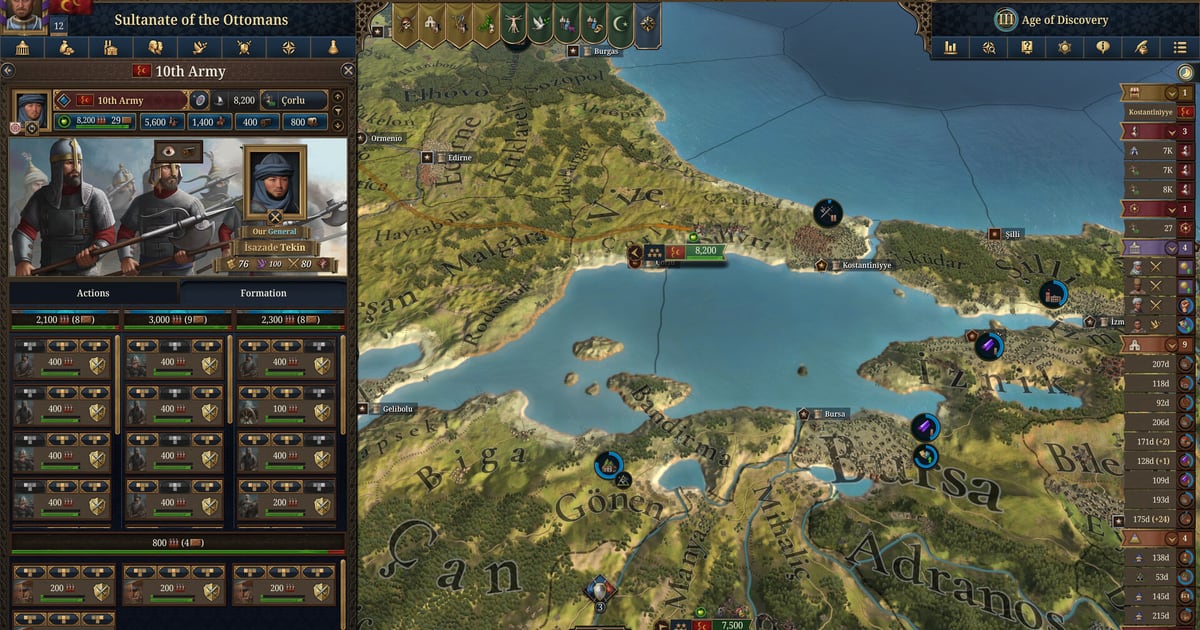
Paradox Tinto has spent the months before release showing, system by system, what the free 1.4 “Río Salado” update for Europa Universalis V will actually do. The update ships on 28 October 2026 alongside Across the Pillars, the game’s first Chronicle Pack: Paradox’s 1 October press release dates the paid pack and states it “will be released alongside the free 1.4 ‘Rio Salado’ update for the base game,” which the publisher calls “the biggest update yet” in Paradox Tinto’s first-year campaign of free features, systems and flavor.
This is a pre-release explainer, not a review. Every mechanic below comes from Paradox Tinto’s own material — the weekly Tinto Talks developer diaries and the publisher’s press release — and each is labeled with the diary that showed it. Where the developers say a system is still changing, that caveat stays in.
What this covers: the confirmed mechanics of update 1.4 — Expeditions, the Cardinals and Curia rework, the Crusade and Jihad overhaul, Religious Orders, and the trade changes. Why it matters: several of these are full reworks of systems already in the game, and one — Expeditions — is a new system the developers themselves still call an early look. Who should read it: EU5 players planning an Iberia or Catholicism campaign for patch day, and anyone deciding whether the free update or the paid pack carries the content they want.
| System | What 1.4 changes | Shown in |
|---|---|---|
| Expeditions | New character-led missions sent to distant lands, with resources, provisions and outcomes | Tinto Talks 121 (19 Aug 2026) |
| Cardinals & Curia | Cardinals become named characters; the Curia is composed of them and they cast its votes | Tinto Talks 125 (23 Sep 2026) |
| Crusades & Jihads | Two-phase holy wars with a spiritual-plus-temporal leadership and a war chest | Tinto Talks 125 |
| Religious Orders | A new cross-realm body of monastic and mendicant orders holding land in several countries | Tinto Talks 125 |
| Trade | Trade Orders become a priority queue; tariffs tax foreign trade inside your markets | Tinto Talks 124 (16 Sep 2026) |
Across the Pillars adds its own layer on top — unique Expeditions, Iberian military orders, the Iberian Union, and 20 new bureaucracy options (12 Iberian, 8 Maghrebi) — but those are the paid pack’s content, not the update’s.
Expeditions: missions to distant lands
Expeditions are the newest system in 1.4, and Paradox Tinto’s own framing is the most important thing to carry into a campaign: in Tinto Talks 121 the team called the feature “an early look,” said it is “still under development,” and stressed that it has “not fully implemented all the required components” to promise the exploration-engagement goal. What the diary did confirm is the shape of the system.
An expedition is a character-led mission to a distant land. At the end of the journey the player is “presented with various outcomes depending on the expedition you choose, and sometimes what decisions and resources you have brought with you along the way.” Tinto Talks 121 showed three examples:
- Circumnavigation — a prestigious race to sail around the world first. It carries resources and provisions, and running out of provisions means low morale, which the diary spells out as “mutiny,” losing the expedition. Succeeding first yields useful bonuses; the voyage returns cloves sold at market price.
- Treasure Fleet — a Middle Kingdom expedition unlocked by the “Age of Treasure Voyages” event. It is political, started from an action in the Middle Kingdom international organization where the country picks the destination, the leader character and the voyage cargo. The leader’s military skill “reduces the loss of cargo on negative events” while diplomatic skill “increase[s] the chance for visited countries to make choices that benefit China.” At local ports the fleet spends cargo on gifts, and hosts choose a submissive or an arrogant stance, each with its own benefits.
- Pilgrimage & Hajj — the Great Pilgrimage to Jerusalem and the Royal Hajj to Mecca. The pilgrimage visits as many Catholic Holy Sites as possible, then Jerusalem; those sites tally into a clergy-satisfaction and legitimacy reward. The Hajj is journey-focused: the ruler leaves with guards and must finish within the same year or fail, routing through Damascus, Cairo, Baghdad or Jeddah, with splendor accrued on the road scaling the prestige paid out at Mecca.
Tinto Talks 121 also confirmed that the expeditions it showed would be “part of the 1.4 Free Update,” with some expedition content exclusive to Across the Pillars.
Cardinals become characters
Tinto Talks 125, the 23 September diary, is where the religious rework lands, and its headline is blunt: “The most important change about Cardinals is simple: They are now characters!” Paradox Tinto retired the Cardinal Seat building, which it said it was “not really very sold on,” and replaced it with proper characters. The diary’s worked example is Cardinal Gil Álvarez de Albornoz, a Castilian churchman it describes as “the main Papal leader in the reconquest of most of the Papal States in the 1350s.”
What that means in play:
- A cardinal still holds a seat in a specific location, so the College of Cardinals now appears on the Catholic Church map.
- The Papal Curia is composed of cardinals, and — the key change — “the ones voting for it to pass or not are the countries that control a Cardinal in the Curia, which limits the number of voting members.” The diary notes France controls the most cardinals at the start of the game.
- Two diplomatic actions, Ask to Support and Ask to Reject, let a country lobby other cardinal-holders over a proposed bull.
- A new religious action, Appoint Dynasty Cardinal, lets a ruler place a member of the ruling dynasty, and the existing Request Cardinal Seat and Remove Cardinal Seat actions remain.
- Cardinals seated in your locations can be appointed Generals or Cabinet Members, and can be promoted to Head of the Cabinet with enough Political Influence. A new Cardinal regency lets a cardinal in Cabinet hold the regency for a minor.
For dynasty play, the diary’s own summary is that cardinals become “the main resource to hold and control the Curia votes,” while giving more options over the Cabinet and the dynasty — “e.g., allowing your ruler’s son to become a Cardinal.”
Crusades and Jihads get a chest and a leader
The same diary overhauled both holy wars at once, reasoning that they “mirror each other.” The confirmed structure:
- Calling them: Crusades are called “via a Curia vote (which… requires a majority of Cardinals to pass)”; Jihads are called via a Religious action.
- Leadership: a Crusade has a Spiritual Leader (always the Papacy) plus a Temporal Leader (the founding realm); a Jihad has a single leader. A country with a higher Great Power score, or a larger contributor, can take over the leadership.
- Two phases. The preparation phase gathers members, gold and zeal. Religious Zeal is a 0–100 scale that “only wanes at war” and boosts damage against heathen troops, war-exhaustion tolerance and peace-offer acceptance.
- The trigger: at 100% preparation, war is declared on the target and “20% of the contribution will be split between all the participating members.”
Tinto Talks 125 also lists the action sets — four shared actions (Hasten Preparations, Convert the Conquered, Discipline the Faithless, Distribute the Spoils), six Crusade actions and seven Jihad actions — plus supporting content: a Crusade Privileges papal bull, an Incite Desertion country interaction, the Take Up the Cross and Answer the Holy Call parliament agendas, and 35 events covering the life of a holy war. Winning means Conquest casus belli, a war chest distributed by contribution, and an instant modifier of +10 Prestige and +10 Religious Influence, plus an opinion modifier and a “Victor” modifier lasting 10 years; deserters carry a heavier penalty while the war runs.
Religious Orders put abbeys on the map
Religious Orders are the genuinely new religious mechanic in 1.4. Tinto Talks 125 describes them as “a new kind of body” that “operate[s] across many realms, with holdings spread across locations in several countries at once, representing local abbeys, priories, and hospices.”
Two types are in: monastic (Benedictines, Cistercians) and mendicant (Dominicans, Franciscans, Augustinians). A third, Iberian military, was flagged for a later Across the Pillars diary. Orders carry a strength value driven by the order’s global Zeal and its standing in your country, and callings shape each one — monastic orders may be Contemplatives, Scholars or Cultivators; mendicant orders may be Preachers, Almoners or Confessors.
Countries interact with orders through Religious Influence: three generic actions (Grant Holding to a Religious Order, Expel Holding, Change the Order’s Calling) plus a unique action per calling. Each holding “will spawn a character who can be used in the cabinet,” and serving in the Cabinet raises that character’s order Standing. The payoff is specialization: the diary’s examples are Dominicans for converting infidels, Franciscans for Peasant Growth and Disease Resistance, and Cistercians for Food Production while pushing toward a Traditional Economy, with more than 20 events and a Clergy Estate parliament agenda tied in.
Trade Orders become a ladder, not a switch
Trade is the fourth confirmed rework, and it comes from Tinto Talks 124 (16 September 2026). The clearest available account of it is the secondary summary at Grand Strategy Hub, which states it read the diary in full and labels everything as preview content that can change; treat the shapes below as that summary’s reading of Tinto Talks 124.
Its stated goal is an involvement ladder for what the developers call optional complexity. Trade stays fully automated by default with a cleaner UI. One level up, Trade Orders become a priority queue: orders higher in the list draw Trade Capacity first, leftover capacity trickles down to the next order, and orders you cannot currently serve stay inactive as fallbacks. Three dynamic presets are named — Any Export, Any Pop need, and Any construction need. At the top level, each order can be edited with a minimum acceptable profit, target markets, and a Profit, Food or shortage-fixing focus; target markets can be dynamic designations such as “All Owned Markets” or “All Colonial Markets.”
Separately, Tariffs tax foreign trade happening inside your own markets and double as revenue: an Export Tariff makes foreign traders pay a premium to export a good, while a negative tariff — a Subvention — lowers the price to encourage exports, with the same logic mirrored for imports. Maximum tariff levels depend on advances, laws and where the country sits on the Free Trade–Mercantilism societal value, and tariffs carry a diplomatic opinion cost that scales with trade volume. A new Promote Industry action specializes production in one industry at the Area level, with a slot count that scales by rank (one by default, two for Kingdoms, three for Empires).
The press release frames all of this as part of 1.4’s “major changes to trade,” alongside “improving dynastic gameplay.” For how the current, live market model works before patch day, the site’s EU5 trade nodes and market guide is the existing reference.
What is still unshown
Two caveats belong on the record before 28 October. First, 1.4 is not final. Tinto Talks 125 confirms the open beta began 1 October 2026, so the figures above — 20% contribution splits, +10 Prestige, a 0–100 Zeal scale — are preview values subject to change, and Tinto Talks 121 is explicit that Expeditions may still be iterated on. Second, the free update and the paid pack are separate purchases: Across the Pillars lands at a suggested $19.99/£16.99/€19.99 and is included in the Premium Edition, while Expeditions, Cardinals, Crusades and Jihads, Religious Orders and the trade rework are the base game’s free 1.4 content.