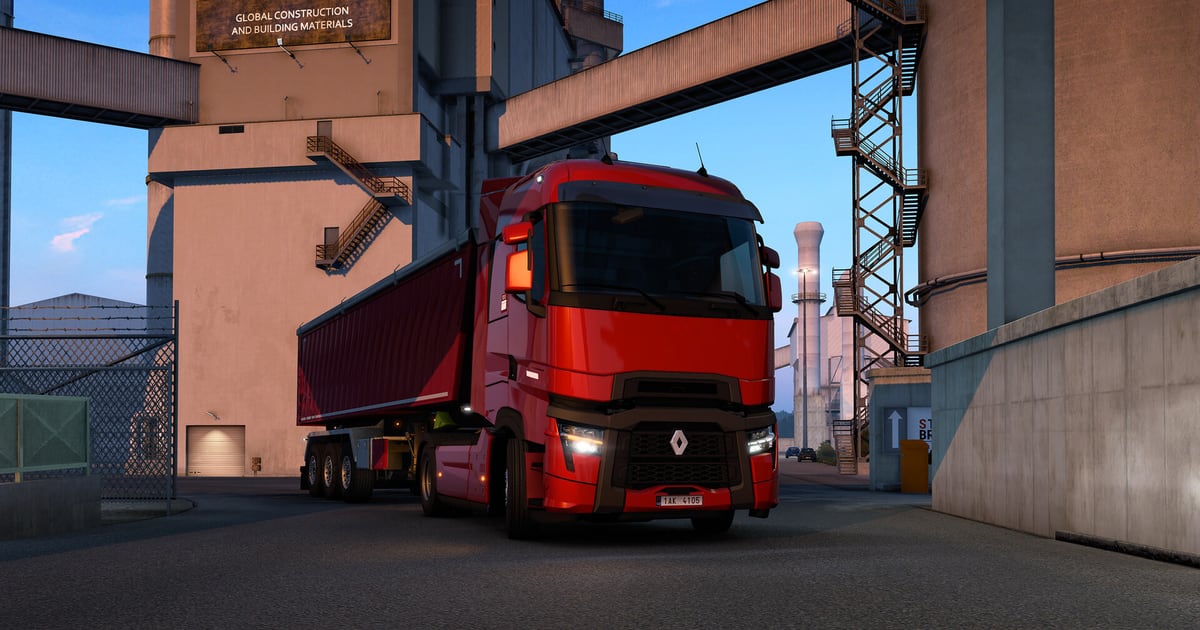
A Euro Truck Simulator 2 career is decided before the wheels turn: which job you accept, which cargo sits on the trailer, and whether the trailer belongs to a driver you hired. SCS Software has never printed the payout formula in a patch note, and neither the 1.61 release post nor the 1.62 open-beta post mentions changing job income. This site already covers what 1.61 added in the Volvo 100 Year Edition guide; this piece prices the career instead.
What this covers: the documented payout formula and its coefficients, the Long Distance tiers that gate which routes you can see, what cargo damage actually costs, the capital maths behind a €180,000 garage, and the hire-driver mechanics that decide when a fleet out-earns your own driving. Why it matters: the game pays per job, not per hour, and the multipliers are invisible on the job card. The same distance is worth about 50% more through the Cargo Market (coefficient 1.0) than as a Quick Job (0.67). Who should care: players past their first truck who are choosing between a third garage and a fifth truck, and anyone who has finished a long haul and wondered why the money looked thin.
The version this advice assumes
The live build is 1.61, released 17 September 2026 according to SCS’s release post, and the version-history page agrees. A 1.62 open beta is running on Steam’s public_beta branch; SCS calls it “only an open beta, not a stable public version” and warns of bugs, instability or crashes. Everything below assumes live 1.61, with 1.62 called out separately. Iceland is dated 10 November 2026 by SCS, and the version-history page lists it as arriving “in update 1.62”.
One caveat, because it applies to every figure that follows. The only published description of the payout maths is the wiki’s Economy page, and it states its constants as of update 1.40 (24 March 2021 per the version history). No patch note I fetched since then revises them, and none confirms them either. Trust the shape of the formula; treat the constants as the best available description rather than a datamined table.
The payout formula, as documented
The base reward is a product of three things — a cargo-units term, a base revenue per kilometre of 15, and the original route length in km — times a market coefficient. On top come a fixed reward of 600 (350 for a Quick Job), a proficiency bonus of 0.015 × player level capped at the base reward (reached at level 67 in ETS2), and four percentage bonuses that each scale with a skill rank.
| Term | Documented value | Effect on profit |
|---|---|---|
| Base revenue per km | 15 | The spine of every payout |
| Quick Job coefficient | 0.67 | A third below the full 1.0 rate |
| Freight Market coefficient | 0.9 | Standard when you drive your own truck |
| External / Cargo Market coefficient | 1.0 | Full rate, own trailer or World of Trucks |
| Fixed reward | 600 (350 for Quick Jobs) | Distance-independent, so it dilutes |
| Proficiency bonus | 0.015 × level, capped at base reward | Punishes a high level in a cheap job |
| Distance / Valuable / Fragile / Urgent bonus | 0.05 × skill rank, each | The four levers you control |
| Cargo damage | 5.0 per 1% plus a 0.04 factor | The one term that erases a haul |
The fixed 600 is a short-haul subsidy: on a 200 km freight job it is worth 3 per km, on a 1,500 km job 0.4 per km. And the formula uses the original route length, so kilometres driven off-route pay nothing while still burning diesel.
Here is the shape with one unit of cargo and no bonuses — arithmetic on the wiki’s constants, not a claim about your save:
| Route (Freight Market, 0.9) | Base reward | + fixed 600 | Revenue per km |
|---|---|---|---|
| 200 km | 2,700 | 3,300 | 16.5 |
| 550 km | 7,425 | 8,025 | 14.6 |
| 1,500 km | 20,250 | 20,850 | 13.9 |
| 1,600 km, rank 6 (+30% of base) | 21,600 + 6,480 | 28,680 | 17.9 |
Swap in your own cargo-units figure and every row scales linearly. Until a distance bonus kicks in, longer hauls earn less per kilometre; only the skill tiers reverse the slide.
Route selection is a distance-tier decision
You cannot pick a route the Long Distance skill has not unlocked, so this is the first gate, not a late luxury. The skill page gives the caps and the bonus thresholds:
| Rank | Maximum job distance | Reward bonus |
|---|---|---|
| Unskilled | 250 km | — |
| 1 | 350 km | +5% over 250 km |
| 2 | 550 km | +10% over 403 km |
| 3 | 850 km | +15% over 550 km |
| 4 | 1,100 km | +20% over 850 km |
| 5 | 1,500 km | +25% over 1,100 km |
| 6 | Anywhere | +30% over 1,500 km |
Read both columns together and the rule appears: each tier unlocks a longer ceiling but only pays above the previous tier’s ceiling. Rank 4 unlocks 1,100 km and pays from 850 km, so the efficient band sits just inside the cap. Because the fixed 600 dilutes, a rank-5 player choosing between 900 km and 1,400 km is not choosing more money per km — they are buying absolute money at a lower rate, which is right only if the alternative is idle time.
External Contracts and the Cargo Market pay at 1.0 against the Freight Market’s 0.9, but the trade is real. The job-market page notes ETS2 External Contracts cap speed at 90 km/h, only show jobs in a circle around your truck, and run their deadline in real time rather than in-game time. The Cargo Market needs your own trailer and makes damage permanent — “the cargo damage is PERMANENT, so you have to finish this job without any hits on your truck and trailer.”
Cargo weight, fragility and the damage bill
There is no per-tonne rate in the formula. Weight changes feasibility and risk, not the rate card: the job-market page warns you need “to ensure your truck is capable of carrying the weight of heavier cargoes, especially when going up-slope.” No source I fetched gives a money-per-tonne figure, so none appears here — a heavy load pays more because it carries more cargo units, not because the game charges by the kilogram.
Damage is where the money leaks. The Economy page lists 5.0 subtracted per 1% of damage and a 0.04 factor, and the job-market page adds that damage “will reduce your XP gained and greatly reduce your pay.” Those two wiki constants are not obviously the same mechanism and I will not pretend to reconcile them; what matters is that the payout is fixed when you accept, so a clean 850 km run can beat a damaged 1,600 km one.
Fragile and High-Value Cargo each grant +5% at rank 1, rising to +30% at rank 6, but only on flagged jobs — and only those jobs carry the handling risk. Hauling fragile cargo with zero ranks in the skill means taking the risk for none of the multiplier, so grind the rank first, then take the flagged loads.
Garage timing: the €180,000 decision
Garage capacity is the gate on fleet size, and the prices are lopsided. Your headquarters garage has one bay. A newly bought garage costs €180,000 (the wiki also gives £154,998) and arrives with three bays. Upgrading the headquarters from one bay to three costs the same €180,000. The step from three to five bays costs €100,000 and adds a fuel pump whose diesel is 15% below the country’s normal price.
| Purchase | Cost | Bays after | Notes |
|---|---|---|---|
| Headquarters upgrade, 1 → 3 bays | €180,000 | 3 | Priced like a garage purchase |
| New garage | €180,000 | 3 | Puts slots in a second city |
| 3 → 5 bay upgrade | €100,000 | 5 | €50,000 per extra bay, plus the pump |
| Five-bay garage, all-in | €280,000 | 5 | €56,000 per bay |
The last two rows are arithmetic on the first two. They answer the timing question the UI does not: the second upgrade is the cheap one. Five bays cost 1.56× a three-bay garage for 1.67× the slots, and it throws in cheaper fuel. If you will fill them, buy one garage and upgrade it rather than buying two — the exception being that garages sit in cities, and location decides where drivers start their out-and-back loops.
Loans change the timing more than the total. The bank page lists the ETS2 offers; the totals are its installment multiplied by its term:
| Loan | Term | Interest (p.a.) | Daily installment | Total repaid |
|---|---|---|---|---|
| €10,000 | 35 days | 23% | €290 | €10,150 |
| €50,000 | 35 days | 20% | €1,446 | €50,610 |
| €100,000 | 35 days | 18% | €2,888 | €101,080 |
| €400,000 | 70 days | 12% | €5,788 | €405,160 |
A €400,000 loan costs about €5,160 in interest across 70 days — roughly 1.3% of the principal, trivial against a garage that hosts drivers for the rest of the save. The bank page makes the same case, calling loans “a good idea for the player to get their first truck” or extra trucks “for hired drivers that help recoup the daily loan cost with profit from jobs taken.” The risk is the overdraft, not the interest: an unpaid loan lets the bank close every garage except your headquarters and repossess trucks, and up to ten loans can run at once.
When a driver beats driving the truck yourself
A recruitment agency charges a one-time fee of 1,500 per driver. You assign them to a garage and a truck, or leave them in an empty slot until a truck exists. The wage is deducted from each completed job “along with any fuel and toll expenses”, and it rises with the driver’s rating and skills.
Missing is the number that would settle the question — what a driver nets per in-game day. No source I fetched publishes it, and it depends on skills, truck and city, so I will not manufacture a break-even. The sources give the shape instead:
- A driver needs a truck you are not driving. Trucks are not shareable, and trailers “cannot be assigned to drivers” at all; they use them as needed.
- Idle time is built in. Drivers run out-and-back loops from their home city, with a 10% chance of “no return job” per driver according to the game files, said to fall with skill.
- Training choice matters more than the hire. Default training is “Balanced”; the page advises Long Distance or ADR and at least one point in every skill, because a driver who finds no matching job returns empty, “which costs money.”
That yields a usable rule without the break-even: hire when a truck would otherwise sit idle and the bay is already paid for, since the marginal cost is €1,500 plus fuel and tolls on their jobs. Do not buy a truck for a driver while you are still the constraint on your own income.
The used-truck dealer, and what it does not tell you
Used trucks arrived with 1.49 on 28 November 2023, and the dealer page describes a side effect worth knowing: older models left the showroom at the same time, and “the players can still buy them, but only if the players had bought them first as used truck.” The used lot is therefore the only route to a discontinued model, not just a discount. The same page counts 127 dealerships, 57 large and 70 small, open Monday to Saturday from 8 a.m. to 6 p.m. and closed Sunday.
How much a used truck saves is not stated in any page I could fetch — no discount range, condition grade or mileage figure — so treat it as a decision to check at the lot, not a rate to plan around.
What 1.62 changes for the spreadsheet
SCS’s open-beta post confirms new garage models across the entire base map and all map DLCs, with the studio saying it kept “their performance cost in check compared to the older models.” Neither the 1.61 nor the 1.62 post mentions bay counts or prices changing, so the €180,000 and €100,000 figures stand until a patch says otherwise. The version-history page’s in-progress 1.62 section also lists a refuel UI update and “fuel prices updated across the map”; neither appears in SCS’s own beta post, so treat both as unconfirmed until 1.62 leaves the beta branch.
The garage rework reaches the whole map because the game’s map content is now spread across Going East!, Scandinavia, Vive la France!, Italia, Beyond the Baltic Sea, Road to the Black Sea, Iberia, West Balkans, Greece and Nordic Horizons, with Heart of Russia still listed as postponed and Iceland, The Isle of Ireland and Soul of Anatolia unfinished.
The other dated item is Iceland on 10 November 2026: 14 cities and settlements including Reykjavík and Akureyri, the Ring Road, and single-lane bridges where “drivers must give way to oncoming vehicles.” That is a new long-haul corridor with slow average speeds — exactly where the fixed 600 stops compensating you. Buy it for the driving, not the rate.