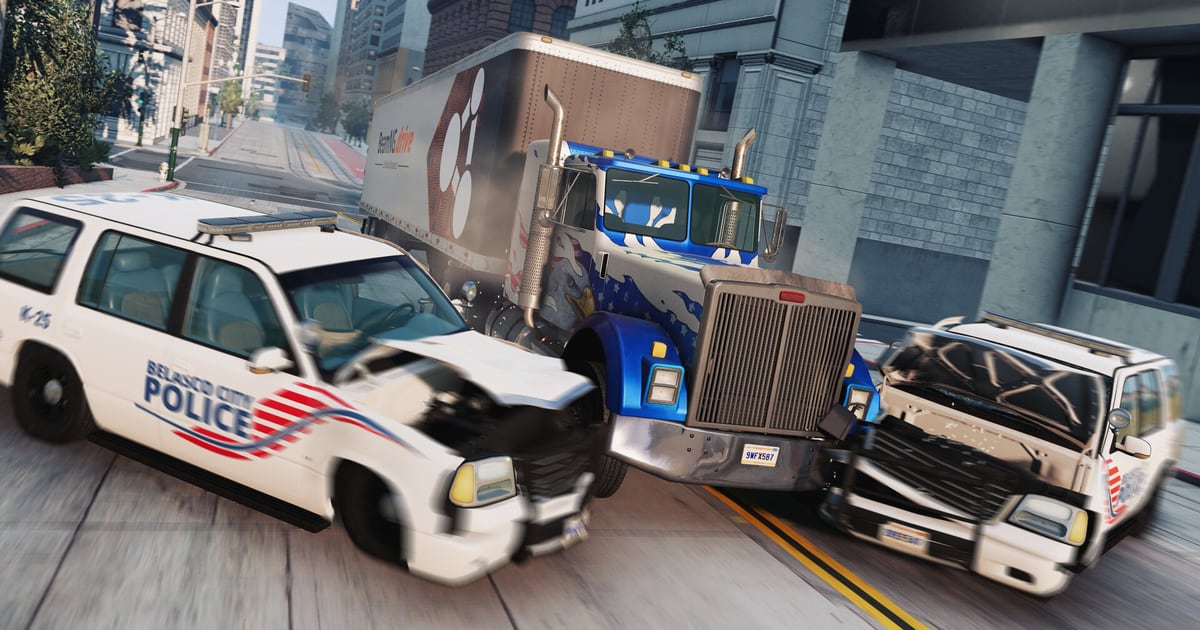
Career mode is the one part of BeamNG.drive where the crash is not the point. Everywhere else a wreck is the content; in career it is an invoice, itemised across the same node-and-beam body that makes the wreck look right. The rules that set the bill have been replaced twice in the last year, which is why most career advice online is wrong.
This guide is written against v0.40.4, published 29 October 2026, the newest release note on BeamNG’s news index when this was written, and it assumes the PC branch Steam serves today. It is a companion to the v0.39 renderer and PS5 launch piece, which owns the graphics overhaul and the console launch and reasonably wrote that PC would reach 0.40 “around” 19 October 2026 — it did, with 0.40.4 ten days later. What that piece did not cover is the money — which jobs come first, what repairs do to a car’s value, and how the insurance model that 0.37 deleted and 0.38 restored now bills you.
What this covers: career mode’s economy in v0.40.4 — the four career paths and their job types, the 0.38 insurance model (classes, providers, 100 km premiums, Driver Score), and the documented ways damage becomes a bill. Why it matters: the insurance system has been made complex, simplified, and re-complicated since April 2024, so a guide written against the wrong regime gives exactly inverted advice — and no patch note I fetched publishes a payout, premium or part price to check it against. Who should care: anyone starting a fresh career profile, and anyone running one on advice written before 10 December 2025.
Career mode’s rules changed under the guides
BeamNG opened career mode as an “Early Preview” in the v0.32 notes (16 April 2024) and kept that label through 0.39; the 0.40 notes (19 October 2026) read simply “Career Mode”. No fetched page announces the mode as finished, and the 0.39 devblog still called it “Career Mode (WIP)”, so treat the dropped label as framing. The last explicit caveat in a patch note is 0.35’s: “Career gameplay systems are still under active development. Balancing, progression speed, and challenge content are subject to frequent updates.”
| Version | Date | What it did to the career economy |
|---|---|---|
| 0.32 | 16 Apr 2024 | Early Preview begins: milestones, vehicle and trailer deliveries, parcel rewards adjusted |
| 0.33 | 18 Sep 2024 | Material Deliveries gated at Delivery Skill 5; organizations, reputation, loaner vehicles; repair time counts while career is closed |
| 0.34 | 10 Dec 2024 | Damaged vehicles worth less; Series system added |
| 0.35 | 2 Apr 2025 | Delivery gameplay becomes Logistics; four Career Paths replace branches; Performance Index, career-only |
| 0.36 | 17 Jun 2025 | Selling system with offers; unpainted and repeatedly repaired parts lower value |
| 0.37 | 16 Sep 2025 | Insurance simplified — “only the insurance score remains”, setting the repair deductible |
| 0.38 | 10 Dec 2025 | Insurance re-complicated — three classes, three providers each, premiums per 100 km, Driver Score; cargo parking bonus and penalty |
| 0.39 | 29 Jul 2026 | Two start modes; multiple manual saves; taxis with fares; insurance save bug fixed |
| 0.40 | 19 Oct 2026 | Insurance and Repair become full screens; shared shopping cart; test-drive damage liability explicit |
| 0.40.4 | 29 Oct 2026 | Career freeze when installing parts fixed; potential fix for part conditions blocking a save |
The 0.37 → 0.38 reversal is what dates a guide fastest. September 2025’s notes said the player “doesn’t have to buy specific insurance tiers, tweak insurance perks, or worry about renewing their plan”, with only a score moving the deductible. Twelve weeks later BeamNG “decided to re-introduce a more complex and realistic insurance system, while keeping its intricate mechanism optional for the non-interested players”. Nothing in 0.39, 0.40 or 0.40.4 reverses that: 0.39 only fixes a bug that could “corrupt a save”, and 0.40 only moves insurance to “a full screen, with a list of policies and their details side by side”. The 0.38 model is the live one, so advice to ignore insurance tiers is a year out of date.
The work is organised in paths, not contracts
First honest limitation: no patch note I fetched uses the word “contract”. BeamNG’s notes describe deliveries, missions, challenges, series and milestones. If a guide sells you “contract types” with figures attached, it is paraphrasing or inventing — I found no published payout, premium or part price to check such a list against.
What the notes do document is structure. In 0.35, branches became four Career Paths: Apex Performance Metrics (APM), “the premier test-driving career path — structured, professional vehicle evaluations”; Belasco Motorsports Racing Association (BMRA), covering time trials, AI races, drag racing and the drift series; Logistics, “formerly delivery gameplay — now a dedicated path for commercial driving and cargo hauling”; and Freestyle, the sandbox of stunts, Barrel Knocker, police chases and evasions.
Logistics is where a new profile earns, and its skills are gated. 0.38 added a tutorial requiring you to “deliver a tutorial package and a tutorial vehicle before unlocking Parcel Delivery and Car Jockey”, while Material Deliveries “Unlocks on Delivery Skill lvl 5” (0.33) and needs “a special container (Fluid Tank or Aggregate Box)”.
| Job family | Gate | What the notes say about terms | Damage exposure |
|---|---|---|---|
| Parcel Delivery | Tutorial package delivery (0.38) | Parcel reward formula “adjusted” in 0.32; no figure published | Light cargo, but a bad drop takes a parking penalty |
| Car Jockey | Tutorial vehicle delivery (0.38) | Reward balancing revisited in 0.33; no figure published | Someone else’s car, and you may not own the parts |
| Materials | Delivery Skill level 5 (0.33) | Fluid Tank or Aggregate Box required; container naming reworked in 0.39 for career variants | Heavy mass, long stopping distances |
| Vehicle and trailer deliveries | Core gameplay from 0.32 | “bringing them safely to their destination”; liability unstated | Coupling, reversing, shifting loads |
| Loaner vehicles | Skill and reputation per organization (0.33) | “Higher reputation” unlocks “better vehicles” | Borrowed hardware you cannot sell to fund its repair |
Reputation is a payment multiplier: 0.33 states “Higher reputation will give you improved rewards and can unlock loaner vehicles.” And 0.40 moved every Italian trucking mission onto Cherrier Percheron configurations — a 12.8 L I6 of 310 to 500 hp, 12-speed manual or 7-speed automatic. Heavy freight now asks for a semi: a capital decision, not a starter job.
Two ways to start, and what each one costs you
Since 0.39, profile creation asks you to pick a start mode.
| Start mode | What it does | What the notes do not say |
|---|---|---|
| APM Onboarding | “Complete introductory assessments and get to know Apex Performance Metrics” | Whether the assessments pay anything |
| Open World | “Skip the onboarding, start directly by buying your first car” | What balance you start with, or whether skipped assessments are lost |
The choice is about the evaluation content, not a head start. The notes hint which to pick when the ledger matters: Open World drops you into the purchase, where 0.37’s negotiation applies — private sellers with “an interactive offer system that reacts to both market value and seller patience”, and “each counteroffer dynamically updates based on how far your bid strays from the seller’s asking price”. Negotiation is a lever on opening capital.
The insurance model as written, and what it charges for
The 0.38 model is in force, and every line below is a decision a starter profile gets wrong.
| Element | What the 0.38 notes state | What it means for a fresh profile |
|---|---|---|
| Class | “Daily driver” for casual vehicles, “Prestige” for exotic vehicles, “Commercial” for trucks, buses and other commercial vehicles | The car sets the class, so Prestige means Prestige running costs |
| Providers | Three per class, with perks including “refueling discounts, free roadside assistances, cheaper repairs, cheaper premium” | Not equivalent; choosing on premium alone ignores repairs and fuel |
| Premium | Paid “every 100 kilometers of driving under one insurance provider”, pooled: two cars at 50 km and 51 km on one provider trigger it | A car you barely drive still feeds the meter if it shares a provider |
| Scaling | “The higher the total cost of the insured vehicles under a specific provider is - the higher the premium will be” | One expensive car raises the whole pool’s premiums |
| Group discount | “Multi-vehicle group discounts” tiers are reached by insuring more expensive vehicles under one provider, lowering its premiums | Discount and scaling pull against each other |
| Driver Score | “one value from 0 to 100, shared across all providers”, which “directly affects the Premium”; falls with each claim, recovers without one | Claims tax every future premium, even when insurance pays |
| Coverage | You can “customize the coverage options of their vehicle policy, or the provider’s coverage” up or down | Lowering it is available, and right on a beater |
| Uninsured | An uninsured vehicle “will not trigger any premium payments, will not benefit from any perks, and the player will have to cover the full cost of repairs” | Real strategy on a cheap car: self-insure and own the bill |
Premiums accrue per provider per 100 km, not per car, so six cheap cars pay premiums on six cars’ worth of insured value however few kilometres each covers. The 0.40 screen that lists policies side by side is the one to open before buying a fourth car.
One caution from outside the notes: a player bug report from 23 December 2024 describes insurance bought after the fact being charged without clearing an “Insurance Required” state. It predates both the 0.37 simplification and the 0.38 rewrite, and I could not confirm it still reproduces in 0.40.4 — history, not current behaviour, but a reason to buy the policy at the point of sale.
Where the soft body turns into a bill
The damage you pay for is not a health bar. In the PS5 announcement post, CEO Thomas Fischer describes “every component of the vehicle” as “simulated individually as a network of nodes and beams that can flex under load, deform, or even break outright when pushed too far”, with physics updating “at a rate of 2kHz”. That is why repairs are priced part by part: the vehicle is a list of parts, each of which can be individually bent.
Damage lowers value before you sell. Since 0.34, damaged vehicles are worth less regardless of repair cost.
Repairs themselves cost value. In 0.36, “Unpainted parts (like after a repair) will now lower the vehicles’ value” and “Repeatedly repairing parts will now lower the value with each repair”. The trap for anyone who fixes every scuff: a car you mean to sell is often better sold bent.
Time is a cost, not a pause. 0.33 states “The waiting time when repairing your vehicle now keeps counting even when career is not active”, and added a function “for expediting the standard repair”. By 0.40 the repair screen had moved to the pause-menu layout and an “instant repair” navigation bug was being fixed. No published expediting price exists in my sources, so I quote none.
Test drives carry liability. 0.40 made a warning explicit: “You damaged the vehicle, you will have to pay if you don’t buy it”, shown during the drive and in the purchase UI. A test drive is a financial exposure, and 0.39’s save-corruption bug lived in that seam.
0.40 also fixed “incorrect cost of some parts in career mode”, and 0.40.4 added “a potential fix for broken vehicle part conditions that can prevent the save from loading” — part pricing has been wrong in a live build this month.
A starting routine that survives the numbers
No source I fetched publishes a payout figure, so this is a decision order rather than a shopping list.
- Open World if you are optimising, APM Onboarding if you are learning. Negotiation on the first purchase is documented; the assessments have no documented payout.
- Buy one car you can afford to write off. The car sets the insurance class, so Prestige means Prestige premiums. Weigh a repair bill against the premium per 100 km — only one side is visible in the UI.
- Choose insurance or self-insurance per car. Uninsured is a documented state with a documented consequence: full repair cost. Fine on a cheap car, not on a commercial vehicle.
- Run the tutorial deliveries immediately. Parcel Delivery and Car Jockey stay locked until you do, so “easy starter jobs” advice assumes you cleared that gate.
- Do not repair a car you plan to sell. Repeated repairs and unpainted parts both cut value.
- Deliver the parking. Since 0.38, correct parking pays “bonus money and rewards” and a bad job produces “a penalty instead” — the cheapest money in the mode.
- Save before buying hardware. 0.39 added multiple manual saves; 0.40.4 is still fixing part conditions that can stop a save loading.
For the same economy-first discipline applied to a different SIM, the Frostpunk 2 fuel chain breakdown works out what the system charges before you spend.
What is still unconfirmed
No numbers. No payout, premium, deductible, part price or starting balance appears in any page I fetched. If a guide hands you figures, ask which build it was written for.
Career on PS5. The PS5 version launched with 0.40 on 19 October 2026, and 0.40 reworked “many career screens for controller use”, which implies career is playable there. No fetched page says so in those words, so treat it as inference. The PS5 launch coverage documents what the console build shipped without — mods and VR at launch — and says nothing about career.
Cross-platform saves. 0.39 added multiple manual saves per profile; whether one moves between PC and PS5 is not stated anywhere I read.
The mode is also, by BeamNG’s own wording through 0.39, unfinished. Plan for the rules to move again — and when they do, the patch note is the only guide worth reading.