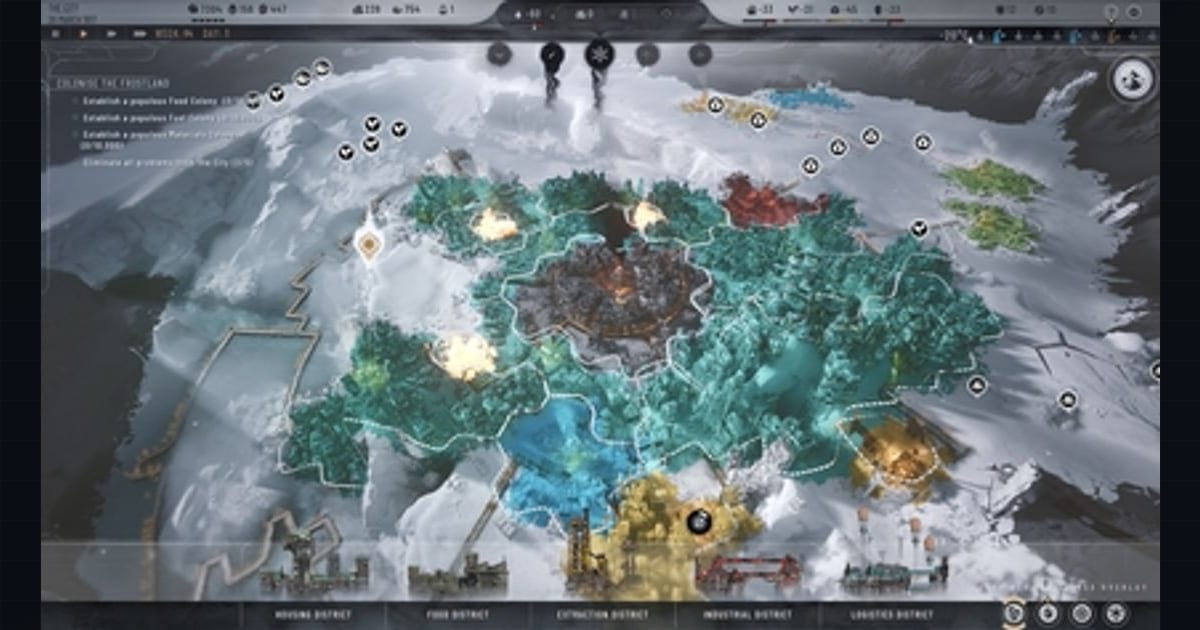
Frostpunk 2’s economy runs on a chain that is longer and more fragile than the original game’s. Raw deposits feed extraction districts, extraction feeds processing, processing feeds stockpiles, and stockpiles feed the city’s heat and consumption needs. Break one link — usually fuel — and the whole chain reverses on itself: cold drives sickness, sickness removes workforce, missing workforce cuts extraction, and the city spirals in two or three crises flat. This guide maps the full extraction-to-stockpile flow, the conversion ratios that matter, and the stockpile math that keeps a city alive through a Frostbreak or Whiteout.
What it covers: The extraction-to-stockpile chain — conversion ratios and the fuel math that survives a Whiteout. Why it matters: Break one link, usually fuel, and the whole chain reverses within two or three crises. Who should pick this: Players whose cities spiral into fuel-death loops.
The Resource Pipeline At a Glance
Frostpunk 2 collapses the original’s single-building economy into districts placed on deposits or in zones. The pipeline has four stages:
- Deposits — finite or renewable nodes on the map (coal seams, oil fields, frozen forests, fishing waters, material outcrops).
- Extraction districts — placed on a deposit; consume workforce and heat, produce raw resources.
- Processing districts — convert raw into refined goods (oil → fuel, raw food → rations, materials → goods/prefabs).
- Stockpiles & storage — limited-capacity buffers that absorb output and feed downstream consumption (the Generator, housing heat, market goods).
The critical design choice versus Frostpunk 1: extraction and processing are now physically separated and workforce-balanced independently. You can’t just plop a coal mine next to the Generator and call it done. Every district draws from your shared workforce pool, and every district produces into a stockpile that has a hard ceiling.
Extraction Districts: What You Mine and Where
Primary Deposit Types
| Deposit | Raw Output | Extracted By | Notes |
|---|---|---|---|
| Coal seam | Coal | Mining/Extraction district | Burnable directly in the Generator; lower energy density than oil. |
| Oil field | Oil | Oil extraction district | Primary late-game fuel; must be refined before efficient use. |
| Frozen forest | Wood/Sawlogs | Forestry district | Feeds the materials chain; finite without replanting or deep cores. |
| Fishing waters | Raw fish | Fishery district | Renewable food source; seasonal yield varies. |
| Material outcrop | Raw materials | Extraction district | Feeds goods and prefab production. |
Deep versions of most deposits exist and require a Core to unlock. Cores are the rarest strategic resource in the game — you get a small number from exploration and story events, and spending one on a deep extraction extension permanently commits it. The general rule: never spend a Core on deep extraction of a deposit you haven’t already depleted the shallow layer of, unless a crisis forces it.
Workforce Is the Real Constraint
Every extraction district has a workforce requirement that scales with its size (number of modules/extensions). Your workforce pool is population minus the sick, the dead, and those assigned to non-productive roles (guards, delegates’ staff, etc.). The death spiral usually starts here: a cold snap spikes sickness, sickness removes workers, and the first districts to go under are extraction — because they’re the ones farthest from the heated core and often the last to get heatstamps invested in their insulation.
Build order rule of thumb: over-provision workforce to extraction early, then trim as you add housing and processing. An extraction district running at partial staffing produces proportionally less output, and under-staffed extraction is the single most common cause of a surprise stockpile crash.
Processing: Conversion Ratios That Decide Games
Raw resources are not directly consumable in most cases. Processing districts convert them:
- Oil → Fuel. Oil extraction yields crude; a fuel refinery (industrial district) converts it to Generator-ready fuel. Fuel has higher energy value per unit than raw coal, so a city that transitions from coal-burning to oil-refining can run the same Generator output on fewer extraction workers — but only if the refinery is built and staffed before the coal seam runs dry.
- Raw food → Rations. Fisheries and foragers produce raw food; a food-processing district (kitchen/mess hall) converts it to rations the population can actually eat. Stockpiling raw food without enough processing throughput wastes yield — the raw stockpile hits its ceiling and further extraction output is lost.
- Materials → Goods & Prefabs. The industrial chain splits: materials can go to a goods factory (consumer products that raise population satisfaction and reduce unrest) or to prefab fabrication (construction modules used to build new districts and extensions). Prefabs are the bottleneck on expansion — you cannot place a new district without prefab stock, and prefab production competes with goods production for the same material input.
The Conversion Tax
Every processing step loses some input to overhead — there is no 1:1 raw-to-refined ratio. This means a city that over-processes (too many refineries, not enough extraction) burns through raw stock faster than it can replace it, while a city that under-processes (lots of extraction, one refinery) fills its raw stockpile ceiling and wastes extraction output. The goal is to balance throughput, not maximize either end.
Stockpiles: The Buffer That Saves or Kills You
Storage Ceilings
Each resource has a stockpile ceiling. When the ceiling is hit, further production is wasted — the district keeps consuming workforce and heat but outputs nothing. This is silent: there’s no alarm for “your coal stockpile is full and you’re throwing away output,” only the stockpile number sitting at max. The first time most players notice is when a crisis hits and the buffer that should have been twice as large is exactly at cap.
You raise ceilings by building storage districts/warehouses or by researching stockpile extensions. Storage is cheap in materials but costs a district slot and workforce, so players tend to under-build it. Don’t. A city that can hold two crises’ worth of fuel and food survives a Frostbreak; a city that can hold half a crisis’ worth doesn’t.
The Fuel Stockpile Is Sacred
Fuel (coal or refined oil) feeds the Generator, and the Generator feeds every heat zone in the city. The single most reliable predictor of a death spiral is fuel stockpile trend over time, not the absolute number. If your fuel stockpile is trending down across three or four non-crisis days, you are already in the spiral — you just don’t feel it yet because the buffer is absorbing the deficit.
Diagnostic: open the resource overview and read the net fuel flow (production minus consumption). A positive net flow with a half-full stockpile is fine. A negative net flow with a full stockpile is a ticking bomb. A negative net flow with a low stockpile is an emergency — cut non-essential heat, shift workforce to extraction, and queue a fuel refinery if you don’t have one.
Avoiding the Coal/Oil Death Spiral
The classic death spiral follows a predictable sequence. Recognizing it early is the whole game.
- Coal seam depletion. The starting coal deposit is finite. If you haven’t scouted and secured a second fuel source (oil field or second coal seam) before the first hits ~30% remaining, you’re already behind.
- Refinery lag. You find oil, but you haven’t built the refinery yet. Coal runs out before the refinery comes online. The Generator drops to low power.
- Cold spike. Low Generator output means housing zones drop below the frost threshold. Sickness rises sharply.
- Workforce collapse. Sick workers don’t extract. Extraction output falls, which cuts the fuel supply further, which deepens the cold. This is the feedback loop that kills the city — usually within two in-game crises.
- Unrest and factionfaction. An in-game group or nation players can align with or fight against, with its own goals and reputation system. pressure. Cold and hunger drive unrest; factions demand action in the council; passing emergency laws costs heatstamps you need for infrastructure. Political collapse compounds the economic one.
Prevention Checklist
- Scout fuel early. Send a logistics expedition to locate a second fuel deposit within the first third of the scenario. Do not wait for the first seam to deplete.
- Build the refinery before you need it. A fuel refinery sitting idle is not wasted — it’s insurance. The prefab and material cost is recoverable; a two-day Generator outage is not.
- Maintain a fuel buffer equal to your peak consumption × crisis duration. If a Whiteout or Frostbreak lasts N days at peak burn, your floor stockpile should be that number. If you don’t know N, aim for at least several days of peak burn.
- Keep extraction over-staffed relative to processing. It’s easier to throttle a refinery than to emergency-staff a mine. Raw buffer is more flexible than refined buffer because raw can feed multiple processing paths.
- Never let the fuel stockpile trend negative on a non-crisis day. If it does, treat it as a fire alarm — fix the flow before the next crisis compounds it.
Heatstamps and the Currency Layer
Heatstamps are the civic currency used to pass laws and fund certain constructions. They’re generated passively and through specific council actions, and they’re not part of the physical resource chain — but they gate the laws that let you raise stockpile ceilings, mandate emergency extraction, or redirect workforce. Running out of heatstamps during a fuel crisis means you can’t pass the emergency extraction law that would save you. Budget heatstamps the same way you budget fuel: keep a reserve for the crisis you haven’t seen yet.
Glossary
- Deposit — a map node that yields raw resources when an extraction district is placed on it.
- Extraction district — a placed zone that mines raw resources from a deposit, consuming workforce and heat.
- Processing district — a placed zone that converts raw resources into refined, consumable goods.
- Stockpile ceiling — the hard cap on stored units of a resource; production past the cap is wasted.
- Core — a rare strategic resource required for deep extraction extensions and advanced buildings.
- Prefab — a construction module produced from materials; required to place new districts.
- Heatstamp — the civic currency for laws and select constructions.
- Frostbreak — a ground-freezing event that halts new construction and can damage infrastructure.
- Whiteout — an extreme cold event that spikes Generator fuel demand and sickness.
Sources & further reading
- Frostpunk 2 official site — https://frostpunk2.com/
- Frostpunk 2 on Steam — https://store.steampowered.com/app/1601580/Frostpunk_2/
- Frostpunk Wiki (community) — https://frostpunk.fandom.com/wiki/Frostpunk_2
- 11 bit studios news — https://11bitstudios.com/
- Frostpunk 2 Wiki (community) — https://frostpunk-2.game-vault.net/
Next read
- For the politics layered on this economy, see Frostpunk 2: Factions, Delegates, and Law Chaining.
- All our coverage lives on the Frostpunk 2 hub.