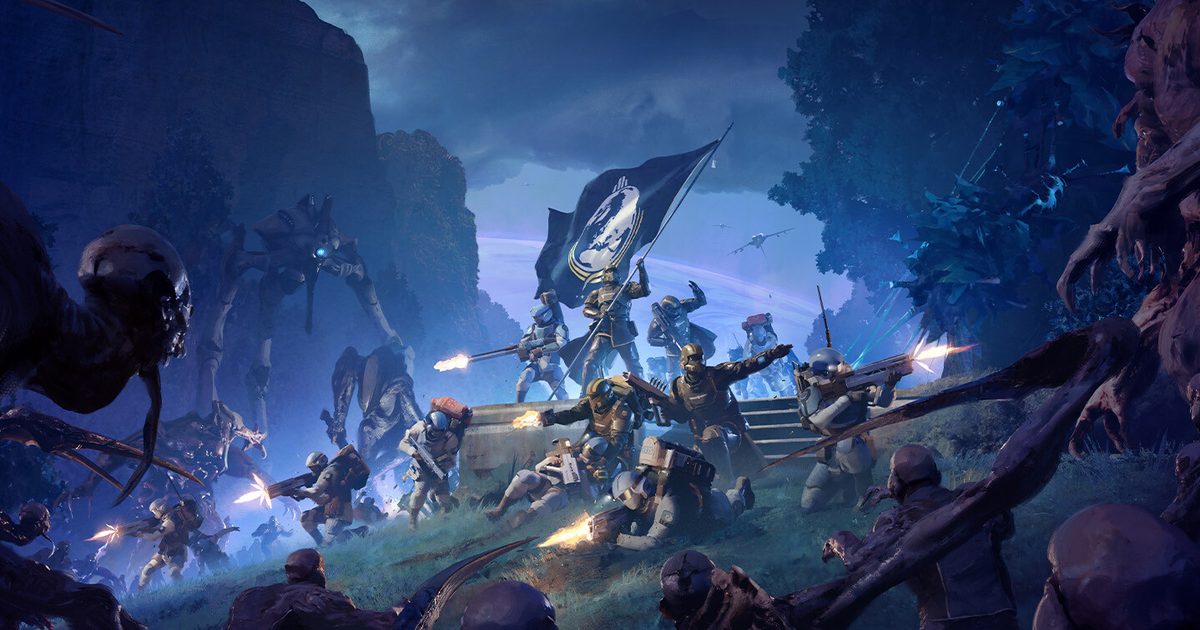
HELLDIVERS 2 sat 29th in the Steam most-played rollup we captured on 11 November 2026, with a listed peak of 31,828 in that snapshot. That is a game deep into its second year of live updates, which means the interesting question is no longer “what is in the new track” but “what do four people actually carry into a level 10 mission”.
Our October piece on the Scope of Authority warbond answered the purchase question: five weapons, two armour sets, one passive. This answers the loadout question underneath it.
What this is: a reference for the difficulty ladder, the four stratagem slots, and the armour-penetration rule that decides whether your squad can kill the thing in front of it.
Why it matters: difficulty 5 is not difficulty 10 with more enemies. Samples, modifiers, outpost types and the enemy mix all change, and with the mix so do the armour values you meet, so a loadout built for one tier can be unable to damage a target at the next.
What this is not: a tier list, and not a claim about what Arrowhead will do in Update 8.0. Where a number comes from a community wiki rather than Arrowhead, this piece says so.
Where the game stands in November 2026
Arrowhead’s November developer blog dates the current update plainly: “Our patches run roughly six weeks apart meaning Update 7.2 came on October 20 and the content is due to unfold over the next six weeks until Update 8.0 in early December.” The most recent build note in the game’s Steam feed is the hotfix titled “Devoid of Liberty: 7.2.3”, which opens: “Today’s hotfix tackles crash and bug fixes, as well as unblocking some cosmetic modifications.” So the advice below is written against the 7.2 line, with 8.0 still ahead.
The warbond ledger is larger than most returning players remember. The Helldivers wiki counts “All 26 Warbonds categorized and listed in chronological order”, splits them into Standard, Premium and Legendary, and notes that as of September 18 2026 the medal cost to max out every one of them is 18,522 medals. Scope of Authority was the October premium track; it is one line item in that list, not the loadout.
What difficulty actually changes
The ladder is ten levels, and the wiki states it directly: “a difficulty can be selected between level 1 Trivial and level 10 Super Helldive.” What most primers skip is that each step changes several unrelated systems at once — payout, samples, outpost weight, map size and the number of operation modifiers.
| Level | Name | Missions per operation | Medals, mission sequence (total) | Requisition and XP multiplier | What appears here first |
|---|---|---|---|---|---|
| 1 | Trivial | 1 | 1 (1) | +0% | No outposts; 250m map radius |
| 2 | Easy | 1 | 2 (2) | +0% | Outposts, optional objectives, 300m radius |
| 3 | Medium | 2 | 2 / 4 (6) | +25% | Medium outposts, 350m radius |
| 4 | Challenging | 2 | 3 / 5 (8) | +50% | Rare samples, heavy outposts, 400m radius |
| 5 | Hard | 3 | 4 / 6 / 8 (18) | +75% | First operation modifier |
| 6 | Extreme | 3 | 5 / 7 / 9 (21) | +100% | Super samples |
| 7 | Suicide Mission | 3 | 6 / 8 / 10 (24) | +150% | Factionfaction. An in-game group or nation players can align with or fight against, with its own goals and reputation system.-themed points of interest |
| 8 | Impossible | 3 | 7 / 10 / 12 (29) | +200% | Second operation modifier |
| 9 | Helldive | 3 | 8 / 11 / 14 (33) | +250% | — |
| 10 | Super Helldive | 3 | 9 / 12 / 15 (36) | +300% | Giant outposts |
Two lines in that table do the most work for loadout planning. “Commons appear on all difficulties, while Rares first appear on Challenging, and Supers on Extreme difficulty” — so a squad farming upgrades is choosing a difficulty tier, not a map. And on pressure: “The frequency of enemy patrol being spawned increases alongside the difficulty. In relation, the frequency of DSS Eagle Strike and other tactical actions during missions decreases with increased difficulty.” More contacts, fewer free off-map answers.
The four slots and what each is for
“Helldivers can select up to four different stratagems when defining their loadout for a Mission.” Four slots, and the roster sorts them into four permit colours: Offensive (red), Supply (blue), Defensive (green) and Mission (yellow). Support weapons and backpacks both live under Supply, which is where the first real trade-off appears — a backpack-fed heavy weapon and a utility backpack compete for the same budget.
| Stratagem | Permit and slot it earns | Base cooldown | The problem it answers |
|---|---|---|---|
| Orbital Gatling Barrage | Offensive, orbital | 70s | Large groups of light enemies — Troopers, Scavengers, Voteless |
| Eagle 500kg Bomb | Offensive, Eagle | 15s | Single hardened targets; wiki files it at Anti-Tank III |
| Orbital Railcannon Strike | Offensive, orbital | 180s | Single massive targets — Bile Titans, Vox Engines, Harvesters |
| GR-8 Recoilless Rifle | Supply, support weapon | 480s | Large-to-massive enemies; crew-loadable by a second player |
| EAT-17 Expendable Anti-Tank | Supply, support weapon | 70s | The same job on a disposable tube you can re-drop |
| AC-8 Autocannon | Supply, support weapon | 480s | Heavy armour at range, at the cost of an ammo backpack |
| AMW-20 Apex | Supply, support weapon | 480s | Anti-Tank-labelled precision after the 7.2.2 display fix |
| A/MG-43 Machine Gun Sentry | Defensive, sentry | 90s | Covering an angle no Helldiver can hold alone |
The wiki is explicit about the backpack cost: “Certain support weapons (such as the AC-8 Autocannon) require Helldivers to carry an ammunition backpack to reload the weapon,” and “It is only recommended to bring a backpack when a Helldiver is not already bringing a support weapon that requires a backpack for reloading.” A Guard Dog or a shield pack is not a free extra — in the backpack-fed case it is a fourth slot spent on nothing.
The anti-armour maths a squad has to cover
This is the part that decides missions, and it is three rules, not a spreadsheet. Every enemy part carries an armour value from 0 to 10; every weapon carries an armour-penetration value on the same scale. The wiki’s outcome table:
- Penetration greater than the part’s armour value: full damage, red hitmarker.
- Penetration equal to it: “the weapon deals 65% damage (White Hitmarker)”.
- Penetration less than it: “the weapon deals NO damage (Ricochet)”.
The equality case is the one squads get wrong. A weapon that exactly matches a target’s armour is not a clean answer — it is a 35% tax on every shot, permanently.
| Part armour value | Parts the wiki files there | AP tier needed for full damage | Examples at that AP tier |
|---|---|---|---|
| Medium | Devastator torso, Gunship, Hive Guard head and front legs | Heavy | Autocannon, Anti-Materiel Rifle, Heavy Machine Gun, Laser Cannon |
| Heavy | Bile Titan, Charger, Hulk, Impaler, Factory Strider head and legs | Anti-Tank I | Railgun, Eagle Strafing Run, Orbital Gatling Barrage, Anti-Tank Mines |
| Tank I | Annihilator Tank, Automaton Fabricator, Dropship, Leviathan | Anti-Tank II | EAT-17, Recoilless Rifle, Quasar Cannon, Commando, Orbital Laser |
| Tank II | Command Bunker, Hive Lord head and mandibles | Anti-Tank III | Eagle 500kg, Eagle Airstrike, Spear, Thermite, Orbital Railcannon |
Note the ordering: the Railgun is Anti-Tank I, one rung under the Recoilless Rifle at Anti-Tank II. Above Tank II the wiki files no enemy part at Tank III or Tank IV at all — only the Gazer Spire at Tank V and the Hive Lord’s crown plus the Illuminate Overship at Tank VI. Anti-Tank III therefore deals full penetration damage to every part the wiki lists through Tank II, including the Command Bunker and the Hive Lord’s head and mandibles — but it sits below those three Tank V and Tank VI exceptions, and the Eagle 500kg at Anti-Tank III does not reach them.
Penetration is only half of it. Damage splits into standard and durable values, and enemy parts have a durability percentage that decides the mix. The wiki’s formula is Standard × (1 − Durable%) + (Durable × Durable%), and its own worked example is worth repeating: the BR-14 Adjudicator carries 95 standard and 23 durable damage, so against a 30% durable part it deals 95 × 0.70 + 23 × 0.30 = 73.4, rounded down to 73.
That is the mechanic behind the Charger problem. “Charger butts are Unarmored, 950 hp and 80% durable” — so a high-standard, low-durable weapon is throwing most of its damage away on the one part it can always hit. Arrowhead’s own 7.2.2 notes show the same split being corrected on a live weapon: the SG-22 Bushwacker’s “correct values are Increased damage from 405 to 486, Increased durable damage from 108 to 135.”
One caution on the newest gear. Patch 7.2.2 states of the AMW-20 Apex: “Fixed, so it correctly displays armor penetration is ‘Anti-Tank’”, alongside “Decreased caliber from 60 to 20” and “Increased demolition strength to 30”. The same note fixes the LAS-44 Nova’s label. The patch does not print a tier numeral, and the wiki’s scale runs Anti-Tank I to VI, so read “Anti-Tank” as a band and not as a promise against a specific target.
What the three enemy factions ask of the slots
The wiki recognises “The four primary factions found in Helldivers 2 are the Terminids, the Automatons, the Illuminate, and the Federation of Super Earth” — three of them hostile. Each one invalidates a different lazy loadout.
Terminids “usually attack by swarming into melee range with acid projectiles as support”, and the wiki’s framing is that they “reward mobility and crowd management more than other factions by swarming the player”. A squad of four anti-tank tubes loses to a breach it cannot thin out.
Automatons field “heavily armored but slow moving infantry and vehicles supported by fragile light infantry”, and they “reward marksmanship more than other factions with weaker weak points and stronger armored areas”. This is the faction that makes the anti-armour table mandatory rather than optional.
Illuminate “make significant use of their ancient technology, employing energy shields, jet-packs, plasma weaponry, and drones”, and they “reward awareness more than other factions through their reinforcement mechanic”. Killing the caller matters more than killing the call, which prices area denial and fast-response stratagems over slow barrages.
What your own armour is doing
Armour choice is a survivability formula, not a costume. The wiki counts “a total of 32 light, 50 medium, and 31 heavy armors”, and gives the rule for ratings at or below 150: Damage taken = Attack Damage × (1.5 − Armor Rating ÷ 200).
Run the three archetypes through it. At 50 rating the multiplier is 1.5 − 0.25 = 1.25, so light armour takes 25% more damage. At 100 it is 1.00, baseline. At 150 it is 0.75 — heavy armour takes a quarter less. The same page prices the other side: Speed = 600 − Armor Rating, which is 550 for light, 500 for medium and 450 for heavy, and the wiki’s own summary is that light is “10% faster than Medium (100 AR) and 22% faster than Heavy (150 AR)”.
A four-slot template that covers the ladder
Our reading, built from the tiers and cooldowns above rather than from a tier list:
- One Anti-Tank II support weapon. Recoilless Rifle, Quasar Cannon or EAT-17. It answers Heavy and Tank I parts outright and Tank II at 65%.
- One Anti-Tank III or better offensive. Eagle 500kg or Orbital Railcannon. Anti-Tank III closes the Command Bunker and the Hive Lord’s head and mandibles outright; the Gazer Spire, the Hive Lord’s crown and the Illuminate Overship sit above it, so this slot does not answer those.
- One volume-clear. Orbital Gatling Barrage at a 70s base cooldown, or an Eagle cluster or strafing run, for the Terminid and Voteless problem the anti-armour slots cannot solve.
- One flexible slot. A sentry to hold an angle while the squad moves, or a backpack — but only if slot one is not already backpack-fed.
Two numbers keep that honest. The Eagle 500kg recharges on a 15s base cooldown while the Orbital Railcannon sits at 180s, so the cheap frequent answer and the expensive guaranteed answer are not interchangeable. And the EAT-17’s 70s cooldown means a disposable tube can be re-dropped far more often than a crew-served launcher, at the cost of needing a fresh call-in every time.
What this piece does not claim
Difficulty tuning, armour values and penetration displays all move between patches, and two of the numbers above moved as recently as 7.2.2. The ladder table, the stratagem cooldowns and the armour-value tiers here are read from the Helldivers wiki, a community source, not from an Arrowhead document — the wiki’s own damage section states its figures are “confirmed to be accurate as of Game Version 1.001.001”. Treat the tier assignments as the shape of the problem, and the in-game armoury as the authority on the build you are actually holding.