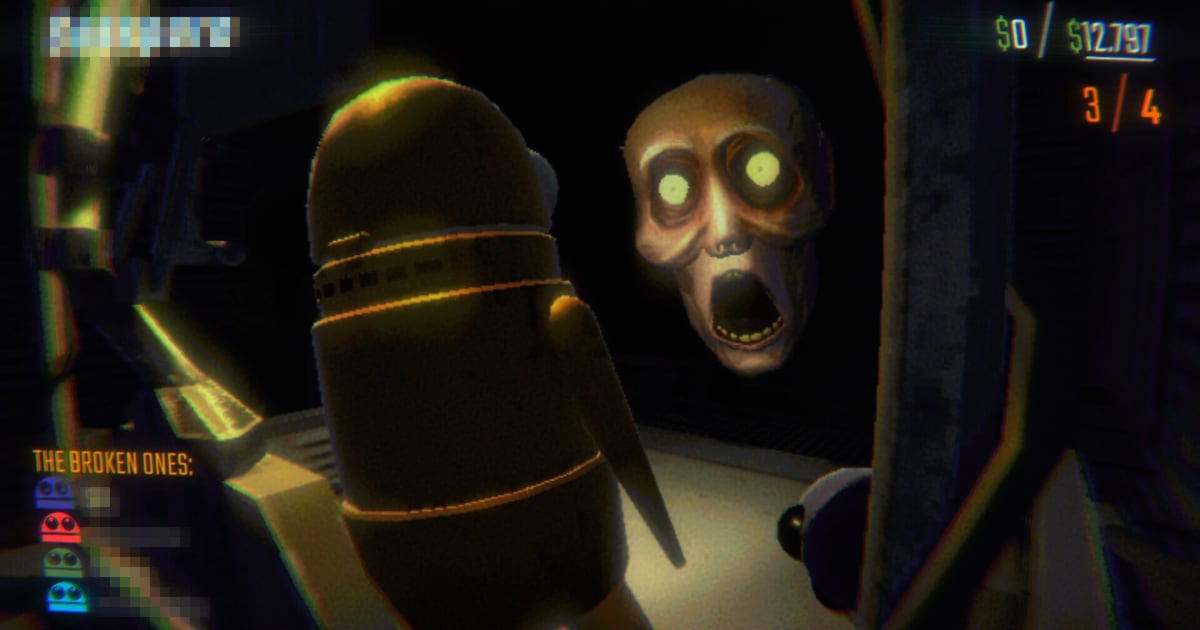
R.E.P.O. is a six-player co-op horror game about carrying heavy objects, and the object that matters most is the number printed on the extraction pad. semiwork pushed its fourth major update onto Steam today — v0.5.0, The Sunstone Update — which makes this a reasonable moment to write down what the extraction loop asks of a team, what the quota is and is not, and why the proximity voice chat is structural rather than decorative.
One caveat runs through the piece: R.E.P.O. is still in Early Access, semiwork documents mechanics through bullet-point patch notes rather than design write-ups, and the store page’s only support link is a Discord invite rather than a wiki or knowledge base. Where a rule comes from a player-written Steam guide rather than the developer, this article says so.
What this covers: the extraction loop as it stands in v0.5.0 — the quota gate at each extraction point, the physics handling that punishes a heavy haul, and the proximity voice design that the store page lists as a headline feature. Why it matters: the quota rules live in patch-note bullets and community guides, and both describe them only in passing; most disagreements about “what the quota resets” come from mixing level structure with run structure. Who should care: new six-player groups deciding how to split a haul, and returning players who last played before the Monster Update in October 2025.
R.E.P.O. in the store’s own terms
The listing is direct about the pitch: “An online co-op horror game featuring physics, proximity voice chat and scary monsters.” The longer description adds that you and up to five friends “extract valuable objects using your physics-based grabbing tool”, that “even the monsters are affected by Newton’s law of gravity”, and that upgrades are bought with cash the game labels SURPLUS.
| Field | Value | Where it comes from |
|---|---|---|
| Developer and publisher | semiwork, an independent studio based in Uppsala, Sweden | Steam store metadata; studio site |
| Release status | Released 26 Feb 2025, still tagged Early Access | Steam store page |
| Players | Up to 6 (you plus five) | Steam store description |
| Platform | Windows | Steam store page |
| Price | $9.99 list, with a 35% discount to $6.49 running at the time of writing | Steam appdetails API, US region |
| Latest patch | v0.5.0, The Sunstone Update, 29 Oct 2026 | Steam patch notes |
| Concurrent players | 49,071 when checked on 2026-10-29 | Steam player-count endpoint |
semiwork’s own site lists two games, R.E.P.O. and the roguelite VOIDIGO, and there is no developer blog beyond the Steam feed.
The loop, stage by stage
Every job has the same shape: leave the truck, find a cart, loot a building, and convert what survives the trip into money at an extraction point. Between levels you spend that money on upgrades in a shop run by a character the patch notes call the Shopkeeper. The store page frames the arrangement as working for “a mysterious computer intelligence”.
| Stage | What the game asks | Where the pressure comes from |
|---|---|---|
| Truck and start room | Leave the safe zone, collect the cart, find the first extraction point | Nothing yet — this is the only quiet minute you get |
| Looting | Grab, rotate and carry objects with the physics grabber | Monsters, darkness, and the value of what you are holding |
| Hauling | Push or drag the cart, or carry items by hand | Weight, corners, stairs, and impact damage |
| Extraction | Deposit valuables until the pad’s displayed value reaches the quota | Time, monster attention, and how much you overfilled the cart |
| Shop | Spend SURPLUS on upgrades and weapons | Upgrade stock limits and prices |
| Next level | Repeat with a higher quota and more extraction points | Everything above, scaled |
The looting stage is where the game’s identity sits. Objects are not inventory slots; they are rigid bodies with mass and fragility, and the store page’s own example is the range you will actually meet — “from heavy pianos to fragile ceramics”. A community beginner’s guide on Steam is explicit that slamming an item into a wall or dropping it “can damage it, significantly reducing its value”, and that items placed inside the cart are protected from impact damage. That one rule explains more about R.E.P.O. than any monster: the safest place for a valuable is a container the game lets you push, and pushing it takes both hands.
What the quota actually resets
The quota is a dollar target, not a kill count or a timer. A player-written Steam guide describes it as “the minimum dollar value of loot you must extract to successfully complete the level”, “displayed on the screen at each extraction point and in the top-right corner of your screen”; the Definitive Guide records the HUD detail separately — “the quota you need for the extraction point and the amount of extraction points is shown at the top right of your HUD”. That beginner’s guide also notes that partial deposits are kept: you can drop value on the pad, come back with more, and the point activates once the total is met.
Two details of that system are visible in semiwork’s own patch notes, which is what makes them worth trusting over guide text:
- A point has a “haul goal”, and it can be reached late. The v0.5.0 notes fix a money bag “not spawning when valuables were added after extraction started with the exact haul goal reached” — “haul goal” being semiwork’s own term for the quota at a given point.
- Valuables are consumed on extraction. The same notes fix “extracted valuables not always being destroyed”, so what you deposit does not come back.
The community guide adds two rules semiwork has not restated: only one extraction point can be active at a time, and money above the quota at a point is returned as a “Tax return” in the form of a money bag that must be physically carried to the remaining points. That turns a big first haul into cargo rather than profit.
What the quota resets, then, is the level’s contract, not your account: each new level issues a fresh target and a fresh set of points, while the SURPLUS you earned carries into the shop. The number of points scales by level, and the same guide tabulates it:
| Level | Extraction points required |
|---|---|
| 1 | 1 |
| 2–3 | 2 |
| 4–5 | 3 |
| 6–14 | 4 |
| 15+ | 5 |
Treat that table as the shape of the curve, not a schedule to plan against: it was written for the Monster Update, predates both the Cosmetic Update (v0.4.0) and today’s Sunstone Update, and semiwork’s notes never restate these figures. No source read here gives the dollar values, and no scaling formula has been published.
One bullet from v0.5.0 reads as a design statement rather than a bug fix: under balancing, “Valuable Soft Lock — If there aren’t enough valuables left in the level to complete extraction, new smaller valuables will now spawn a short distance away from players.” That is semiwork acknowledging a team could loot a level dry and still fall short of the goal — the quota was a hard gate with a possible dead end behind it.
Greed is priced in physics
Most extraction games punish greed with a timer or an inventory cap. R.E.P.O. punishes it with mass, fragility and the fact that both hands are already full. An item’s value is attached to its condition, condition is lost to impacts, and impacts come from carrying too much through geometry that was not designed for it. The cart is the answer — the same guide that warns about impact damage also notes the cart “has a built-in display that tracks the total value of all the items you place inside it”, which means the game hands you a running total against the quota on the object you are pushing. Overloading it costs mobility, and mobility is what you need when a monster notices the noise you are making.
The upgrade economy reinforces the same lesson. Strength is a purchasable stat, and two separate patches tune it rather than replace it: v0.3.0 fixed grabbed-item movement “degrading when strength exceeded 90”, and v0.5.0 made “held objects more stable at high strength”. The grabber is a physical tool with tolerances, not a magnet.
Death is the other greedy outcome, and it costs time: v0.4.4 added one second of invincibility after a revive “to prevent instant deaths”. Dead players are not idle, though, and that is the next section.
Proximity voice is the design
The store page lists “proximity voice chat” in the same sentence as physics and monsters, and the patch history shows semiwork treating voice as infrastructure rather than a chat toggle.
The clearest evidence is what the team did with dead players. With the Monster Update on 30 October 2025, semiwork added Death Head Possession, trailed in September 2025 as the answer to a long-standing request: “you’ll finally be able to communicate from spectator mode, possessing your death head to talk and interact with alive semibots.” The announcement is specific about the cost — you wait for a battery to charge, then take control of your head, and jumping while possessing it “drains more battery”. Voice is therefore a resource with a cooldown attached, and the dead are not silent, they are intermittent.
Today’s patch continues the thread. v0.5.0 reduced freezes when loading levels, “now allowing continuous microphone input between levels” — a fix that only matters if an unbroken voice channel is part of the intended experience — and lists “Voice Chat — various playback and reconnect fixes” beside the routine save-file and money-bag bugs.
The horror logic depends on voice being positional. The store page’s instructions end with a warning — “know when to stay quiet” — and the patch notes confirm enemies model hearing as a channel: v0.4.1 states “Item Staffs — Enemies can now hear them while charging or when used”, and v0.4.2 removed enemies’ ability to hear a fully charged staff while it sits idle. semiwork tunes what monsters hear with the same granularity it tunes damage.
What semiwork has not documented is that monsters react to voice chat itself. The store page does not say it and the patch notes never mention it, but the player-written Definitive Guide does: “Noise includes Sprinting, jumping, talking, or breaking valuables”, and “The Huntsman can hear talking or Text to speech so be quiet when he is near.” The safe reading is that proximity voice is a human-to-human channel whose tension comes from the difficulty of coordinating quietly — but a guide promising “don’t talk near monsters or they will hear you” is asserting something semiwork has not documented. The verifiable version is narrower: sound from items is heard, and the game tells you to stay quiet.
What v0.5.0 changed inside this loop
The Sunstone Update is the fourth major update by semiwork’s own count, and most of it lands on top of the loop rather than inside it:
- A new level, Sunstone Valley Resort, plus new rooms in four existing levels.
- One new enemy, Pony.
- New items: the Human Gun, the Human Adventure Cable and the Recharge Orb.
- Ten new cosmetics, an expressions wheel, gamepad support and localisation for 21 languages.
- A Shopkeeper interaction where you hold an item up to them “for a chance at a discount… or having the item destroyed”.
- A map that now “shows a shopping list of what’s currently at the extraction point while in the shop”, the most useful quality-of-life change for quota planning in the patch.
The two loop-level changes are the Valuable Soft Lock fix and the money-bag fix described above. Everything else is content, cosmetics or bug work, and none of it moves the quota.
What is confirmed, and what is not
Three things are absent from every primary source found here, and this article asserts none of them.
The total monster count is unpublished. v0.3.0 added “10 new enemies” as a headline item, v0.5.0 added Pony, and enemy names surface individually in patch notes — Elsa, Spewer, Headman, Rugrat, Mentalist, Bella, Trudge, Birthday Boy, Shadow Child, Bowtie, Chef, Peeper, Heart Hugger, Pony. Adding those up does not produce a trustworthy total, because patch notes only name enemies that needed a fix or an addition that week. Any guide quoting a fixed number is quoting a fan count.
The quota formula is unpublished, as covered above.
The 1.0 date is unpublished. A June 2026 devlog says the studio is “getting closer to the 1.0 Full Release”; a March 2026 Q&A puts achievements at 1.0 and says Steam Workshop support is “not currently planned”. Those are intentions, not a date.
For a new group the practical takeaway is that the quota is a floor and the cart is the ceiling. The team that fills the cart to the brim and sprints for the pad is playing the version of R.E.P.O. where physics decides the payout. If you want to see how another extraction game handles sound propagation and alert states, our ARC Raiders machine threat breakdown covers that side of the genre.