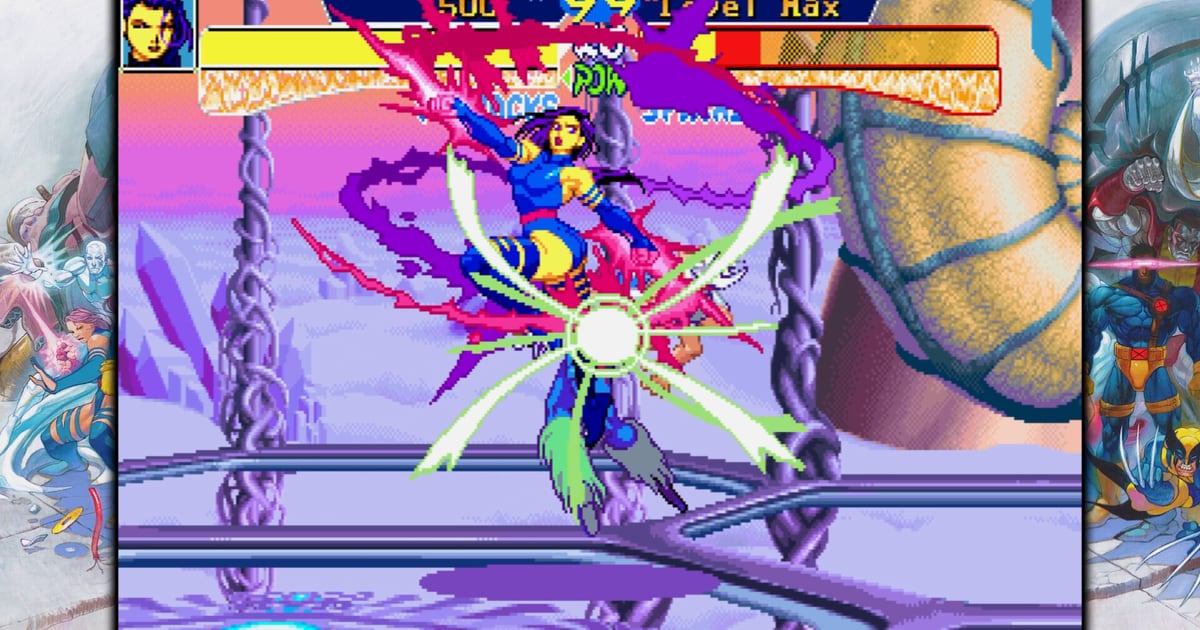
Capcom sells two retro compilations that run on what looks like the same shell, and they do not share a single game. Capcom Fighting Collection 2: Which Game to Start With already settled the boot order inside the eight-title box. This piece answers the other question — which of the two boxes to buy — using each package’s published lineup, its documented online and training features, its patch history, and Valve’s own Steam concurrency numbers for October 2026. Neither box is the “complete” one. They are complementary halves of Capcom’s arcade archive, priced $10 apart, and the arguments for each are more lopsided than the price gap suggests.
What this covers: A package-level comparison of MARVEL vs. CAPCOM Fighting Collection: Arcade Classics and Capcom Fighting Collection 2 — overlap, price, crossplay, co-op, training tools, patch history and 2026 Steam population — with no ranking of titles inside either lineup. Why it matters: The two boxes look interchangeable on a store page and are sold in the same seasonal sales. They differ on local player count, on what training mode shows you, on price per game, and by roughly two-to-one on measured PC concurrency. Who should care: Anyone holding one of these in a cart, anyone who bought one and assumed the other completes it, and anyone whose only impression of the Marvel box comes from launch-window reviews written before its offline Versus Mode existed.
The two boxes, field by field
Every row below is something Capcom or Valve states on a page, not an inference. Where the two feature pages word the same thing differently, the cell quotes each.
| MvC Fighting Collection: Arcade Classics | Capcom Fighting Collection 2 | |
|---|---|---|
| Titles | 7 (six versus fighters plus one beat ‘em up) | 8 (Capcom tags four 2D, four 3D) |
| US list price | $49.99 | $39.99 |
| Platforms | Switch, PS4, Xbox One, Steam | Switch, PS4, Xbox One, Steam |
| Local players | 1–2 | 1–4 |
| Online | up to 9 | up to 9 |
| Rollback netcode | yes, stated on the features page | yes, “All titles employ rollback netcode” |
| Crossplay | “Crossplay between platforms is not supported.” | “Crossplay between platforms is not supported.” |
| One-button specials | available, excluded from Ranked | available, excluded from Ranked |
| Training-mode hit boxes | hit boxes, under a “Fighting Games Only” heading | hit boxes, “2D titles only” |
| Offline Versus Mode | added April 16, 2025 | added May 16, 2025 |
| Internal resolution option | added April 16, 2025 | added May 16, 2025 (SFA3 Upper excluded) |
| Latest patch on Capcom’s page | June 12, 2025 | September 9, 2025 |
| Steam 30-day average concurrency | 64.08 | 33.02 |
The two “added” rows are the reason this article exists. Both boxes list a dedicated offline two-player Versus Mode under a post-launch “New Features” heading rather than in the launch feature set, which means a review written in the launch window described a different product from the one on sale today. More on that below.
The lineups do not overlap on a single title
This is checkable and worth checking before you buy twice. Capcom’s Game List for the Marvel box names seven arcade releases, each on its own page with an original release date and the ROM version being emulated: X-Men: Children of the Atom (December 1994, JAPAN/USA 950105), Marvel Super Heroes (September 1996, 951117), X-Men vs. Street Fighter (September 1996, 961023), Marvel Super Heroes vs. Street Fighter (March 1997, 970707), Marvel vs. Capcom: Clash of Super Heroes (January 1998, 980123), Marvel vs. Capcom 2: New Age of Heroes (February 2000, 000224), and The Punisher (1993, 930422).
The second box’s lineup page lists Capcom vs. SNK: Millennium Fight 2000 Pro, Capcom vs. SNK 2: Mark of the Millennium 2001, Capcom Fighting Evolution, Street Fighter Alpha 3 UPPER, Power Stone, Power Stone 2, Project Justice and Plasma Sword: Nightmare of Bilstein.
| Title | Original release | ROM version in the box | Lineup |
|---|---|---|---|
| The Punisher | 1993 | JAPAN/USA 930422 | Marvel box |
| X-Men: Children of the Atom | December 1994 | JAPAN/USA 950105 | Marvel box |
| Marvel Super Heroes | September 1996 | JAPAN/USA 951117 | Marvel box |
| X-Men vs. Street Fighter | September 1996 | JAPAN/USA 961023 | Marvel box |
| Marvel Super Heroes vs. Street Fighter | March 1997 | JAPAN/USA 970707 | Marvel box |
| Marvel vs. Capcom: Clash of Super Heroes | January 1998 | JAPAN/USA 980123 | Marvel box |
| Marvel vs. Capcom 2: New Age of Heroes | February 2000 | JAPAN/USA 000224 | Marvel box |
No entry from that table appears on the second box’s list, and none of the second box’s eight appears on the first’s. The split is thematic, not arbitrary: one box is the Marvel licence, the other is Capcom’s internal crossovers and 3D experiments. There is no double-dip risk, no “buy the new one and skip the old one”, and no upgrade path — if you want X-Men vs. Street Fighter, only one product sells it.
That table is the whole of what this piece says about individual titles; which of the seven to play first is a separate question.
Both do rollback, neither does crossplay
The single most consequential line on the two feature pages is identical, word for word: “Crossplay between platforms is not supported.” Both boxes carry it, so this is not a tiebreaker — it is a shared ceiling. It means the online population for either product is split four ways by platform before a single match is found, and the Switch, PlayStation and Xbox pools are invisible to anyone measuring from a PC. The mechanics underneath are covered in this site’s rollback netcode and latency explainer; what matters for the purchase is that the shell’s online menus are near-mirror images.
Both offer casual matches, ranked matches with League Points and leaderboards, custom matches with spectating, and a High Score Challenge with its own leaderboard. Both block one-button specials from ranked play — the one place either box protects the integrity of its ladder.
One asymmetry is documented. The Marvel box’s September 2024 patch notes state that “Matchmaking regional limits have been relaxed for online matches”, which tells you those limits existed at launch. The second box’s patch page does not carry an equivalent line.
What you can do with more than two people
Here the two products stop resembling each other. Capcom’s product information for the second box lists 1–4 players locally, up to 9 online, and its lineup page tags Power Stone, Power Stone 2, Project Justice and Plasma Sword as 3D. Its feature page adds a specific carve-out: “Power Stone 2’s 4-player matches can be played in Custom Match.” For a room with four controllers, this is the only one of the two boxes with anything to offer.
The Marvel box lists 1–2 players locally, up to 9 online. Its co-operative mode is qualified to a single title: the features page heads the section “The Punisher” and describes online co-op and spectating with players “dropping in and out as you please”, available from the Custom Match lobby, plus co-op High Score Challenge via Event Mode. The other six games are two-player competitive, full stop.
So “up to 9 online” means something different in each box. In the Marvel box it is a lobby size for head-to-head sets. In the second box it is a lobby size that includes a four-player arena brawler.
Training tools, where the cheaper box is thinner
Both training modes ship input displays, damage numbers and hit box displays — with one wording difference that changes what four games can show you. The second box’s feature page says “hit boxes (2D titles only)”, which excludes Power Stone, Power Stone 2, Project Justice and Plasma Sword from the hit box view. The Marvel box’s feature page lists “input displays, hit boxes, and damage numbers” with no scope note, but titles the whole section “Training Mode — Fighting Games Only”, which excludes The Punisher.
The second box has also had its lab tools expanded in a way the Marvel box’s patch history does not match. Its August 7, 2025 update added a Fixed 100% option to the Groove Gauge setting in both Capcom vs. SNK titles, a Fixed 100% option to the Super Combo Gauge in Alpha 3 Upper, dummy-behaviour settings including Damage Reduction and Timing Guard, five new recovery options, a Combo Route Display in Power Stone 2, and a Mode Select setting for Alpha 3 Upper with NORMAL, MAZI, SAIKYO and CLASSIC modes. That update also added an Additional Characters setting that unlocks Eagle, Maki, Yun and Ingrid — while stating those characters “will be disabled for casual and ranked matches”.
Across the three updates listed on the Marvel box’s patch page — September/October 2024, April 16 2025, June 12 2025 — none documents a training-mode addition. Its patch work is bug fixing and museum content, and one of those bug fixes is worth knowing about: the June 12, 2025 update changed Abyss’ Temple to appear first in player matches after fixing unintended behaviour on that stage during transitions.
If you plan to sit in training mode learning combos, the $39.99 box is the better instrument. That is the one row where the cheaper product wins outright.
Both boxes added an offline Versus Mode after launch
This is the trap for anyone reading 2024 coverage of the Marvel box. It launched on Steam on September 11, 2024 according to Valve’s app data, and its April 16, 2025 update is the one that “Added Versus Mode” across “All Titles” — described as “Fight in offline matches against a second player or the CPU”. Seven months of existence without a dedicated offline two-player mode.
The second box repeated the sequence in miniature. Valve lists its release as May 15, 2025, and Capcom’s patch page records a May 16, 2025 update adding Versus Mode to all titles, along with an internal resolution setting, a game restart button and a configurable menu-button hold. A one-day gap rather than a seven-month one.
The Marvel box’s April 2025 update carried two more items worth flagging for anyone who practises. It added version switching to X-Men vs. Street Fighter across versions 961023, 961004 and 960910 — and states that “961023 will be used for casual and ranked matches”, so two of the three versions you can select are not the build the ladder runs. It also added random character selection to Marvel vs. Capcom 2.
Who is actually in the lobby in 2026
Capcom’s own pages for both products publish no player numbers, and this article does not estimate any. What is measurable is Steam, via SteamCharts, which tracks Valve’s public concurrency feed. Read the two rows below as a single snapshot taken on 2 November 2026, not a trend.
| Measure (Steam only) | MvC Fighting Collection | Capcom Fighting Collection 2 |
|---|---|---|
| Average concurrent players, last 30 days | 64.08 | 33.02 |
| October 2026 monthly average | 63.63 | 32.51 |
| October 2026 peak | 143 | 72 |
| 24-hour peak at time of writing | 84 | 48 |
| All-time peak | 2,019 | 1,508 |
Two conclusions follow, and one caution. First, the Marvel box’s PC pool is roughly twice the size of the second box’s over the last 30 days — the one place where its $10 premium buys something you can measure. Second, both numbers are small in absolute terms: a few dozen players spread across seven or eight separate games and their modes. A collection-level average of 64 is not 64 people waiting in the game you want to play.
The caution: Steam is one of four platforms, neither product supports crossplay, and console pools are unmeasured here. If you play on PS4 or Switch, the PC ratio is evidence about the shape of demand and nothing more.
Patch recency is the other honest signal, and it points slightly the other way. Capcom’s last listed update for the Marvel box is June 12, 2025; for the second box it is September 9, 2025. As of this writing both pages are more than a year old, so neither product is in active feature development by the evidence available — but the newer box was maintained for three months longer.
The 18-game bundle is not the third option
Capcom’s product page for the second box advertises a Capcom Fighting Collection 1 & 2 Bundle: digital only, 18 games, made up of ten in the first collection and eight in the second, with the note that the bundle’s copy of the first “contains the same content as previous releases” and does not include that release’s original bonuses. The Marvel box is not in it. Buying the bundle gets you a large Capcom-internal archive, and still leaves X-Men vs. Street Fighter and Marvel vs. Capcom 2 unbought.
Choosing
- Buy the Marvel box first if you want the 2D versus lineage that runs from X-Men: Children of the Atom to Marvel vs. Capcom 2, whose page in the collection states a 56-character roster and 3-on-3 battles with a Team Hyper Combo system, and if a PC pool roughly twice the size of the alternative matters to you.
- Buy Capcom Fighting Collection 2 first if you need four players on one screen, if you want the 3D half, if you intend to spend your time in training mode, or if $10 is the deciding number.
- Buy both if you want a complete arcade archive — the overlap is zero, so nothing is wasted. That is also the only honest answer to “which one completes the other”.
- Buy neither for crossplay, and buy neither expecting a busy lobby in one specific game at an odd hour.
What this piece does not claim
No player numbers for PlayStation, Switch or Xbox appear here, because nobody publishes them, and no claim is made about whether a specific title’s ranked queue is alive in your region at your hour — neither Capcom page reports it. No game inside either lineup is ranked. The two prices are the US list figures Valve’s app data returned on 2 November 2026; both boxes rotate through Capcom’s discounts, which changes the arithmetic and nothing else.