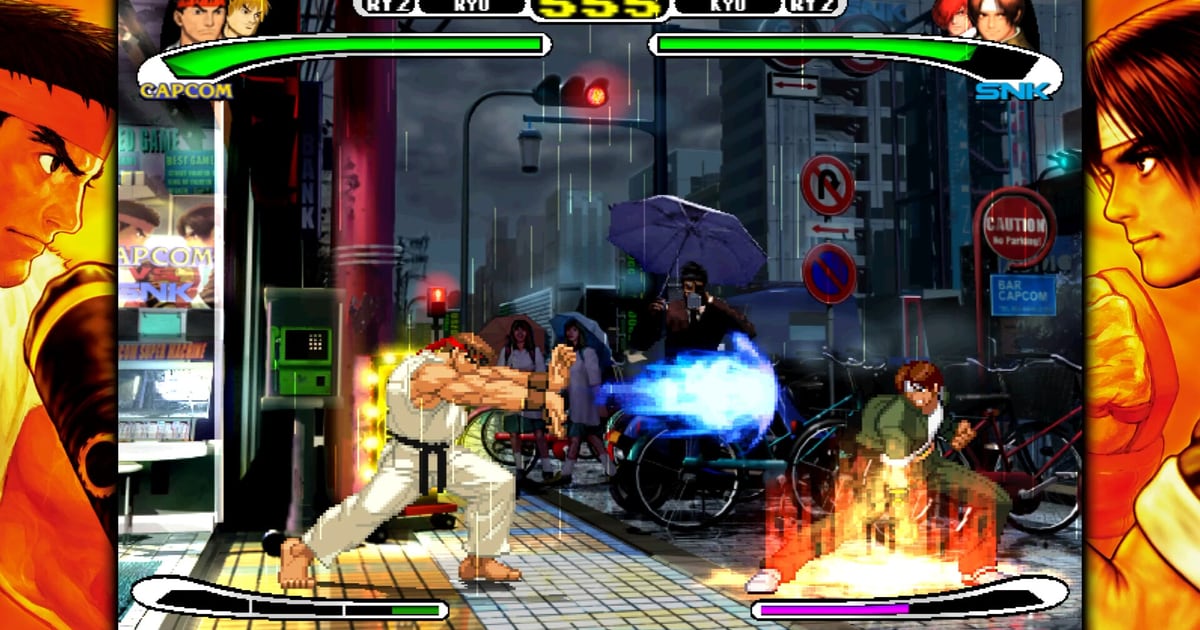
Eight games, one purchase, one price. The hard part of Capcom Fighting Collection 2 is not deciding whether to buy it — it is deciding which of the eight you boot on night one, because most expect you to understand a system designed for an arcade audience with a crowd watching and no tutorial.
This site has answered the forward-looking version of that question — which fighter to main across Street Fighter 6, Tekken 8 and Guilty Gear Strive in 2026 — and it has a vocabulary for the netcode underneath all of this. This piece answers the backward-looking question: how to read an eight-title archive whose games Capcom describes as being “over two decades” from their original releases, and whose new features sit on top of design decisions nobody has re-explained.
What this covers: The eight games actually inside Capcom Fighting Collection 2, what each one asks a new player to learn, and an honest boot order — with two of the eight named as museum pieces rather than mains. Why it matters: Several of these games front-load a system-selection screen before your first match. Pick the wrong door and your first hour is spent reading menus instead of playing, and the collection gives you no guide to which door is which. Who should care: Anyone who bought the collection on sale expecting a modern fighting game, anyone eyeing the $39.99 price or the 18-game bundle, and returning players who last touched these games in an arcade.
The eight games, and what Capcom says each one asks
This is not one game with eight modes. It is eight separate arcade releases sharing a shell, a museum and a lobby system, and Capcom’s game-spotlight press release describes each one differently. Those differences are what make the boot order matter.
| Game | Style | What Capcom’s spotlight says you have to learn | First-night verdict |
|---|---|---|---|
| Street Fighter Alpha 3 UPPER | 2D | Choose an “ism” — Capcom names X-ism for “mind games”, A-ism for “punishing techniques”, V-ism for “original combos” | Best 2D on-ramp in the package |
| Power Stone | 3D | Collect three Power Stones on the stage to transform, then land a Power Drive; the arena itself is ammunition — pillars, throwables, bazookas | Best couch on-ramp in the package |
| Power Stone 2 | 3D | Four-player battle royale where the interactive environment “shifts and changes” mid-match | Second pick, party-first |
| Project Justice | 3D | 3-on-3 team battles plus a cooperative Party-Up technique | Third pick, if teams appeal |
| Capcom vs. SNK: Millennium Fight 2000 Pro | 2D | A Groove system for playstyle plus a Ratio system to build teams of up to four characters | Second pick, steep |
| Capcom vs. SNK 2: Mark of the Millennium 2001 | 2D | Six Groove systems plus a Free Ratio System that assigns strength per team member | The deepest, and the last one you should touch |
| Capcom Fighting Evolution | 2D | A cast drawn from Street Fighter II, III, Alpha, Darkstalkers and Red Earth, each character carrying their home game’s combat system; Chain Combos and Ultimate Guard | Museum piece |
| Plasma Sword: Nightmare of Bilstein | 3D | Character-specific Plasma Fields to “briefly overwhelm” an opponent, and a Plasma Strike finisher | Museum piece |
Two labels in that table are mine, not Capcom’s: “on-ramp” and “museum piece” are editorial verdicts built from what the publisher documents, not from measured player numbers. The middle column is Capcom’s language, paraphrased.
What you are actually buying, in numbers
Capcom’s product page lists the package at $39.99 on Nintendo Switch, PlayStation 4, Xbox One and Steam, with local play for one to four players and up to nine online. Steam’s app data confirms the same price in USD, names CAPCOM Co., Ltd. as both developer and publisher, and lists May 15, 2025 as the release date — while Capcom’s 9 May 2025 Game Spotlights post announces that the collection “launches on May 16th, 2025”, and the “Available Now” post carries a May 16, 2025 date. Treat it as mid-May 2025 depending on storefront and region; Capcom’s pre-order terms run to a May 15 11:59 PM EDT cutoff, which sits near both dates without settling which one is right.
There is also a digital-only Capcom Fighting Collection 1 & 2 Bundle offering 18 games — ten in the first collection, eight in the second — though Capcom notes the bundle’s copy of the first does not carry that release’s original bonuses. Physical copies of the second exist for Switch and PS4 only, some including a 48-page Capcom vs. SNK comic while supplies last.
Why the obvious answer — “start with the best game” — is wrong
The deepest game in this box is Capcom vs. SNK 2: Capcom documents six Groove systems and a Free Ratio System for it alone. It is also the worst first pick, because it asks you to make two global decisions — a Groove and a team ratio — before you have any idea what either one does. That is a knowledge tax, not an execution tax: you cannot play your way out of it, because the game will not tell you what you declined.
The new features soften this, but for everyone equally. Capcom’s launch release says all eight titles have online play with rollback netcode, casual and ranked matches, lobbies, adjustable difficulty, training modes, and customisable controls including one-button specials. So “which game is easiest to execute” is no longer a useful question — the shell flattened execution across the board. What it did not flatten is how many decisions each game gates behind its character select screen. That is the axis the table above sorts on, and it produces a clean boot order.
Start here if you want to learn a 2D fighter: Street Fighter Alpha 3 UPPER
Alpha 3 Upper asks for one global decision — an ism — and Capcom frames the three it names as playstyle choices rather than resource management: X-ism for “mind games”, A-ism for “punishing techniques”, V-ism for “original combos”. Whichever you pick, the game underneath is a 2D fighter built on fundamentals that transfer to every other 2D game here and to every modern one: spacing, anti-airs, hit confirmation. One decision, then a skill tree that still applies.
It also gets the better lab tools. Capcom’s launch post is explicit that the 2D titles offer hit box displays; if your goal is to see why an attack whiffed, this is the half of the collection that will show you.
Be honest about the ceiling, though. Training mode is a tool for practising what you already know how to practise — Capcom documents a training mode, not a tutorial curriculum.
Start here if you want to play with people tonight: Power Stone
Capcom’s description of Power Stone opens with “the sky’s the limit in this intuitive 3D fighting game”, and the copy that follows is about objects and stage geometry — chucking props, launching kicks off pillars, firing bazookas, throwing opponents — with the loop stated plainly: collect three Power Stones that appear on the stage to transform, then finish with a Power Drive attack.
Read that against the Capcom vs. SNK 2 description — six Groove systems and a Free Ratio System — and the difference is in kind. One game’s headline systems are things you do to your opponent; the other’s are things you configure before you meet them. For a first session with four people in a room, that matters more than tier lists, and Steam lists shared and split-screen local play, so one copy covers the room.
Power Stone 2 is the second step, not the first: Capcom bills it as a four-player battle royale sequel where the environment “shifts and changes”, which is a great second hour and a chaotic first one. Learn the first game’s loop, then graduate to the version where the floor stops being trustworthy.
The Groove fighters: second games, not first ones
Capcom vs. SNK: Millennium Fight 2000 Pro and its sequel are the reason to buy the collection if you are a returning player, and the reason to hesitate if you are not. Capcom documents the first game’s two systems directly: a Groove system that lets you pick a playstyle “based on Capcom and SNK fighting games”, and a Ratio system that builds teams of up to four characters. The sequel expands the first system to six Grooves and replaces the second with a Free Ratio System where you assign each team member a strength value.
Both are excellent. Both are also games where a new player’s first ten matches are spent discovering that their configuration, not their execution, was the problem. If you have a friend who already plays, skip ahead — five minutes of explanation beats a week of solo guesswork. And note that neither Capcom page names the individual Grooves, so there is no official reading list to hand you.
Team games: Project Justice first, and only if you like homework
Project Justice is the Rival Schools sequel, and Capcom describes it as a 3D fighter built on 3-on-3 team battles with a cooperative Party-Up technique. Three characters means three move sets and a team-order question on top of them. A superb third pick, a poor first one for the same reason Tekken is: the movement system is the gate, and the team layer sits behind it.
The museum pieces: Plasma Sword and Capcom Fighting Evolution
Some of this collection is history rather than a game to commit to — not a knock on the curation.
Plasma Sword: Nightmare of Bilstein is the Star Gladiator sequel, and Capcom’s spotlight spends its word budget on narrative — a galactic hero with a plasma sword, Plasma Fields that “briefly overwhelm” opponents, a Plasma Strike finisher, and cutscenes the copy calls “not to be missed”. That describes an experience, not a competitive loop. Its mechanics are real and online play applies to it like everything else; there is simply less reason to invest a hundred hours here than in Alpha 3 or the Capcom vs. SNK pair.
Capcom Fighting Evolution is the more interesting museum piece because of its premise: a crossover where “each character represent[s] the combat system of their respective game”, drawing on Street Fighter II, III, Alpha, Darkstalkers and Red Earth. Five systems in one roster sounds generous and plays as a matchup-knowledge tax — you are learning which of five games your opponent’s character came from, not one game, and Capcom documents both Chain Combos and Ultimate Guard as things you must answer.
What I will not tell you is which of these two has a living online population. Capcom has published no player counts, and neither store page carries them. Before committing an evening, open a lobby and look — that costs nothing and settles a question no press release answers.
What the new features fix, and what they do not
Capcom’s launch release is specific about the shell, so it is worth tabulating rather than summarising.
| Feature | Scope Capcom documents | What it actually changes |
|---|---|---|
| Rollback netcode, ranked, casual, lobbies, spectate | All eight titles | You can play all eight online, not just the popular ones |
| Training mode | All eight titles | Practice exists everywhere; depth is not specified |
| Hit box display | Capcom scopes it to the 2D titles | Where it exists, you can see why an attack whiffed |
| One-button specials | Customisable controls across the collection | Execution barriers drop; decision load does not |
| Instant hidden characters | All titles | No unlock grind before you can lab your pick |
| Quick save in Arcade Mode | All titles | Single-player sessions survive a school run |
| Filters, wallpapers, display size, internal resolution | Presentation settings; resolution bump for 3D titles | Old sprites can be tuned; old geometry can be sharpened |
| Museum: 700+ art pieces, 300+ tracks, Shinkiro illustration | Collection-wide | The archive case is genuinely good |
| New “Ver. 2K25” music arrangements | Project Justice, Power Stone 2, Capcom vs. SNK 2 only | Three of eight games get a remixed soundtrack |
The gap in that table is the honest headline: none of these features re-teach an old game. They remove friction — no unlocks, no regional version split — but a Groove screen is still a Groove screen. If you want a fighting game that explains itself, the modern titles remain the better purchase; the accessibility comparison across Street Fighter 6, Tekken 8 and Mortal Kombat 1 shows how far the teaching layer has come since these games shipped.
One thing the sources do not state: crossplay. Neither Capcom’s product page nor the Steam listing commits to cross-platform matching between Switch, PS4, Xbox One and PC. Ask before buying a friend a copy.
The PC build, in one paragraph
Steam’s requirements are modest for games this age: 64-bit Windows 10 or 11, an Intel Core i5-4460 or AMD FX-8300, 4 GB of RAM, a GeForce GTX 760 with 2 GB or a Radeon R9 290x with 4 GB, DirectX 11 and 4 GB of storage. The recommended tier bumps the graphics card only — GTX 970 4 GB or RX 480 4 GB — and the notes recommend an Xinput-compatible controller. Broadband is a listed requirement rather than an option. Steam also lists full controller support, DualShock and DualSense support, Steam Cloud and Remote Play Together.
So: what do you boot first?
- Playing with people in the room tonight: Power Stone. The simplest documented objective in the box, and the collection supports four on one screen.
- Playing online solo, and you want the games to teach you something: Street Fighter Alpha 3 UPPER. One system decision, then fundamentals, plus the hit box display the 3D titles lack.
- You already know 2D fighters and want the deepest lab: Capcom vs. SNK 2, and budget your first week for reading, not playing.
- You want the cutscene spectacle: Plasma Sword, as a two-evening tour.
- You are buying for one specific old favourite: that is the correct reason to own this, and no boot order applies.
The collection is a shelf, not a ladder. Boot the game whose systems you can hold in your head on night one; the rest will still be there when you have room for a sixth Groove.