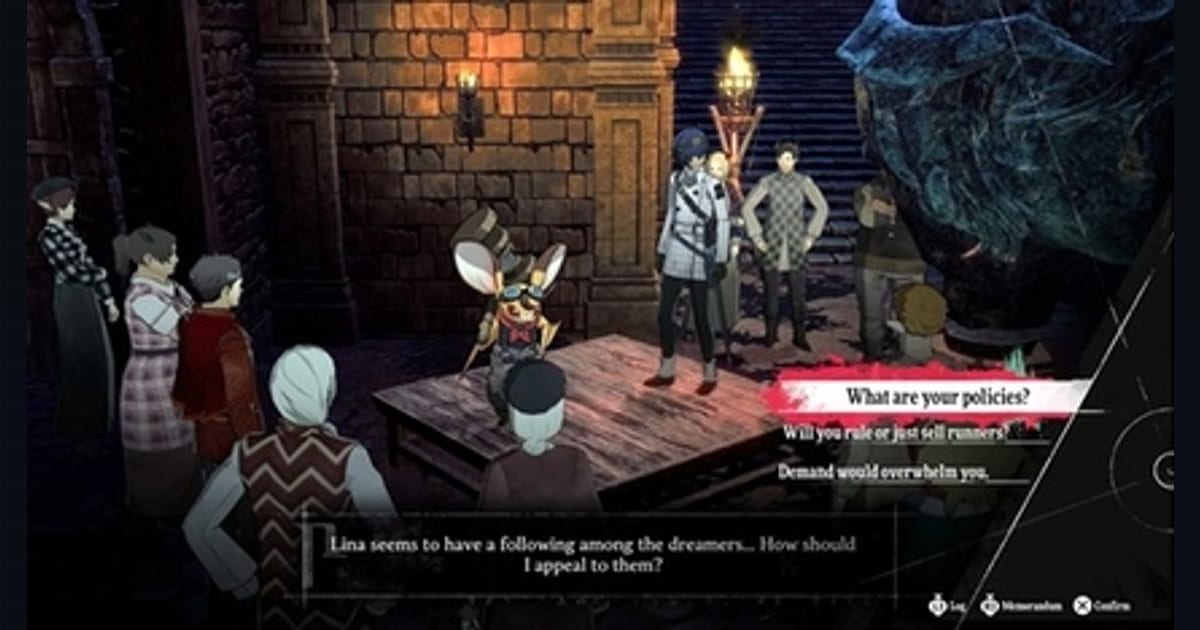
Studio Zero’s role-playing game Metaphor: ReFantazio is scheduled to launch on Nintendo Switch 2 on November 12, 2026. Originally published by Sega internationally and Atlus in Japan, the title first arrived on PlayStation 4, PlayStation 5, Windows, and Xbox Series X/S on October 11, 2024.
Release Timeline & Commercial Performance
Upon its initial launch in October 2024, Metaphor: ReFantazio sold one million copies on its first day across all available platforms. The game received widespread acclaim for its narrative, worldbuilding, and visuals, though it faced some criticism for technical issues at launch. It won Game Awards for Best Art Direction, Best Narrative, and Best Role-Playing Game, alongside the D.I.C.E. Award for Role-Playing Game of the Year and the Grand Prize at the 2025 Japan Game Awards.
Gameplay Systems & Archetypes
Metaphor: ReFantazio incorporates multiple systems previously used in Atlus titles like Persona and Shin Megami Tensei, blending dungeon crawling with social simulation. The game operates on a day-to-day calendar system tied to a day-night cycle and weather system. Time management is critical, as failing to complete major story events before specific deadlines results in a game over.
The social simulation features a “Follower” system, expanding on Persona’s Social Links. Players forge bonds with locals and party members to increase public favor in an in-game election. Ranking up followers unlocks various gameplay benefits. Players also build five “Royal Virtues”—Courage, Wisdom, Tolerance, Eloquence, and Imagination—through standard activities and side-quests.
Combat utilizes the “Archetype” system, functioning as the game’s job system. Archetypes are physical manifestations of a character’s insecurities, featuring unique skills that can be leveled up and evolved. Unlike previous Atlus titles, party members can wield multiple archetypes and inherit skills from others. Compatible archetypes allow party members to perform synthesis skills in battle.
Why the Switch 2 Port Matters
A November 2026 arrival puts Metaphor: ReFantazio on Nintendo’s hybrid console more than two years after its original debut — an unusually long tail for a JRPG port, and a telling one. The gap reflects two things working in concert. First, the Switch 2’s hardware envelope: Atlus’s internally engineered titles have historically leaned on PlayStation-era rendering pipelines, and bringing a game built around dense UI overlays, real-time dungeon traversal, and elaborate battle presentation to a portable target demands a genuine port effort rather than a checkbox recompile. Second, the commercial case is now unambiguous. One million copies on day one, a sweep of major award categories, and a Japan Game Awards Grand Prize convert this from a “nice-to-have” catalog addition into a headline hybrid title that Nintendo’s storefront can anchor a holiday window around.
The relevant comparison is Persona 5 Royal’s belated multiplatform expansion, which demonstrated that Atlus’s calendar-driven RPGs have a second commercial life once they escape PlayStation exclusivity. ReFantazio follows that template but arrives with stronger critical backing and a fresher design identity — it is not a repackaged Persona reskin but a new IP that has already proven its own legs.
The Take: Archetypes Are the Real Innovation
The headline system here is not the social sim — Persona refined that formula across two decades — but the Archetype framework, and specifically its cross-class inheritance. Letting any party member wield multiple archetypes and inherit skills from others dissolves the rigid job-lock that defined Shin Megami Tensei party construction. The synthesis-skill gating, where compatible archetype pairings unlock combo attacks, adds a layer of team-composition reasoning that prior Atlus combat only gestured at.
The thematic hook is what elevates it above mere mechanical refinement: archetypes are framed as externalized insecurities, not abstract classes. That framing does real work. It ties buildcraft to character arc — the party member you invest in mechanically is also the one whose anxieties you are helping them weaponize — which closes a loop that Persona’s Social Links left half-open. In Persona, bonding unlocked combat perks as a reward; in ReFantazio, the bonding and the buildcraft are conceptually the same act. For a genre that has spent fifteen years iterating on the social-link loop without fundamentally changing its contract with the player, that is a meaningful structural advance.
What It Signals for Atlus’s Trajectory
Studio Zero is Katsura Hashino’s post-Persona team, and ReFantazio is their first original title. Read as a mission statement, it signals that Atlus is consciously migrating its flagship JRPG design language off the Persona brand and onto a new franchise that can carry the calendar-and-bonding formula without the high-school setting that increasingly constrains where Persona can go narratively. A fantasy electoral stakes structure — the in-game popularity contest that the Follower system feeds — is a deliberate pivot toward adult political themes, and it landed cleanly enough to win Best Narrative at The Game Awards. Expect the next decade of Atlus’s prestige output to follow this template rather than Persona’s.
The Switch 2 timing also signals where hybrid fits in Atlus’s platform strategy. A day-one million across PS4/PS5/Windows/Xbox showed the core audience is not platform-loyal; the delayed Switch 2 port extends that thesis to the portable cohort without cannibalizing the launch window. For a calendar-driven RPGRPG. Role-Playing Game — a game built around character progression, story, and player choices. whose session structure — short day-segments, discrete activities, save-anywhere social beats — is naturally suited to handheld play, the port is less a concession to Nintendo’s install base and more a recognition that the design was portable-native all along.
Context: The Award Haul and What It Validates
The hardware critique at launch — technical hiccups on a title that otherwise swept its categories — is worth keeping in view as the Switch 2 version approaches. Atlus’s engine has historically prioritized art direction and UI density over raw technical polish, and the same pipeline that produced Best Art Direction wins is the one that produced the launch stumbles. The Switch 2 port is the first real test of whether that engine can scale cleanly to a non-PlayStation-primary target under the stricter frame-budget constraints of a portable display. If it ships without the technical baggage that dogged the original, it becomes the definitive version for the format the game was arguably designed for. If it inherits those issues, the awards narrative and the portable promise pull in opposite directions — and the two-year wait will look less like patience and more like missed optimization.
Either way, the catalog value is settled. Metaphor: ReFantazio is now a reference point for what a post-Persona Atlus RPG looks like, and the November 2026 port is the moment that reference point becomes portable.