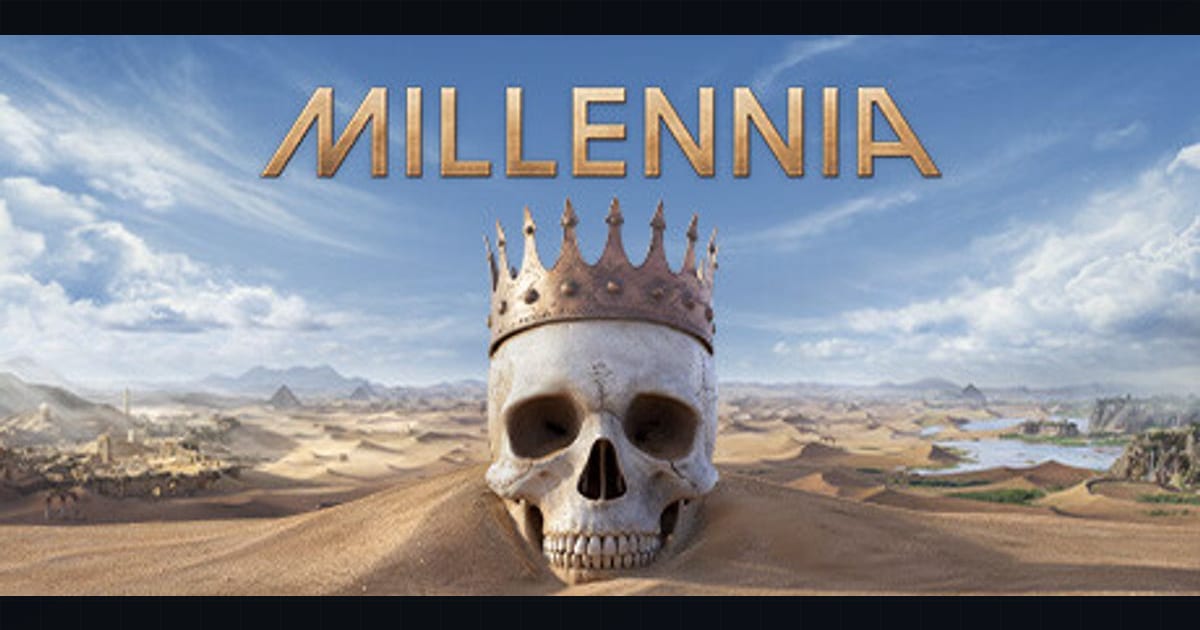
Millennia is a historical turn-based 4X4X. eXplore, eXpand, eXploit, eXterminate — a grand-strategy subgenre about building a civilization over a long arc. game from C Prompt Games and Paradox Interactive that spans roughly 10,000 years, from the first cities to possible futures. Its two defining systems are the Age timeline, which can fork into alternate histories, and National Spirits, the archetypes that give each nation its identity. Understanding how the two interact is the difference between a civilization that drifts and one that compounds.
What the Age system actually changes
Most 4X games advance through fixed eras. Millennia instead runs ten Ages, and the path through them is not guaranteed. As the official store page describes, accomplishing certain objectives can move time into a Variant Age, “an alternate history with new rules, new technologies, and new units.” Travel a darker path and you can instead slip into a Crisis Age filled with war, sickness, or ignorance.
The important mechanical detail is that when one nation enters a new Age, every nation does, regardless of their own progress. This makes the Age transition a shared event. Whoever drives the transition gets to steer the rules for everyone, so pushing toward an Age whose units and buildings suit your strategy is itself a form of aggression. A nation built for conquest benefits from forcing the world into an Age of Blood; a knowledge-focused nation wants to reach a Variant Age like the Age of Aether, where steam technology and Cloud Estates reshape what is buildable.
Each Age swaps the baseline pool of Units, Technologies, Goods, and Capital Buildings available to everyone. Variant and Crisis Ages add their own alternatives, from Cloud Estates in the Age of Aether to underwater cities in the Age of Utopia. Because the Age changes the menu for all players, picking an Age is as strategic as picking a tech.
Variant Ages versus Crisis Ages
Variant Ages are the reward lane. Reach one and you gain access to technologies and units that do not exist on the default timeline, which can snowball into a lasting advantage. Crisis Ages are the punishment lane, triggered by disorder, and they bring hazards and penalties that can stall a runaway leader. The store page notes that “a wise ruler can always turn a crisis into an opportunity,” which in practice means some Crisis Ages unlock tools that, if you are positioned for them, can be turned to your favor. The risk is that you do not always get to choose whether a Crisis Age fires; an aggressive rival can drag the whole world into one.
For planning, treat Age selection as a fork you contest. If you are ahead, you generally want to push into a Variant Age that widens the gap. If you are behind, forcing a Crisis Age can equalize by punishing the leader, provided you can survive the fallout yourself.
What National Spirits are
Where Ages change the world for everyone, National Spirits change one nation. The developer diary from C Prompt Games describes them as a “reputation,” answering the question of what a nation is known for, with examples like Spartan Warriors, Swiss Banking, Silicon Valley, or Egyptian Pyramids. Mechanically, a National Spirit is tied to one of five Domains (Exploration, Warfare, Engineering, Diplomacy, or Arts; Government is handled separately) and grants a set of Ideals.
Crucially, nations in Millennia are cosmetic at the start. You pick Spain because you want Spanish names and symbology, not because Spain has fixed bonuses. The official diary is explicit that “no Nation is different from any other at the start of a new game” beyond minor starting bonuses. What makes nations diverge is the National Spirits you adopt as history unfolds. This is the opposite of a civ with hardwired traits, and it means the same starting nation can play very differently across runs.
When and how you pick a Spirit
New National Spirit slots open in Ages II, IV, VI, and VIII. Each time a slot opens you select one Spirit from that Age’s set, associated with a Domain other than Government. There is no cost to make the selection, and you end the game with four Spirits total. Spirits are not exclusive; multiple nations can take the same one. However, the first nation to adopt a Spirit gets a bonus to that Domain’s XP, and every Spirit that goes unpicked grows a larger reward, so neglected options can become attractive later for players who want the bonus XP.
Selecting a Spirit also grants extra Domain XP per turn in its associated Domain. That passive income matters: a Warfare Spirit accelerates Warfare XP, which feeds back into unlocking that Spirit’s Ideals. Sometimes the bonus XP, or the bonus for picking a less-popular Spirit, is itself the reason to choose it.
How Ideals compound
Each Spirit offers seven Ideals in tiers. You must unlock at least one Ideal in a lower tier to reach the next, and Ideals cost Domain XP from the Spirit’s Domain. The final tier is a Legacy Ideal, cheap at one Domain XP, with a requirement tied to the Spirit. Legacies grant Social Fabric points, one of the easier sources of those points, so they are worth planning toward.
The design intent, per the diary, is that Ideals provide capabilities that are unique rather than incremental, “you’re the only ones that have this at all.” The Khans Spirit is a useful example. It is an Age IV Warfare Spirit that spawns a single powerful Khan leader unit for fifty turns, plus Horse Archers, and offers Ideals that let the Khan convert Barbarian Camps into more Horse Archers, Incite Conflict to turn Barbarians against rivals, and eventually Call to War to spawn units across your regions. The package delivers a focused military window, not a permanent stat bump. The takeaway for players is to read each Spirit as a kit: what unique units, Domain Powers, tile improvements, and goods does it unlock, and over what time horizon do those pay off?
Which Spirits compound best
Because Spirits from different Domains can overlap or reinforce, the strongest builds stack bonuses that share an economy. A few reliable patterns emerge from the Spirit list:
- Warfare windows into Warfare engines. Age II Raiders or Warriors give early combat tools and Warfare XP; Age IV Khans or Crusaders convert that XP momentum into a mid-game power spike; Age VI Commanders or Mercenaries sustain veterancy and battlefield healing. Each Warfare Spirit you take accelerates the next by feeding Warfare XP.
- Engineering production chains. Age II God-King Dynasty or Mound Builders build stone and population infrastructure; Age IV Machinery or Siegesiege. A timed, large-scale attack on a settlement — attackers try to destroy it, defenders try to hold it. Masters turn coal, iron, and machines into production and siege units; Age VI Inventors or Sultans push toward power and concentrated population; Age VIII Modernization or Silicon Valley convert that base into high-density output. Engineering Spirits unlock goods and improvements that compound, because production feeds everything.
- Exploration into knowledge. Ancient Seafarers, Naturalists, or Wild Hunters in Age II, Explorers in Age IV, Scholars in Age VI, and Space Agency in Age VIII form a knowledge-and-expansion arc. Scholars are notable because their Center of Learning generates XP for all Domains, which can subsidize a Spirit taken in another Domain.
- Diplomacy and the endgame. Shogunate and Spice Merchants (Age IV) build relations and wealth, Colonialism (Age VI) expands through vassals, and the Age VIII trio (International Finance, Political Science, Flower Child) offers very different endgame engines. International Finance compounds wealth into interest; Political Science manipulates unrest and population; Flower Child trades nuclear options for culture and ideology.
There is no single best set. The compounding principle is to keep at least two of your four Spirits in the same Domain so the XP income and the Ideals reinforce, while using the other slots to cover a weakness your Ages do not.
How Ages and Spirits interact
The interaction is where Millennia earns its replay value. Ages rewrite the shared rules and the menu of technologies; Spirits rewrite what your nation alone can build. A Machinery Spirit that turns coal into production becomes far stronger in an Age that introduces coal-dependent units, and far weaker in a Crisis Age that strips industrial goods. A Theologians Spirit that spreads religion scales with the population following your state religion, which depends on how widely your faith has taken hold across the map.
A practical approach is to choose your first Spirit in Age II based on terrain and neighbors (naval, forest, hill, or war-oriented), then let the Ages you actually land in inform your later picks. If a Variant Age opens new production goods, lean Engineering. If a Crisis Age forces military survival, lean Warfare. Because Spirits stay unlocked for the rest of the game, an early investment keeps paying dividends, which is why chaining two Spirits in the same Domain is usually better than spreading thin across all five.
A note on the economy underneath
The Age and Spirit systems sit on top of an economy that converts basic resources into more valuable products. The store page describes specializing regions to turn iron into weapons or tools, wood into paper or lumber, and gold into coin or jewelry, then shipping surplus goods where they are needed. Spirits plug into this by unlocking new goods (Spice, Shells, Elephants, Media, Computers) and new improvements that consume or upgrade them. When you pick a Spirit, look at which goods and improvements it touches, because a Spirit whose goods your regions can actually produce will outperform one whose chain you cannot feed.