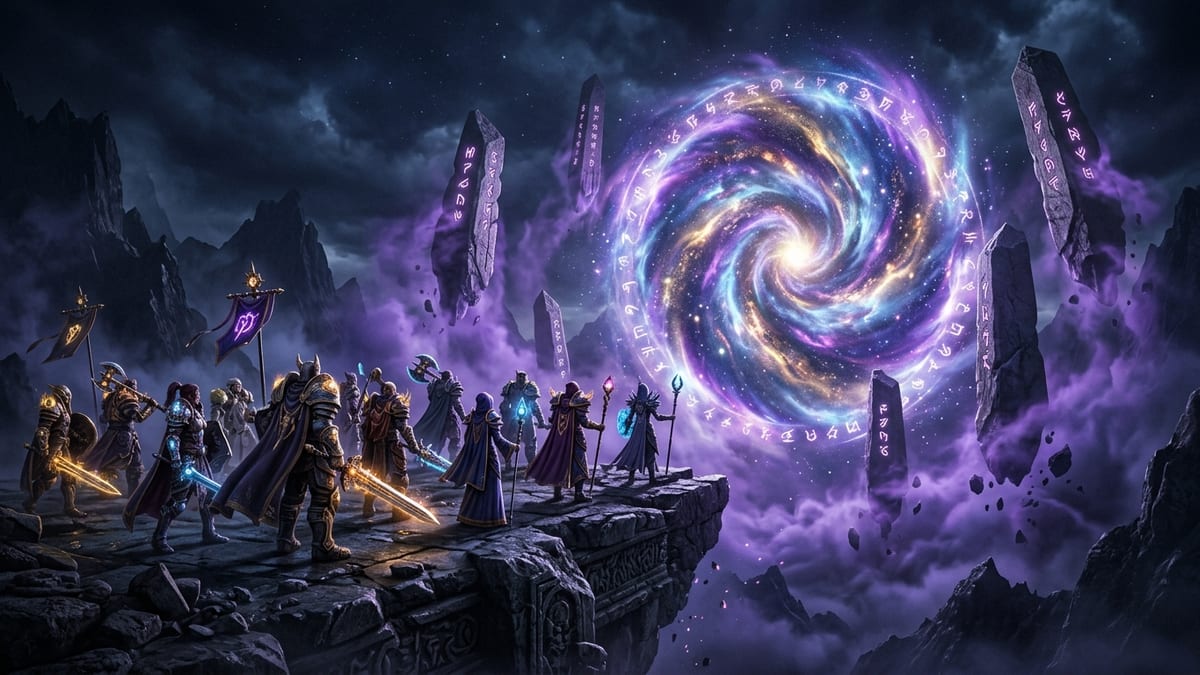
Join any raid group in any major MMOMMO. Massively Multiplayer Online — a game that hosts very large numbers of players together in one shared, persistent world. and within two pulls you’ll hear a sentence like “watch your aggro, hold burst for adds, save CC for the enrage.” Every word in it is compressed jargon built up over two decades of the genre. This glossary defines the terms that matter most for new raiders — across World of Warcraft, Final Fantasy XIV, Guild Wars 2, and the wider genre — so the callouts stop sounding like static.
What changed
Nothing “changed” — that’s the point. MMO vocabulary is one of the most stable bodies of slang in gaming, and it’s remarkably consistent across franchises. A tank in World of Warcraft, a tank in FFXIV, and the closest equivalents in guild-content games like Lost Ark or Black Desert Online all solve the same problems, so the community solved them with the same words. If you learn this shorthand once, it transfers.
It’s worth noting where the terms are documented officially versus where they live purely in community usage. Square Enix’s official FFXIV Play Guide and Game Manual, for example, formally define roles, enemy signs, waymarks, and party systems in the game’s own language, while the broader cross-genre terms (aggro, GCD, BiS) spread through community wikis, forums, and the Lodestone’s player-run spaces before most studios ever printed them. The definitions below reflect standard cross-game usage; where a term means something different in one franchise, that’s flagged.
How it works — the combat core
These are the mechanical terms. They’re the ones that get you killed if you guess wrong.
Aggro (also: threat, enmity, hate). The targeting priority of AI enemies — essentially, who the monster wants to hit. “Pulling aggro” means dealing enough damage or healing to overtake the tank and become the target. In FFXIV the official UI term is “enmity” and the party list shows it as a colored bar per enemy; the concept is identical everywhere. New DPS players cause most aggro accidents by opening with their hardest-hitting abilities before the tank has established a lead.
Tank / Healer / DPS (the trinity). The three combat roles. Tanks hold aggro and absorb damage; healers restore it; DPS (“damage per second,” used both for the role and the literal damage rate) kill things fast enough that mechanics stay manageable. Most modern MMOs structure group content around specific compositions of these — FFXIV’s “light party” is one tank, one healer, two DPS, for example.
CC (crowd control). Any effect that neutralizes an enemy without killing it: stuns, sleeps, roots (movement-locked), silences (interrupts casting), knockbacks, and slows. “CC the adds” means stop them from acting, not focus them down. Many raid bosses are immune to CC; it’s usually a trash-pull and add-management tool.
GCD (global cooldown). The short shared lockout after using an ability, during which most of your other abilities can’t be used. In FFXIV the base GCD is roughly two and a half seconds, modifiable by speed stats; abilities exempt from it are called oGCD (“off global cooldown”) and are “woven” between GCD skills. Games differ — WoW’s GCD is shorter and more abilities sit off it — but the vocabulary (GCD, weaving, clipping) is shared. “Clipping” your GCD means delaying your next main ability by cramming in too many off-GCD actions.
AoE (area of effect). Anything hitting a zone rather than a single target. Used for both your attacks and, more importantly in raids, enemy attacks. Enemy AoEs telegraphed on the ground — circles, cones, lines, donuts — are the genre’s universal “move or die” language.
DoT / HoT. Damage over time and heal over time — effects that tick per interval rather than landing once. “Keep your DoTs up” is rotation advice; a HoT “ticking” is how healers stabilize between big heals.
Buff / debuff. Temporary positive and negative stat or status effects. Raidwide debuffs (damage down, healing down) are often the failure state of a missed mechanic rather than a direct death.
Interrupt. An instant ability that cancels an enemy’s cast bar. FFXIV formally splits this into “interruption” effects by role; in WoW it’s core raid utility. “Kick” is common synonyms, from WoW’s Rogue ability.
How it works — raid-call shorthand
These are the social terms. They vary more by game and region, but these meanings dominate English-language raiding.
Pull. One attempt at a fight, from engagement to death or clear. “One more pull” is the eternal lie of raid night. As a verb, “pull” means to start combat.
Adds. Additional enemies that spawn during a boss fight. “Add phase” or “adds” in a callout always means: switch targets, now.
Tank buster (TB). A heavy, usually telegraphed hit aimed at the tank, requiring them to use a defensive cooldown (“pop a CD,” “mit”) or be swapped. A tank swap is when the off-tank takes aggro mid-fight, usually because of a stacking debuff.
Raidwide. Unavoidable damage hitting the whole party, requiring group mitigation (“mitigation plan,” “mit sheet” — a shared spreadsheet assigning each defensive cooldown to each raidwide hit).
Stack / spread. Positioning calls. Stack markers mean everyone shares the damage by grouping up; spread means the opposite, because overlapping hits would multiply damage. Cleave is a cone attack from the boss’s front — don’t stand there. Donut and line describe AoE shapes.
DPS check. A fight phase tuned so the group must output enough damage before a timer, failing which the boss enrages — gains massive damage or simply wipes the raid. Uptime is how long a melee DPS stays in range hitting the boss; dropping uptime to dodge mechanics is the core greed-versus-safety tension of raiding.
Opener / rotation / burst window. Your opener is the rehearsed first seconds of a fight, aligned with party buffs (“raid buffs”) that often land on two-minute cycles — hence “hold burst for the 2-minute window.” Your rotation is the repeating ability order after that.
BiS (best in slot). The mathematically optimal gear for your job at a given patch, and the thing half of raid loot drama is about. iLvl (item level) is the coarse gear-power number most games use for entry requirements.
Wipe / prog / reclear / farm / parse. Wipe: everyone dies, reset. Prog (progression): practicing a fight you haven’t cleared, often phase by phase (“fresh prog” means starting a new fight). Reclear: the weekly repeat of something already cleared for loot. Farm: content on easy repeat. Parse: a logged damage-performance ranking, recorded via third-party tools — beloved and resented in equal measure.
PUG / static / PF / DF. Social group types. A PUG (pick-up group) is strangers assembled per-session, via the Party Finder/Group Finder (PF) or the random-matchmaking Duty/Dungeon Finder (DF). A static is a fixed roster on a schedule. Neither is better; they solve different scheduling problems.
Res/raise, invuln, LB/ult. Resurrection abilities (“swift res” — casting raise with an instant-cast buff), invulnerability cooldowns (“invuln the tank buster”), and shared party super-meters (FFXIV’s Limit Break; “ult” in games with ultimates).
Build path — learning it in layers
You don’t need this whole list on day one. Learn it in the order raids will demand it:
- Survival layer: aggro, AoE, stack, spread, cleave. These kill you in the first dungeon.
- Role layer: your trinity job’s expectations — tanks learn tank buster, swap, mit; healers learn raidwide, HoT, res; DPS learn rotation, uptime, DPS check.
- Optimization layer: GCD weaving, openers, burst windows, BiS. This is where “good” stops being “alive” and starts being “fast.”
- Culture layer: prog, reclear, parse, static etiquette. None of it is mechanical; all of it determines whether groups invite you back.
The genre’s official onboarding has improved — FFXIV’s Active Help windows, Hall of the Novice, and its official Game Manual’s party-play sections teach many of these concepts in-game — but the vocabulary itself is still mostly transmitted player to player. Keeping a glossary like this open during your first few raids is normal, not embarrassing.
What it means
Raid shorthand exists because raid fights outpace typing and even voice. “Stack, spread, bait, swap” is a sentence that saves runs. The vocabulary also encodes the genre’s shared design DNA: when a brand-new MMO launches, you can predict its combat language before playing it, because the trinity, the GCD, threat tables, and telegraphed AoEs are inherited assumptions across the genre — even games that reject one piece (Guild Wars 2’s softening of the trinity, action MMOs that minimize the GCD) are understood and discussed in reference to it.
For a new player, the practical takeaway is that fluency is a skill like any other in the game: you acquire it through exposure, and the definitions above are enough to stop you being the person standing in the fire wondering what “spread” meant. Learn the survival terms first, ask when a callout is unfamiliar — raid leads answer those questions happily before the pull and angrily after the wipe — and the rest of the dictionary fills itself in.