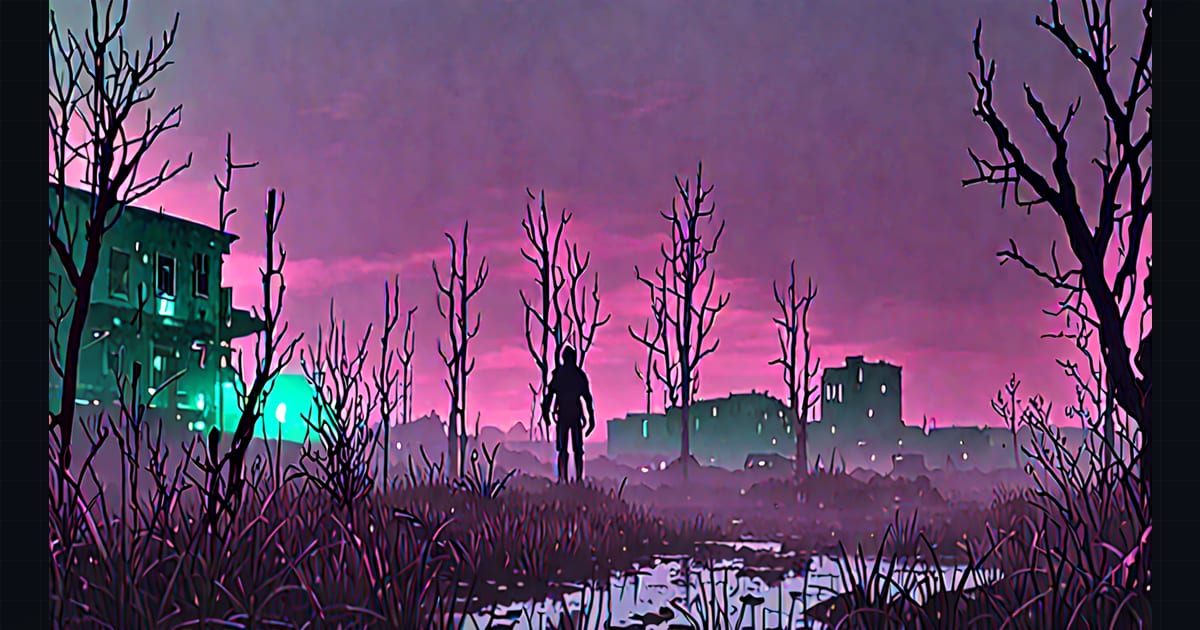
Once Human is a free-to-play post-apocalyptic survival game developed and published by Starry Studio, a subsidiary of NetEase. Built on the NeoX engine, the game blends third-person shooter and looter shooter mechanics within a shared sandbox open world. It was released for Windows on July 9, 2024, followed by iOS and Android on April 23, 2025, with PlayStation 5 and Xbox Series X/S versions scheduled for August 25, 2026.
Gameplay Systems
Players load into a shared environment and complete a tutorial that unlocks survival systems and progresses the narrative. From the main menu, players select a story-driven scenario, such as Manibus, and join a server. Servers operate on a timed shelf life and wipe after the time expires. Progression is tied to memetics, a skill system where players unlock skills using ciphers earned through quests and leveling.
A key structural element is Eternaland, an isolated island where players store high-end items, gear, and Deviants. These stored items can be carried into new scenarios, though transfer limits are based on item rarity. In Eternaland, players can build using dust, a material generated from inventory items that cannot be carried over.
Survival mechanics require players to manage hunger, hydration, and sanity meters. Maintaining hunger and hydration above certain thresholds grants buffs to health and damage. Spending time in supernatural areas decreases the sanity meter, reducing the player’s maximum health pool. Sanity can be restored by consuming specific resources or resting in a bed.
World Structure and Combat
The open world features strongholds, silos, and monolith battles. Strongholds are large, themed locations populated with enemies and resources. Activating a stronghold’s rift anchor yields rewards and progresses the player toward monolith battles. Monolith battles are multi-phase boss encounters, of which there are currently three unique variations. Silos function as instance-generated dungeons with multiple difficulty tiers, populated by basic and elite enemies, and culminating in a mini-boss encounter.
Plot and Expansions
The narrative begins with an amnesiac player waking up after the Starfall, an event caused by the alien substance Stardust that mutated most life into violent Deviations. The player is a Meta-Human, a biologically enhanced being created by the company Rosetta, who caused the Starfall. Players can collect friendly Deviations, known as Deviants, to assist in combat or resource gathering.
In September 2024, Starry Studio released The Way of Winter expansion. This scenario introduces an icy northern region where players reunite with Mitsuko, a first-generation Meta-Human, and encounter a mysterious masked figure named Igna.
Why It Matters: The Wipe-and-Preserve Loop
The single most consequential design choice in Once Human isn’t its setting or its combat — it’s the structural loop between timed servers and Eternaland. By running scenarios on a wipe cycle while letting players bank rare gear and Deviants on an isolated island between resets, Starry Studio has engineered a hybrid that sits between two genres that usually refuse to coexist: the reset-driven tension of a survival sandbox (the Rust/Tarkov lineage, where every wipe is a clean slate) and the persistent-accumulation fantasy of an MMOMMO. Massively Multiplayer Online — a game that hosts very large numbers of players together in one shared, persistent world. (where progress is permanent and a wipe would be a betrayal).
That tension is what makes the transfer-by-rarity mechanic genuinely interesting rather than a footnote. If everything carried over, the wipes would be cosmetic — a scheduled reset in name only. If nothing carried over, the game would be a pure survival sandbox with no long-term hook. The rarity-gated transfer is the valve that lets the studio tune exactly how much “past self” a returning player gets to import into a new scenario. It is, in effect, a retention dial: rare gear carries forward enough to reward veterans and give them a head-start cushion, but common progression is re-earned each cycle, keeping the early-server economy and PvE race meaningful for newcomers. For a free-to-play title whose entire monetization premise depends on players returning season after season, that dial is the product.
The Take: Sanity as a Travel Budget, Not a Gimmick
Survival meters are the most commoditized mechanic in the genre — hunger and hydration as generic buff toggles are everywhere. Once Human’s sanity meter deserves more attention than it usually gets, because it does something structurally different from its siblings. Hunger and hydration gate performance (buffs to health and damage). Sanity gates access: supernatural areas drain it, and a drained sanity pool shrinks maximum health, which means players can’t simply out-gear the dangerous zones — they have to budget the duration of their excursion.
That reframes sanity as a travel budget. The bed-rest and resource-consumption restoration loop turns every deep-zone trip into a risk/return calculation about how long you can stay before your effective health cap erodes below what the enemies there demand. It’s a soft enrage timer applied to the player, not the boss. Combined with the stronghold → rift anchor → monolith progression chain, it gives the open world a pacing rhythm that pure loot-grind survival games often lack — you push until your sanity says stop, then you cycle back to a safe bed and re-prep. It’s a small system doing a lot of architectural work.
What It Signals: NetEase’s Engine and Platform Play
The NeoX engine choice is worth reading against Starry Studio’s parent. NetEase has spent the last several years pushing proprietary tech across its portfolio, and Once Human is one of the clearest demonstrations of that stack reaching outward — from a mobile-first Chinese market onto Windows, then iOS/Android, and now a late-2026 console launch on PS5 and Xbox Series X/S. The staggered platform cadence (PC in 2024, mobile in 2025, consoles in 2026) is the tell: this isn’t a simultaneous multi-platform launch, it’s a sequenced porting effort, which implies the engine is being adapted tier by tier rather than being cross-platform-native from day one.
For the MMO genre that matters because it reframes what “a NetEase MMO launch” looks like going forward. The old model was a single regional release followed by a localized global push. Once Human’s trajectory — PC soft-launch, mobile extension to capture the commute/second-screen audience, console migration to claim the living-room and controller audience almost two years later — reads like a template other NetEase subsidiaries are likely to copy. The risk is fatigue: a player who played on PC in 2024 and mobile in 2025 has little reason to re-buy on console in 2026 unless cross-progression and shared scenarios follow them. The Way of Winter expansion (September 2024) shows the studio is already leaning on seasonal scenario drops to keep the cadence alive, but whether Eternaland persistence is enough to hold a console audience that arrives two years late is the open question the 2026 launch will answer.
Context: Where It Sits in the Survival-MMO Convergence
Once Human is arriving into a genre that has spent the last decade arguing with itself about what it wants to be. The survival-craft branch (Rust, ARK, Palworld) favors wipes and emergentemergent. Behavior that wasn't explicitly designed but arises from simpler rules interacting — player-run economies, cartels, surprise tactics. player conflict. The looter-shooter branch (The Division, Destiny, Warframe) favors permanent progression and curated endgame. The shared-world MMO branch favors persistence and social scale. Once Human’s pitch is essentially “all three,” and its systems map almost one-to-one onto that ambition: Eternaland handles the persistence, timed servers handle the survival-craft reset tension, silos and monoliths handle the looter-shooter instanced endgame, and the shared open world provides the MMO social layer.
That’s a lot of plates to keep spinning, and the honest analytical read is that the game’s long-term success hinges less on any single feature than on whether the wipe-and-preserve valve stays well-tuned. If the rarity transfer ratios drift too generous, the scenarios become trivial for veterans and the early-server economy collapses. If they drift too stingy, returning players feel punished and the seasonal loop breaks. Everything else — the Deviant collection, the Rosetta/Starfall lore, the icy Way of Winter region — is content layered on top of that core economic tension. The 2026 console launch will be the real stress test: a fresh audience hitting servers that PC veterans have already optimized, with Eternaland banks already stocked. How Starry Studio balances those two populations is the design problem worth watching, not the headline feature count.