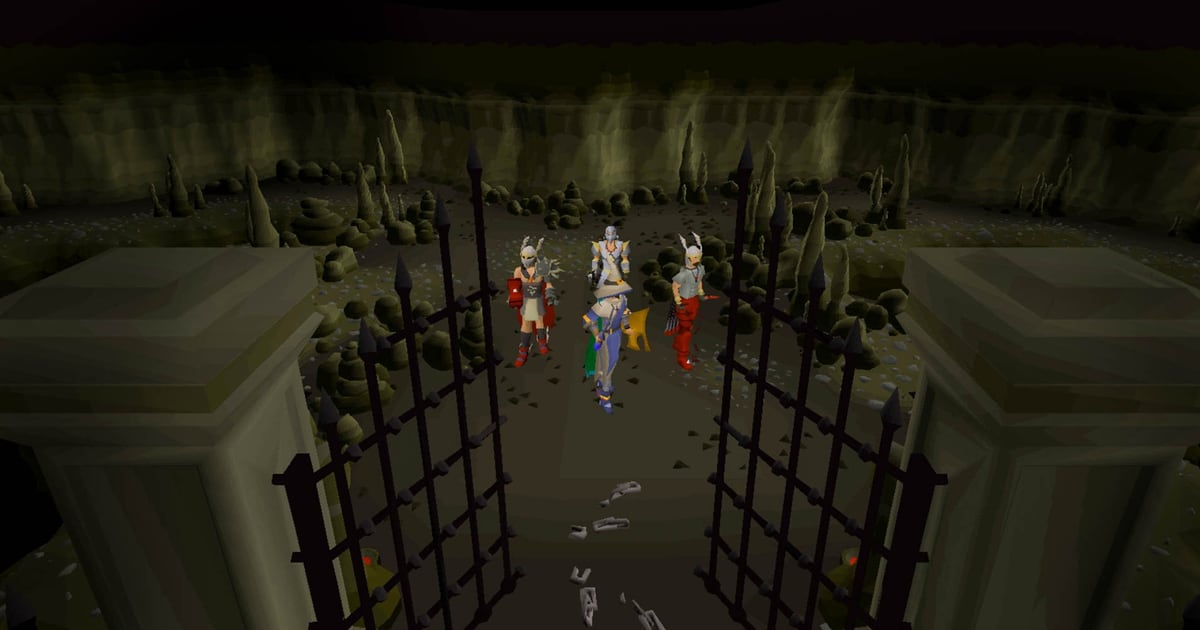
Old School RuneScape asks one question you cannot answer later, and it asks it at the end of Tutorial Island. Speak to the Ironman tutor before the Magic Instructor teleports you and the character is permanently self-sufficient; walk past him and the door shuts in one direction. Jagex’s own support page does not soften it: “It’s not possible to become an Ironman after account creation.”
This site’s only other Old School piece covers the Fractured Archive raid launch — endgame content, and the place where the account-mode argument gets settled. It does not tell you whether you will reach it. This one works through the choice underneath: what Ironman removes, how the six variants differ, and which of them you still are logging into next October.
What this covers: the six official Ironman variants, the restriction list in plain terms, what membership gates and what a bond buys, and how to match a mode to the hours you actually have. Why it matters: the Ironman decision is one-way at character creation, and the reverse trip is deliberately slow — a mode chosen in a first-hour mood can outlast the mood by years. Who should care: anyone starting an Old School account in 2026, anyone returning after a long break, and anyone recruiting friends into Group Ironman on the strength of one good evening.
The door only opens one way
Jagex’s support article walks the free path precisely: create an account, log in to Old School, and at the end of Tutorial Island speak to the Iron Man tutor before the Magic Instructor teleports you. It also covers the common failures — mode missed, Ironman died, unwanted experience gained: “we’re unable to rollback the account”, so the fix is a new character.
Going the other direction is possible but never quick. The wiki documents a 7-day waiting period after you confirm a toggle-off, during which you can cancel; the change is also cancelled if a Hardcore Ironman dies during the wait. Permanent lock-in was removed on 23 October 2024 and replaced with a 90-day downgrading process, and players who had locked an account in can now remove it once it is converted to a Jagex Account.
One clarification that saves agonising: the one-way door is per character, not per login. A Jagex Account holds up to 50 characters under a single login, so a normal main and a fresh Ironman can sit behind the same email. What you cannot do is convert one character into the other.
What Ironman removes, and what that does at the keyboard
The wiki’s restriction list is not so much a list of prohibitions as a list of shortcuts that stop working. Read it as consequences.
| Restriction | What the source says | What it means mid-session |
|---|---|---|
| Trading | Cannot “Trade with other players”, except certain quest items from Shield of Arrav and Heroes’ Quest, and bonds | Every gear upgrade has a source you must reach yourself |
| Grand Exchange | Cannot “buy or sell any item except for bonds”, which are purchasable but not sellable | No converting gold into progress; gold becomes a shop and repair currency |
| Other players’ drops | “No loot will drop whatsoever if another player has attacked that monster”; for some monsters even zero damage from another player voids it | A crowded boss is a dead boss — world choice becomes part of the plan |
| PvP experience | Cannot “Gain experience from player-versus-player encounters”, though base Magic experience from casting still applies | No shortcut levels from fighting players |
| Aid and housing | Cannot use Accept Aid or enter another player’s player-owned house | No borrowed teleports or restoration pools |
| Shops | Cannot buy from overstocked shops or exploit understocked sell prices; stock has been split for Ironmen since 2014–15 | Shop runs are your own runs, at your own stock |
| Achievement diaries | Diary tasks involving monster kills cannot be earned if another player assists — the wiki’s example is the Giant Mole for the Falador Hard Diary | Some diary rewards need a solo kill, not a carry |
Two change-log entries show how carefully this is policed. Since 14 April 2021, certain Slayer monsters’ loot and experience are discredited if another player hits a zero — an anti-alt measure. And Ironmen are not outside group content entirely: the wiki says Iron accounts do receive group-boss rewards when fighting with others, then lists exceptions to the standard loot rules — the three raids, the skilling bosses Tempoross, Wintertodt and Zalcano, several Wilderness bosses, and newer encounters from Nex to the Moons of Peril. Check a specific boss’s entry before you plan around it.
Six modes on one map
The wiki counts six Ironman types and five separate hiscores, with Unranked Group Ironman the one left off the boards.
| Mode | Released | Extra rule on top of standard Ironman | Listed on hiscores |
|---|---|---|---|
| Ironman | 13 October 2014 | Baseline: no trading, no Exchange, no picking up others’ drops | Yes |
| Ultimate Ironman | 13 October 2014 | No bank, plus the storage and death rules that follow from it | Yes |
| Hardcore Ironman | 10 November 2016 | One life; an unsafe death converts the account to a normal Ironman | Yes, name struck through after death |
| Group Ironman | 6 October 2021 | 2–5 players, free trade inside the group | Yes |
| Hardcore Group Ironman | 6 October 2021 | One life per player, pooled across the group; prestige required | Yes |
| Unranked Group Ironman | 26 May 2022 | Group Ironman without the hiscore listing or the trade restrictions | No |
Ultimate is less “Ironman but harder” than a different inventory game. The wiki’s storage section is the summary: no bank, no item sets at the Exchange, no seed vault, no Managing Miscellania resources, no bank-by-Cart or boat services, and restricted looting bag and Chambers of Xeric storage. Death rules follow: no Protect Item, no graves, no Death’s Coffer, and dropped items lie for an hour, paused while logged out.
Hardcore is the one people underestimate. Safe deaths — minigames and scripted fights such as the Inferno, Nightmare Zone, Pest Control and Chambers of Xeric — do not cost the status, but everything else does, and the chatbox announces the fall. The trap is that some activities safe for a solo Hardcore Ironman are unsafe for a Hardcore Group Ironman, because group lives are pooled: Barbarian Assault, Nightmare Zone, Pest Control and Fishing Trawler are named as safe alone, not in a group.
What self-sufficiency does to progression
The wiki’s free-to-play Ironman guide opens by noting that Standard, Hardcore and Ultimate training all “differ significantly from normal skill training”. That sentence is the whole genre of the mode. A normal account buys its way past a bottleneck — the sword, the herb, the plank, the teleport — because someone else already did the boring part and listed the result. An Ironman meets the bottleneck as a dependency chain: the weapon needs a drop, the drop needs a quest, the quest needs a skill, the skill needs a second skill and a shop run with split stock.
That changes the shape of a session more than the difficulty of any single step. On a normal account the interesting decision is what to buy; on an Ironman it is what to do next, because the correct next step is whatever unblocks the most future steps. The wiki becomes load-bearing rather than optional, and luck feels different — a drop you can buy is a price; a drop you cannot buy is a plan that either resolves or does not.
The social texture shifts too. Ironmen cannot be carried, so help means information, company, or a boss you can both fight without invalidating the loot. And the trip is one way: the wiki notes these restrictions “cannot be retroactively imposed”, so an experienced normal account cannot be demoted to make the game interesting again.
Money: what membership gates, and what it costs
Old School is playable free. Steam’s store copy says “Old School is a free-to-play game that anyone can enjoy”, and the wiki maintains a free-to-play Ironman guide covering Standard, Hardcore and Ultimate — so every solo variant can be played without paying, and self-sufficiency can be tested at zero cost.
Membership adds, per Jagex’s benefits page: 9 member-only skills named there as Sailing, Herblore and Construction among others; over 170 quests; a world four times larger; over 65 bosses; bank slots expanded from 900 to a maximum of 1,410; player-owned housing; member worlds; and voting on future content. Steam’s copy of the same pitch still says “8 additional skills” and “Over 120 additional quests” — two Jagex pages of different vintages, with the membership page the one to trust.
On price, Jagex sells a monthly plan and a 12-month plan — the page labels are “Billed Every Month” and “Billed Every 12 Months” — and the 12-Month Membership package replaced Premier Membership from March 2026, retiring monthly drops, Premier Tokens, the chat badge and VIP worlds in stages. Figures render client-side and vary by region and currency, so this article quotes none.
The bond route matters most for an Ironman. The wiki records that one bond redeems for 14 days of membership, two for 29 days and three for 45. Ironmen can buy bonds on the Grand Exchange — the one Exchange interaction the mode allows — can receive them as gifts, and since 9 April 2025 can give them to other players. An Ironman can therefore fund its own subscription with in-game wealth, and, per Jagex’s store copy, membership is shared across Old School and RuneScape.
Group Ironman is a social contract written as rules
Group Ironman sounds like Ironman with friends and behaves like a small organisation with bylaws.
Only newly created accounts can enable it, and the group is 2 to 5 players. Members joining an existing group without prestige face weekly trade caps that lift over five weeks: 1,000,000 coins of value in week one, 20,000,000 in week two, 50,000,000 in week three, 100,000,000 in week four, unlimited from week five. Shared storage starts at 80 slots and rises to 200 through unlock tasks, which groups cannot complete until five weeks have passed. Storage is fenced off from free-to-play worlds, so a member whose subscription lapses cannot hand items back through the chest.
Prestige decides how the group ages. It is a cosmetic star for regular groups but required for Hardcore Group Ironman, and it is lost by inviting a new member after creation, by a member being permanently banned, or by doing listed PvM activities with outsiders — Chambers of Xeric, Theatre of Blood, Tombs of Amascut, The Fractured Archive, The Nightmare, Nex, Royal Titans and Yama. The raid this site covered in October is also a rule inside the group mode: bringing an outside friend carries a mode-level cost, not just a social one.
Leaving is where groups actually break. A departing player gets a 7-day grace period, then chooses between staying a ranked Group Ironman — new group, all tradeable items deleted — becoming an Unranked Group Ironman, which keeps items but leaves the hiscores, or converting to a regular account, which keeps everything. A regular Ironman can also convert into an Unranked Group Ironman with a 7-day grace period, and that step cannot be reversed.
How to tell which one you will still be playing in a year
The honest test is not which mode sounds better. It is which mode survives the week you have a cold, a deadline, and two hours instead of eight.
| Axis | Normal account | Ironman | Group Ironman |
|---|---|---|---|
| Session shape | Buy the missing piece, spend the saved time on content | Plan the chain, execute two links of it | Ironman, split across people you must coordinate with |
| Failure cost | Gold and time | Time, occasionally a rewritten plan | Time, plus a group decision nobody wants to chair |
| Social dependency | None — the Exchange is other people, abstracted | None, but help means information and company | High: 5-week storage gate, prestige rules, 7-day exit |
| Information load | Guides tell you what to buy | The wiki becomes a tool, not a lookup | Mode rules plus group rules |
| Reversibility | Permanent at creation | 7-day wait to de-iron | Irreversible in several directions |
If your enjoyment comes from the content behind the grind — quests, bosses, the raid ladder — a normal account is the shorter path, and there is no prize for the longer one. The membership page’s counts describe a runway long enough without extra friction, and the site’s solo-MMO comparison of five titles does not include Old School at all: solo play here is a mode you opt into, not a pillar Jagex advertises.
If your enjoyment comes from routing — deciding what to do next and being right — Ironman rewards exactly that, and nothing else compensates for its absence. If that dependency-chain paragraph sounded like work rather than a puzzle, the mode will feel like a second job by month two.
If you are starting because of friends, start together or accept Unranked: the 5-week storage gate and the prestige loss on late recruits both punish the friend who joins in month three.
If losing the run would end your interest rather than sharpen it, do not pick Hardcore. One unsafe death converts the character and strikes through the hiscore entry.
One low-risk way to see endgame first: unrestricted worlds, the member-only beta and tournament servers, where progress does not carry over and a boss helper tool hands you stats, gear and quest unlocks. They do not simulate Ironman rules, so they answer “will I enjoy this boss”, not “will I enjoy this mode”.
The short answer
Start a normal account if you want the content on a schedule you control, and an Ironman if planning is the point. Pick Group Ironman only with people committed to the same weeks. Start free-to-play, decide at the tutor rather than after the fact, and remember the reverse trip costs a week at best and ninety days at worst.