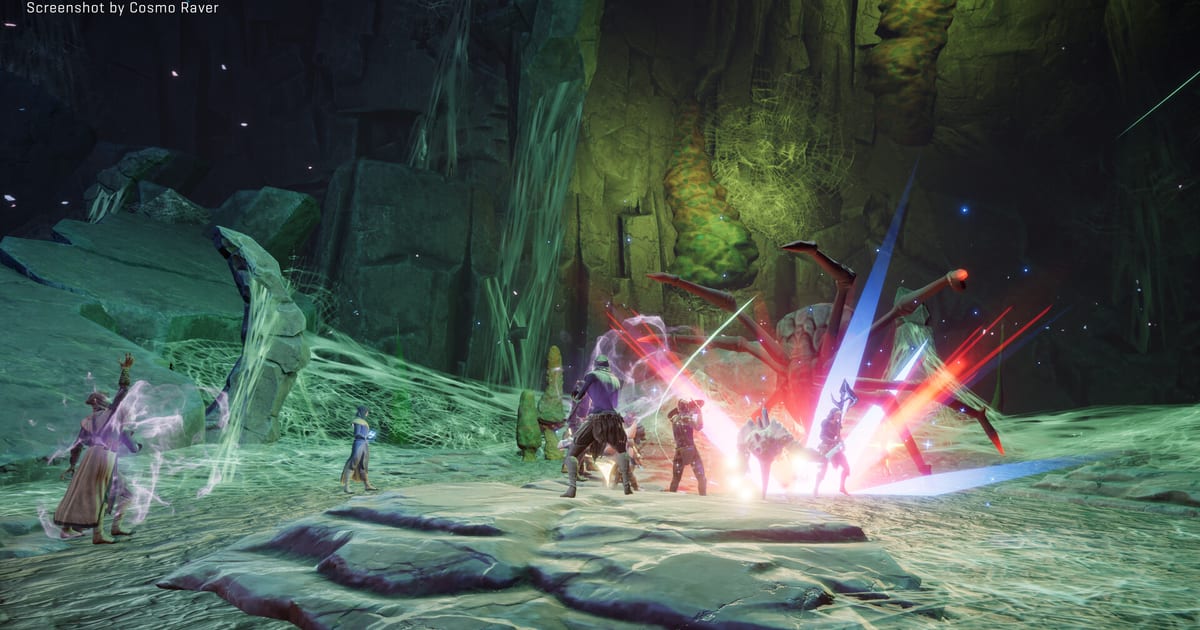
Pantheon: Rise of the Fallen is built on a classic group-combat foundation: the quaternity of Tank, Healer, DPS, and Crowd Control. Unlike modern MMOs that homogenize roles, Pantheon leans into distinct class identities where pulling, splitting, and crowd control are not optional — they are the core loop. This primer covers how the quaternity shapes group composition, how pull mechanics work, and how the pull-and-park loop creates the rhythm of Pantheon’s group combat.
The Quaternity: Four Roles, Not Three
Pantheon’s group design is built on four roles: Tank, Healer, Damage, and Support (which includes crowd control). The CC role is a defined part of group composition, not an afterthought. This is a deliberate departure from the modern “holy trinity” of Tank/Healer/DPS, where CC is folded into DPS utility.
The quaternity creates encounter design that assumes a CC role. Packs of mobs are linked — if one is aggroed, its social-agro neighbors come too. This means groups must either crowd-control the adds or split the pull. The CC role exists to manage this: to mez, root, pacify, or otherwise neutralize mobs that the group cannot or should not fight simultaneously.
How Pulling Works
Pulling is front-end crowd control. It is the act of bringing a mob — or a controlled subset of a pack — to the group for engagement. In Pantheon, pulling is not trivial. Mobs are linked by social agro: if you attack one member of a factionfaction. An in-game group or nation players can align with or fight against, with its own goals and reputation system., nearby members of the same faction will also aggro. This creates the need for deliberate pull technique.
The main methods of pulling are:
- Direct pull by the tank — the tank body-pulls or uses a ranged ability to bring a mob back to the group. This is the safest method if the group is positioned correctly and the tank can survive the incoming pack.
- Crowd control pull by the enchanter — the enchanter pacifies or mezzes members of a pack, then pulls one away for the group to fight. This requires coordination: the CC must land before the pull, and the group must not break the mez with area damage.
- Lull pulling by the cleric — the cleric pacifies a mob, reducing its aggro radius, then the tank pulls the unpacified target. This is a reliable method for splitting linked mobs.
- Feign Death pulling by the monk — the monk pulls a pack, then feigns death to drop aggro. Mobs that were not social-linked return to their spawn, leaving only the linked mob for the group. This is the most skill-dependent method and the most powerful single-pull technique.
Each method has risks and rewards. The tank pull is safe but may bring more mobs than the group can handle. The CC pull requires coordination and timing. The lull pull is reliable but limited by the cleric’s pacify line. The FD pull is powerful but requires the monk to understand pathing, social agro, and mob behavior.
The Pull-and-Park Loop
The pull-and-park loop is the rhythm of Pantheon group combat:
- Position the group — the group sets up at a camp spot, away from patrol paths and social-agro ranges.
- Pull — the puller (tank, CC, or monk) brings a mob or a controlled subset to the group.
- Park — the CC parks any adds: mezzes, roots, or off-tanks mobs that the group is not currently killing.
- Burn — the DPS focus-fires the active target while the tank holds aggro and the healer keeps the tank alive.
- Repeat — as the active target dies, the group transitions to the parked mobs, or the puller brings the next pull.
This loop creates a deliberate, methodical combat pace. It is not a zerg. It is not an AoE fest. It is a sequence of controlled engagements where each role has a specific job, and failure to execute any role creates a cascade: a broken mez brings an add, the tank loses aggro, the healer falls behind, and the group wipes.
Class Synergy and the CC Chain
Class synergy in Pantheon is built on the CC chain — the sequence of crowd-control abilities that a group uses to manage a pull. The chain typically looks like:
- Pre-pull: The enchanter pacifies or the cleric lulls members of the target pack to reduce the number of incoming mobs.
- Pull: The tank or monk brings the pull to the group.
- Park: If adds come, the enchanter mezzes them, the ranger roots them, or the druid snares them.
- Engage: The tank establishes aggro on the primary target. The DPS attacks through the tank. The healer keeps the tank up.
- Transition: As the primary target dies, the group moves to the parked adds. The CC re-mezzes or re-roots if durations expire.
This chain requires communication. The group must know which mobs are mezzed (and not break them), which are rooted (and not move out of root range), and which are being off-tanked. A group that does not communicate will break its own CC and create chaos.
Why This Design Matters
Pantheon’s pull-and-park loop is a deliberate design choice that creates a different kind of MMOMMO. Massively Multiplayer Online — a game that hosts very large numbers of players together in one shared, persistent world. combat. It rewards preparation, communication, and class knowledge over reaction speed and gear. A well-played group in Pantheon is a team where each member understands their role and executes it with precision.
The trade-off is accessibility. This style of combat is slower, more deliberate, and less forgiving than modern AoE-focused MMO combat. It is not for everyone. But for players who want a group-combat experience where pulling is an art, crowd control is a role, and class synergy is the difference between a clean clear and a wipe, Pantheon’s quaternity design is the framework that delivers it.