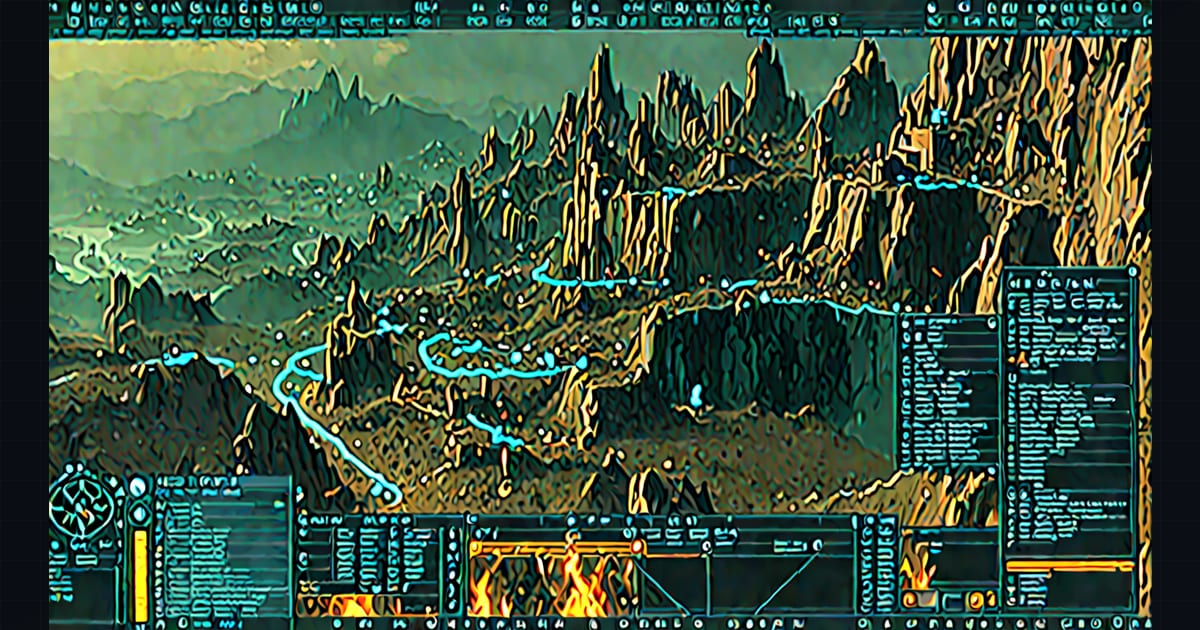
Visionary Realms has published updated patch notes for Pantheon: Rise of the Fallen, highlighting improvements to the climate adaptation system and tactical group combat encounters ahead of its upcoming seasonal playtest phase.
This is not the kind of patch note that grabs headlines. There is no raid teaser, no cinematic, no launch date. What Visionary Realms shipped instead is a statement of design philosophy: three systems — perception-driven exploration, hostile climates, and engine-level presentation work — that each push against what the modern MMOMMO. Massively Multiplayer Online — a game that hosts very large numbers of players together in one shared, persistent world. has become. Taken together, they read less like feature items on an early-access roadmap and more like an argument that the genre has optimized itself into a corner.
1. Perception & Environmental Systems
- Perception Trait System: Players with high Perception uncover hidden keeper artifacts, secret dialogue options, and ambient lore clues scattered throughout Terminus.
- Extreme Climate Hazards: Zones feature severe environmental temperatures (Frigid, Torrid, Toxic) requiring specialized resistance gear and magical buff rotations to survive.
- Old-School Group Synergy: Combat emphasizes class inter-dependency, crowd control management, pull positioning, and tactical mana conservation over brainless spamming.
The Perception Trait System is the most structurally interesting of the three. In the dominant MMO design template, world content is surfaced through UI: quest markers, map icons, minimap pings. The world itself is set dressing, and the client tells you where the content lives. Pantheon is walking that back. Making hidden artifacts, dialogue branches, and lore clues contingent on a character’s Perception value means the content surface of Terminus is not fixed — two players standing in the same ruin genuinely experience different worlds. That has real knock-on effects: it makes exploration a build decision rather than a checkbox, it gives gathering-adjacent and scouting playstyles mechanical weight, and it creates information asymmetry between players, which is the raw material of emergentemergent. Behavior that wasn't explicitly designed but arises from simpler rules interacting — player-run economies, cartels, surprise tactics. community behavior (guides, secrets, arguments on forums, and the kind of “did you know” sharing that the genre used to run on).
The climate system pushes in the same direction from a different angle. Zone-level hazards — Frigid, Torrid, Toxic — that demand resistance gear and buff rotations are not difficulty-in-the-abstract; they are logistics. The player’s question changes from “can my group kill what lives there” to “can my group operate there at all, and for how long.” That reintroduces a supply-chain layer that most contemporaries removed years ago: consumable preparation, elemental resistance gear as a second equipment track, and casters whose buff uptime becomes a survival resource rather than a damage multiplier. It also creates a natural gating mechanic that is diegetic rather than level-band based — you fail in a Torrid zone because you are unprepared, not because your number is below the zone’s number.
2. Tactical Group Combat
The combat notes reinforce the pattern. Class inter-dependency, crowd control management, pull positioning, mana conservation — this is an explicit rejection of the ability-rotation-centric DPS race that defines endgame MMO combat elsewhere. It is also, almost word for word, the vocabulary of EverQuest-era group combat: the pull matters as much as the fight, CC is a tax on the group’s attention budget rather than a button that exists, and a mana pool drained early is a wipe later.
The strategic consequence is that combat difficulty scales with coordination rather than reaction speed, which has implications for both accessibility and retention. Coordination-scaled difficulty tolerates slower hands but punishes silent groups, which is why this design only works in group-first content — and why the same system tends to create durable social bonds. Players who must talk to survive keep talking.
3. Technical Engine & Netcode
Unity High Definition Render Pipeline (HDRP) upgrades provide improved volumetric lighting, atmospheric fog scattering, and multi-threaded server-side tick rate stability during large raid events.
The pairing of HDRP visual work with server tick stability is telling on its own. Volumetric lighting and fog scattering are atmosphere investments — they sell Terminus’s mood, which matters for a world-driven game — but tick-rate stability during large raid events is the harder engineering problem and the more meaningful promise. MMO raid stability is a server-authority problem: every combatant’s state must be simulated, validated, and broadcast within a tight frame of latency, and the load is roughly quadratic with participant count. Committing to multi-threaded tick simulation suggests Visionary Realms is taking large-encounter architecture seriously at the engine layer rather than assuming the classic six-person group ceiling and hoping raids work out later.
The published system requirements support a pragmatic read: GTX 1060 minimum and RTX 3070 recommended with 32 GB of RAM is a wide generational spread for the GPUGPU. Graphics Processing Unit — the chip that renders the game's visuals; the main driver of framerate and image quality. but a demanding memory floor. That combination is typical of HDRP titles where volumetrics and high-resolution material streaming are texture-memory heavy — VRAMVRAM. Video RAM — memory on the graphics card used for textures and frames; more of it lets you run higher settings. and system RAM do the lifting, while the older GPU tier survives at reduced fidelity. Players on 2018-era systems should read “minimum” as playable, not pretty.
Why It Matters
Pantheon’s significance is not any single system; it is that all three systems pull in the same direction. Perception-gated secrets, climate logistics, and coordination-scaled combat are each individually unfashionable. Collectively they constitute a coherent bet: that a meaningful portion of the MMO audience is underserved by the convenience-forward, solo-tolerant, UI-mediated design that the genre has converged on, and that this audience will accept friction as the price of meaning.
That bet has a real constituency. EverQuest’s enduring emulated-server scene and the demonstrated longevity of deliberately friction-heavy RPGs suggest the demand is genuine, if narrower than the mass-market MMO audience. The historical question is not whether the design philosophy can produce a good game — it has before — but whether it can produce a sustainable one at modern development cost.
The Take
The strongest signal in these notes is architectural honesty. Visionary Realms is telling players exactly which game it is building: unforgiving climate logistics, knowledge as a character stat, CC tax in combat, and server engineering sized for the raid content that usually breaks MMOs at scale. That clarity is rare enough to be worth an impact score on its own, and it cuts both ways — anyone hoping Pantheon would drift toward a more accommodating mainstream template should treat these notes as confirmation it will not. The Seasons Early Access playtest will be the first real read on whether the friction is tuned as depth or as tedium, and on whether the tick-rate promises survive contact with a full raid group. On the design evidence here, Pantheon remains one of the few MMOs in development with a genuinely distinct answer to what the genre is for — and one of the few whose success or failure will actually teach the industry something.