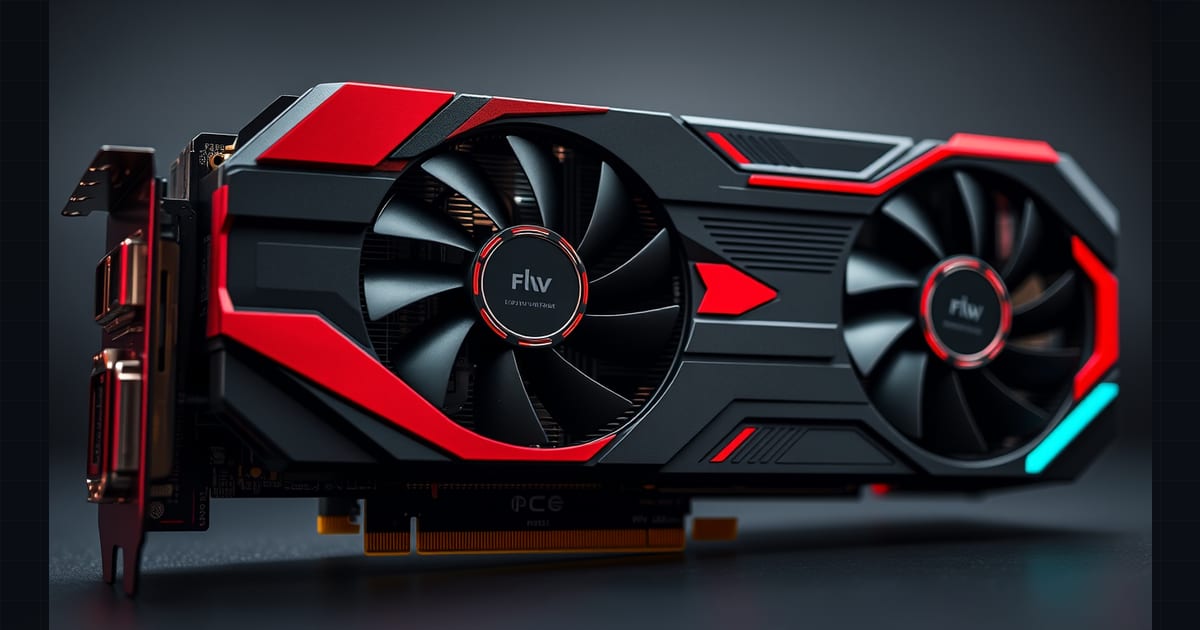
AMD’s RX 9070 and 9070 XT represent the most competitive Radeon GPUs in years. RDNA 4 doesn’t just close the gap with NVIDIA’s Blackwell — it wins on raw rasterisation at the same price point, while delivering meaningful improvements in ray tracingray tracing. A rendering technique that simulates how light bounces, for realistic shadows, reflections, and lighting — costly to compute. and a machine-learning-based upscaler that finally competes with DLSS.
The two cards
| Spec | RX 9070 | RX 9070 XT |
|---|---|---|
| Compute units | 56 | 64 |
| Stream processors | 3,584 | 4,096 |
| Boost clock | 2,540 MHz | 2,970 MHz |
| Game clock | 2,070 MHz | 2,400 MHz |
| Memory | 16GB GDDR6 | 16GB GDDR6 |
| Memory bus | 256-bit | 256-bit |
| Memory bandwidth | 640 GB/s | 640 GB/s |
| TGP | 220W | 304W |
| Price | $549 | $599 |
Both cards ship with 16GB of GDDR6 on a 256-bit bus — a deliberate choice to provide VRAMVRAM. Video RAM — memory on the graphics card used for textures and frames; more of it lets you run higher settings. headroom that NVIDIA’s competing 12GB cards lack. The XT variant adds 8 more compute units and a 770 MHz higher boost clock, but draws 84W more power to get there.
RDNA 4’s three big improvements
1. Ray tracing that finally competes
RDNA 4 introduces a redesigned ray-tracing pipeline. AMD hasn’t published exact architecture details, but benchmark data tells the story: the RX 9070 narrows the RT gap with the RTX 5070 to single-digit percentages in moderate ray-tracing workloads. In the heaviest path-tracing scenarios (Cyberpunk 2077 Overdrive, Alan Wake 2), NVIDIA still leads — but the gap is no longer the chasm it was on RDNA 3.
The practical takeaway: if you play with ray tracing on but don’t use the heaviest path-tracing presets, the 9070 is a viable RT card for the first time in AMD’s history at this price tier.
2. FSR 4: machine learning arrives
FSR 4 is AMD’s first machine-learning-based upscaler — a significant departure from the temporal-algorithm approach of FSR 1-3. The RX 9070’s AI accelerators handle the upscaling, delivering image quality that’s competitive with DLSS 4 Quality in most 2026 AAA titles.
Key FSR 4 facts:
- ML-based, runs on RDNA 4’s AI accelerators (not backwards-compatible with RDNA 3)
- Supported in major 2026 releases at launch
- Image quality: closes most of the gap with DLSS 4 Quality
- Still behind DLSS 4 in motion stability and fine texture detail
- FSR 3 remains available as a fallback for older titles
3. Power efficiency gains
RDNA 4 improves performance-per-watt over RDNA 3, though the 9070 still draws more power than the competing RTX 5070 in most workloads. The 9070 (220W) is the efficiency leader of the two — the 9070 XT (304W) trades efficiency for raw compute, drawing significantly more power to hit its higher framerates.
Performance vs the competition
The RX 9070 at $549 beats the RTX 5070 at $549 by approximately 13% in rasterisation at 1440p (geomean of 23 games). The 9070 XT at $599 competes with the RTX 5070 Ti at $749 — delivering within 5% of the 5070 Ti’s performance for $150 less.
VRAM is the differentiator. 16GB on both RX 9070 variants means every current AAA title fits comfortably at 1440p with upscaling, with room to spare for future titles that push beyond 12GB. Several 2026 releases already use 10-11GB at 1440p with FSR Quality — right against the RTX 5070’s 12GB limit.
The 9070 XT question
The 9070 XT ($599) is the card for users who want maximum raster performance without paying NVIDIA’s premium. It trades blows with the RTX 5070 Ti ($749) in most workloads while costing $150 less. The trade-off: higher power draw (304W vs 250W), no DLSS 4 Multi-Frame Generation, and slightly worse ray-tracing performance in the heaviest titles.
For pure gaming at 1440p, the 9070 XT is arguably the best value GPUGPU. Graphics Processing Unit — the chip that renders the game's visuals; the main driver of framerate and image quality. of 2026 — if you can accept AMD’s ecosystem over NVIDIA’s.
What AMD needs to fix
- Software stability: Adrenalin drivers have improved but still lag NVIDIA’s in consistency, particularly with day-one game releases.
- AI ecosystem: CUDA’s dominance in AI/ML workloads means the 9070 is a gaming card, not a productivity card. NVIDIA’s CUDA, NVENC, and Studio ecosystem remain a moat.
- Ray tracing in path-traced games: The gap in the heaviest RT scenarios is still 15-20%. AMD needs another RT architecture iteration to close it fully.
Verdict
The RX 9070 at $549 is the rasterisation value champion of 2026. The 9070 XT at $599 is the best overall value if you don’t need NVIDIA’s RT or AI ecosystem. For gamers who prioritise raw framerates, VRAM headroom, and price-to-performance, these are the cards to buy. For ray-tracing enthusiasts, AI developers, or DLSS power users, NVIDIA remains the safer bet.