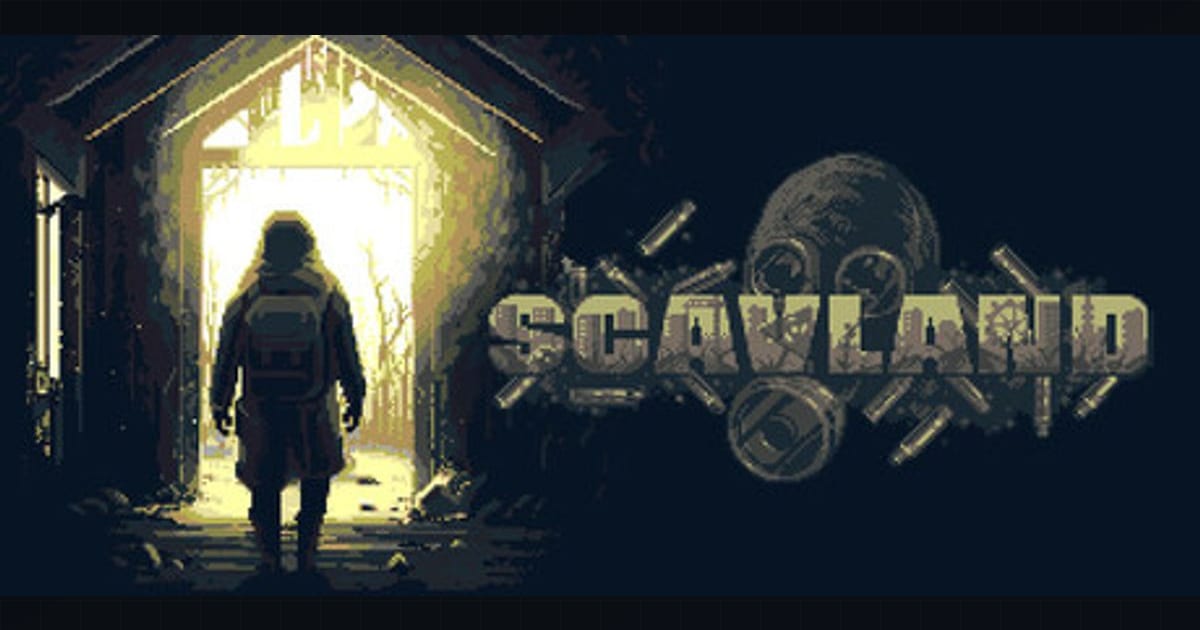
Scavland is a hardcore top-down pixel-art survival RPGRPG. Role-Playing Game — a game built around character progression, story, and player choices. set in Zalesye, a post-apocalyptic Soviet-flavored region wrecked by war and a phenomenon called the Mist. Developer NoShadow and publisher UNSUBSCRIBE confirmed the game will hit Steam Early Access on September 4, 2026, after roughly six years of development during which the team grew from three people to fifteen.
What changed in the announcement
The September 4 launch date was locked in via an August 20, 2026 community post on X and a series of press write-ups. The studio also published a free demo on Steam in June 2025 and has been running patch cycles through Patreon early builds and Steam’s experimental branch, with changelogs dating back to at least version 0.2.4 in early June 2025.
NoShadow describes Scavland as a “love letter” to S.T.A.L.K.E.R., Escape from Tarkov, Metro, Darkwood, Ultima Online, and Tibia. One of the developers credits Tibia specifically as the reason they started doing pixel art sixteen years ago, after trying to add a custom sword to a modded server as a kid. The genre pedigree is on the screen and in the systems.
How the systems fit together
The Steam page and the August 20 press coverage line up on a clear set of core systems, all tuned for a pure PvE experience. There is no player-versus-player in Scavland; the threat is the world.
Setting and premise
You play a Vulture, a scavenger living off what the old world left behind. The opening hook in the Steam description is that you “survived being near-fatally shot by mysterious soldiers said to have come from a far-away land with no Mist.” Now you want answers, and the people of Zalesye talk about the East as a promised land beyond the RO-29 Highway — a place untouched by the Mist and the horrors consuming the Continent. Whether those stories are true is up to you to find out.
Factions and reputation
Ten unique factions populate Zalesye, and a dynamic reputation system sits behind them. Traders offer weapons, attachments, supplies, and other valuable goods, but “their best stock has to be earned” — take jobs, complete requests, and build your relationship with the people of the region to unlock better items and opportunities. Your standing with each group shapes how they treat you, and the Steam page is explicit that “some are trying to rebuild society. Others are simply trying to survive it.”
Weapons and attachments
The arsenal is the headline number on the Steam page: 25+ weapons and 300+ attachments. Weapons are treated as something you build, not just loot. The Steam description explains that you collect firearms and attachments throughout the world, swap components, experiment with configurations, and tune a loadout around where you are going, what you expect to encounter, and how much you are willing to risk. Tactical combat itself supports firearms, melee, stealth, and weapon suppression, with ammunition scarcity and weapons that can jam as core pressures. Radiation is layered on top.
Open world and proceduralprocedural. Generated by rules or algorithms rather than hand-placed — e.g. terrain or quests that the game builds itself. bunkers
Zalesye is a handcrafted open world filled with abandoned structures, dangerous forests, irradiated swamps, hidden locations, mutants, and bandits. Beneath the surface, entrances lead to underground bunkers and other dangerous locations with procedurally generated layouts, creating different spaces to explore across playthroughs. The further you leave known roads and settlements, the greater the danger — and the better the rewards.
Combat and survival pressure
The combat design pulls from S.T.A.L.K.E.R. and Tarkov more than from arcade shooters. The Steam page describes tactical combat with firearms, melee, stealth, and weapon suppression, and the patch notes for v0.2.4.1 include the kind of granular balance changes that come from this kind of design: reducing bleed chance from human projectiles from 50% to 33%, capping shotgun bleed to one effect per shot instead of one per pellet, and improving player vision distance while aiming so that “players can now see enemies before being spotted.” Those are not just bug fixes; they are the traits of a game where sightlines, ammo count, and status effects decide engagements.
Radiation is layered on top of the combat pressure. The Steam description places irradiated swamps alongside the forests and abandoned settlements, and the developer commentary on patch notes lists both mutants and “environmental hazards” as ongoing threats. Day and night cycle was added in v0.2.4, with the team noting they temporarily removed the option to choose a fixed time of day while they tuned the lighting pass. The cycle is part of the survival pressure — the world changes around you whether you are ready or not.
Accessibility and platforms
Scavland was built with controller input and Steam Deck support from the start. The Steam page calls this out in its “SURVIVE ANYWHERE” section, noting that “your save follows you. Unfortunately, so does the Mist.” Steam Cloud support means players can save on a desktop PC and pick up the same session on a Deck, or any other supported device. The page also confirms that no platform parity is being sacrificed to make this work — controller support is treated as a deliberate accessibility decision rather than a port afterthought.
What Early Access contains, and what’s coming later
The “current state” section on the Steam page is unusually specific for Early Access:
- Handcrafted open world with procedural underground bunkers.
- Dynamic minimap and world map system.
- Journal for contracts, main quests, and side quests.
- 10 unique factions and a dynamic reputation system.
- Tactical combat with firearms, melee, stealth, and weapon suppression.
- 25+ weapons and 300+ attachments.
- Crafting, looting, traders, and contracts.
- Main and side quests.
- Dangerous creatures and environmental hazards.
- Day and night cycle.
- Original soundtrack.
- Full controller support and Steam Deck compatibility.
The full release is planned as a three-act story. Early Access will include Act I with the first region, core gameplay systems, factions, quests, and progression. Future updates will add Act II and Act III, each introducing new regions, quests, creatures, factions, and story content; additional weapons, equipment, crafting recipes, and points of interest; more underground bunkers; improved AI, balancing, optimization, and quality-of-life features; and a cooperative multiplayer mode. The Early Access window is anticipated at roughly 12 to 24 months, “depending largely on community feedback.”
Price is explicitly not changing between Early Access and full release: “No, the price of Scavland will remain consistent from Early Access through to full release, with the exception of seasonal discounts.” NoShadow has also committed to a public roadmap with community voting on priorities.
What it means for players
For survival RPG fans, Scavland is one of the clearest “old-school world-first” pitches of 2026. The Tibia and Ultima Online lineage is real, not decorative: top-down perspective, pixel art, ten factions with named reputations, contracts and quests driving the economy, and weapon customization as a long-tail pursuit rather than a flat tier list. The PvE-only design is a deliberate call against extraction-shooter griefing, and the 25+ weapons / 300+ attachments figure is large enough that loadout theorycrafting will be a major part of the endgame.
The Early Access timing matters too. With the Early Access window anticipated at 12 to 24 months, NoShadow is committing to a long public development runway rather than a quick-then-vanish approach. The studio has promised a public roadmap with community voting on priorities, and the price will not change between Early Access and full release except for seasonal discounts. For players who have been burned by Early Access projects that ship thin and then stagnate, that combination — fixed price, public roadmap, multi-year commitment, and a six-year track record already on the books — is the most concrete signal that Scavland is intended as a flagship project, not a quick cash grab.
The community process is also worth weighing. The team has stated they will listen to feedback through Discord, forums, and social media, and that they will shape the development roadmap based on the most-requested features. Given that cooperative multiplayer is explicitly listed as a post-Early-Access feature rather than a launch feature, players who care about co-op are betting on a feature that is documented but not yet in the build. That tradeoff is reasonable for a project of this scope, but it is worth naming.
There are caveats. The Steam system requirements are surprisingly light for a Unity top-down RPG — minimum Intel 2.77 GHz quad-core with 4 GB RAM and a 2 GB dedicated graphics card supporting OpenGL 2.1 and GLSL 1.2, with 1 GB of storage — which is a reminder that pixel art is not the same as low spec. The Early Access build is Act I only, with two more acts and co-op multiplayer planned but not yet in the launch build. There is a known bug with shotguns applying excessive bleeding that was patched in v0.2.4.1 but tracked in subsequent patch notes, and the v0.2.4.1 changelog also lists money going negative, dead bodies not saving, and certain status effects not functioning as known issues to watch at launch.