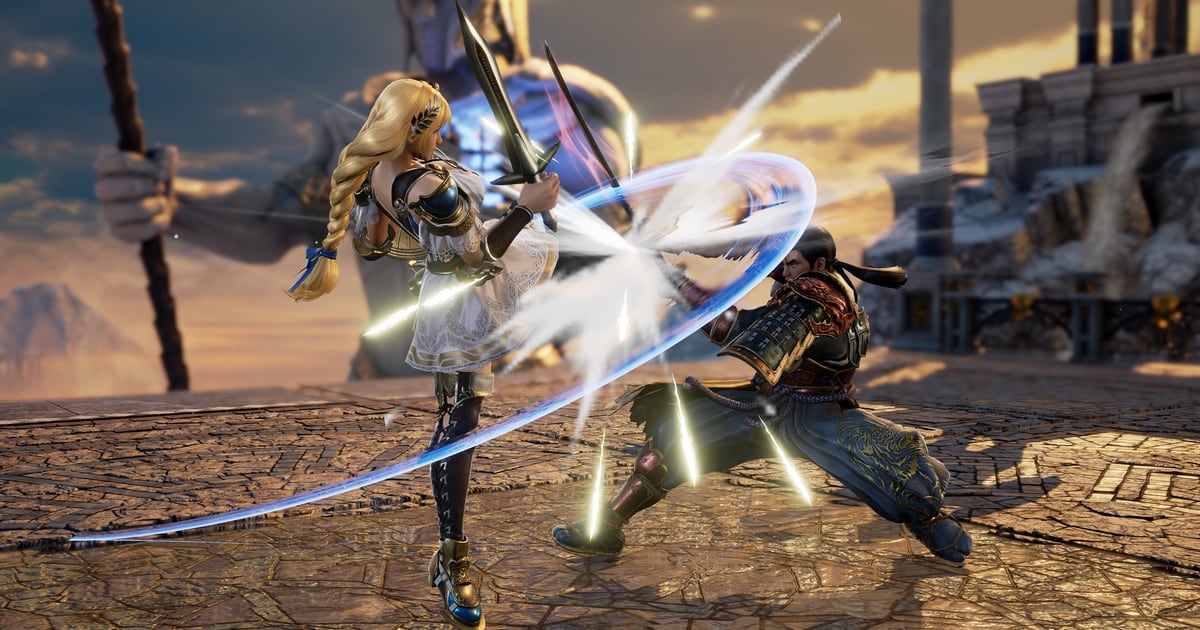
Soulcalibur VI shipped on 19 October 2018 for PlayStation 4, Xbox One and PC, developed by Bandai Namco Studios, and its official product page carries no patch notes newer than Ver. 2.31, dated 11 December 2020. So this is not a live-service primer. It is a primer for the game that exists on disk, written against 2.31, because the three defensive systems it asks you to learn — Reversal Edge, Guard Impact, Soul Charge — are the ones that still catch players arriving from 2D fighters.
This site has never covered Soulcalibur. The nearest piece is the Virtua Fighter 5 R.E.V.O. frame-data and throw-escape guide, 3D fighting theory for a game with no meter at all; the vocabulary does not transfer. What follows is what each system spends, what it beats, and which numbers are official versus measured.
What this covers: the input, cost, activation window and recovery of Reversal Edge, Guard Impact, Resist Impact and Soul Charge, plus the full rule set of the Reversal Edge clash — including the second round most guides skip. Why it matters: the clash is not a coin flip, but it is also not free. Every Reversal Edge attempt spends a fifth of a resource that also gates your guard, and the guard option inside the clash spends more of it than the attacks do. Who should care: players who bounced off the game because “the slow-motion thing feels random,” and anyone who owns it, has no live patch to wait for, and wants the defensive layer explained once, properly.
Three systems, three different currencies
The reason Soulcalibur VI’s defence confuses people coming from Street Fighter or Tekken is that its defensive options do not share one meter. Guard Impact taxes your guard. Resist Impact and Soul Charge spend Soul Gauge. Reversal Edge taxes your guard too, but pays some back if it works.
| System | Input | What it spends | Activation | Total recovery | Stops the attack? | Loses to |
|---|---|---|---|---|---|---|
| Guard Impact | 6G | 10% guard durability | Impact frames 2–11 | 46F | Yes — halts the opponent’s motion | Break Attack, unblockables (both cause Impact Counter) |
| Reversal Edge | B+G (hold to extend) | 20% guard durability, up to 22% on max hold | Parry stance from frame 6, holds to 50F | 80F or more including the attack | No — the attack is parried, not stopped | Break Attack, unblockables (Impact Counter) |
| Resist Impact | 6B+G | 50% of Soul Gauge | Impact frames 2–11 | 46F | Yes | Nothing in the game’s attack set |
| Soul Charge | 4A+B+K | 1 full Soul Gauge bar | Gauge spent on frame 3 | 50F, invulnerable from frame 4 | n/a — offence with an escape hatch | Nothing during the invulnerable window |
Those figures are not printed by Bandai Namco anywhere public. The store page describes Reversal Edge as “block your opponent’s assault and counterattack” and Soul Charge as “a temporary power-up to turn the tide of the battle,” and stops there. The frame and percentage values above come from the Japanese-language community reference wiki, and they are consistent with the guard-durability display the game itself shows in Training mode, where it labels the value GUARD CRUSH and prints it as a percentage. Treat them as measured, not certified — see the last section.
Reversal Edge is two moves stacked on one input
The single most common mistake is treating Reversal Edge as one button. It is a stance and an attack, and they have different properties.
Press B+G and you enter a parry stance. It comes out from frame 6, holds to frame 50, and parries every attack except Break Attacks and unblockables. Crucially, it parries without stopping the opponent: Guard Impact halts their animation, Reversal Edge does not, which is why the two feel similar and behave nothing alike afterwards.
Release B+G and you commit to the Reversal Edge attack — a mid vertical slash. If it connects, the game cuts to the clash. If it whiffs or is stepped, you are holding something with 80 frames or more of total recovery. That asymmetry is the whole design: the stance is cheap to enter and forgiving, the attack is expensive to miss.
Two more properties matter and are almost never mentioned in English-language material:
- Parrying pays you back. A successful parry builds Soul Gauge and restores a little guard durability, so the 20% entry cost is partly refundable if you read the opponent and pure loss if you did not.
- The attack upgrades. Parry at least once, or hold the stance to maximum, and the Reversal Edge attack gains Break Attack property — visible as a red lightning effect. That version can still be guarded normally, but it punches through the opponent’s Guard Impact and their Reversal Edge, and only Resist Impact repels it. Guard Impact’s own Break Attacks are the common A+B assignment, and hitting a Guard Impact or Reversal Edge with one produces an Impact Counter, one of the game’s universal Lethal Hit conditions.
So a Reversal Edge that parries something is not a neutral exchange. It converts into an attack that ignores the two most common defensive answers in the game.
What the four clash buttons actually beat
Once the Reversal Edge attack lands, both players get a short window to choose an action — the part everyone calls rock-paper-scissors. It is three attacks plus a guard, and the three attacks form a closed triangle:
| Input | Action | Beats | Loses to | Dodged by |
|---|---|---|---|---|
| A | Horizontal slash, high | K (kick) | B (vertical slash) | Forward input (6) — steps in crouching |
| B | Vertical slash, mid | A (horizontal) | K (kick) | Axis shift (2 or 8) — steps to the side |
| K | Kick, stepping left | B (vertical) | A (horizontal) | Back input (4) — backstep |
| G | Guard | All three attacks | Nothing, but see below | n/a |
The lever is a fourth answer and it is not cosmetic. Forward (6) ducks the horizontal, a sideways input (2 or 8) evades the vertical, and back (4) retreats out of the kick. Each lever option beats exactly one attack and loses to the other two — a harder read than pressing a button, better payoff when it lands. Guard answers all three attacks, and no input at all means guard is chosen for you.
What makes the exchange a decision rather than a lottery is what happens next.
Round one resolves nothing in three cases. If both players pick the same attack, if both pick guard, or if one picks B while the other picks guard, the clash runs a second round.
Round two is weighted toward whoever pressed B+G. In the second round, if the Reversal Edge initiator lands any attack option, it is a Lethal Hit — the yellow-effect, equipment-breaking version that builds large amounts of Soul Gauge and opens a bigger combo. If both players pick the same attack in round two, the initiator wins it outright with a Lethal Hit. If both guard in round two, the initiator comes out of it in a Guard Impact state at +28 frames of advantage, and the defender can answer with a Reverse Impact. And guarding the vertical slash in round two drains 100% of guard durability, which guarantees a guard crush.
Round one is not free either. Guarding an attack drains guard durability heavily, and guarding B in round one costs 50% of it and sends the exchange to round two anyway. Answering the clash with guard trades a resource you need later in the round to avoid a guess.
Why the read is a resource decision
Put the pieces together and the shape of the mechanic changes. Entry costs 20% guard durability — the same pool Guard Impact taxes at 10% and Guard Crush empties entirely. Guarding inside the clash drains it further, with the vertical slash taking half and the round-two version taking all of it. Meanwhile the thing you are trying to win is a Lethal Hit, which refunds Soul Gauge rather than spending it.
That is an unusual incentive structure for a defensive option: the system rewards initiative and punishes patience. The community reference makes the same point from the other direction — Reversal Edge is strong against big, high-recovery attacks and forced high/low situations, and weakest against an opponent who simply does nothing, because an empty stance held to frame 50 with nothing to parry is 20% of your guard gone and a committed whiff coming.
A Steam community beginner’s guide, last updated in June 2023, makes the same point from the receiving end: “Many people who don’t know this game thinks Reversal Edge is just random rock-paper-scissors… But fighting with other player is completely different. Each option are not equal and balanced. Different damages and different conditions.” Its example is character-specific ring-out conversions, which is the honest limit of a general primer: reach, startup and payoff vary by character.
One design statement is worth knowing. The same wiki reproduces a developer Q&A answer from EVO Japan 2019: Reversal Edge was built so players who had not memorised every attack could still participate in the mind game, and future adjustments would consider making Soul Gauge build more easily for players who avoid it. None of the notes reviewed here describe such a change.
What Soul Charge buys you on block
Soul Charge is the system the store page sells hardest and explains least. Mechanically it is a one-bar, roughly ten-second power-up with a defensive window attached:
- The gauge is spent on frame 3. From frame 4 through the end of the 50-frame recovery you are invulnerable — attacks pass through.
- On frame 6 a shockwave with Break Attack property comes out: no damage, ±0 on guard, +8 on hit, a special mid that can be stood or crouched to guard.
- Damage rises to 1.05× while charged.
- This is the part that matters on block: every attack deals chip equal to 20% of that move’s damage while charged, and Soul Charge-exclusive moves carry their own chip values. Moves that already had chip, such as the Reversal Edge attack, get the charge’s 20% added on top rather than replaced.
- The timer pauses during throws, the Reversal Edge clash and Critical Edge animations, and drains when you use Soul Charge moves or Resist Impact, or when you get hit.
- Kilik is the exception: his charge consumes health instead of time until it reaches the floor.
Two Season 2 additions hang off the same bar. Soul Attack (236A+B+K) spends one gauge to attack while transitioning into Soul Charge, with startup standardised at 16 frames across the roster. Resist Impact (6B+G) answers Break Attacks and unblockables, and during Soul Charge it costs 25% of the remaining charge instead of 50% of a fresh bar — the cheapest answer to the exact move that beats Guard Impact and Reversal Edge.
Read together: Soul Charge does not make you safer on defence. It makes your offence generate value even when blocked, and buys one invulnerable escape on the way in.
Patch history of the systems in this piece
| Version | Date | What it changed for these systems |
|---|---|---|
| Ver. 2.00 | Released 25 November 2019 | Added Soul Attack and Resist Impact for all characters. Reversal Edge no longer shifts into a Reversal Edge clash when the opponent guards the attack. Grapple breaks now deal slight damage, never a knockout. In-game tutorials were updated to teach the new systems. |
| Ver. 2.20 | Released 3 August 2020 | Added Setsuka as DLC. Balance adjustments to certain actions. |
| Ver. 2.25 | Released 10 September 2020 | Further balance adjustments to certain actions. Casual Match “WAITING” behaviour changed so spectators could join the next match. |
| Ver. 2.30 | Released 1 December 2020 | Fixed a bug where body parts could be destroyed by a specific input while Kilik was soul charged. Added a battle-screen icon for “Wind Bearer,” and updated Fighting Style Lessons for the balance changes. |
| Ver. 2.31 | 11 December 2020 | Balance adjustments to certain actions; a character-creation slider unintentionally changed to −50 to +50 was restored to −180 to +180. |
Two patterns are worth noting. Every patch after 2.00 warns that replay data from older versions stops being viewable, which tells you how much recorded history tuning invalidated. And the notes describe adjustments without publishing numbers — 2.25 and 2.30 both say balance adjustments were made and point elsewhere. That gap is what Geppopotamus fills: its log reads “UPDATE TO Ver.2.31.”
The official product page lists 27 news items for the game, 8 of them patch notes, and Ver. 2.31 is the newest. No end-of-support announcement appears there, so the honest statement is narrower than “support ended”: the newest official patch notes are from December 2020, and nothing on Bandai Namco’s pages supersedes them.
What is not confirmed
Soulcalibur VI has no in-game frame-data display. The Steam guide says so bluntly, and every frame number here traces back to community measurement rather than a Bandai Namco document. Three things I could not confirm and therefore did not assert:
- The official English names of the four clash options. The rules above are translated from the Japanese community wiki, which labels them horizontal slash, vertical slash, kick and guard. The English client’s on-screen wording may differ; the inputs and the triangle are what the source states.
- Any per-character clash numbers. Reach, startup and the consequence of each option vary by character. No universal figure exists and none is printed above.
- Whether the current online population makes any of this practical to learn. That is a lobby question, not a documentation one; the store page’s review summary when checked — Very Positive, 83% of 5,806 English-language reviews — measures sentiment, not matchmaking.
If you are weighing a 3D fighter with a live patch cadence, the Guilty Gear Strive defensive-systems piece covers a game still being tuned. Soulcalibur VI is a finished game with a defensive triangle nothing else has copied, and it is cheap to find out whether that triangle suits you.