Cloud Imperium Games (CIG) has published high-level engineering whitepapers detailing Server Meshingserver meshing. A technique that stitches many game servers together so players see one seamless world, even across server boundaries. v1.0—the core networking technology enabling thousands of players to smoothly inhabit the multi-star-system universe of Star Citizen. The docs outline a convergence of three previously separate ambitions: a true single-shardshard. A separate copy of a game world running on its own server; players on one shard don't share the world with another. universe, cross-system persistence without instancing, and a modern renderer capable of feeding that universe to the player without melting the host GPUGPU. Graphics Processing Unit — the chip that renders the game's visuals; the main driver of framerate and image quality.. This is the moment Star Citizen stops being a collection of engineering demos and starts being judged as an MMOMMO. Massively Multiplayer Online — a game that hosts very large numbers of players together in one shared, persistent world. architecture.
What changed: New whitepapers detail Server Meshing v1.0, Replication Layer isolation, and Vulkan RHI rendering. Why it matters: State survives server crashes; a true single-shard universe becomes architecturally plausible. Who should care: MMO players and hardware enthusiasts tracking Alpha 4.0’s demanding client spec.
1. Dynamic Server Meshing Architecture
Traditional MMOs divide players into isolated channels or instances. Server Meshing dynamically clusters physical server nodes to manage specific locations and entities within a single shared universe:
- Replication Layer Isolation: The game state memory layer is separated from dedicated server nodes. If a dedicated server crashes, the Replication Layer preserves player positions, cargo inventory, and ship states without triggering server disconnects.
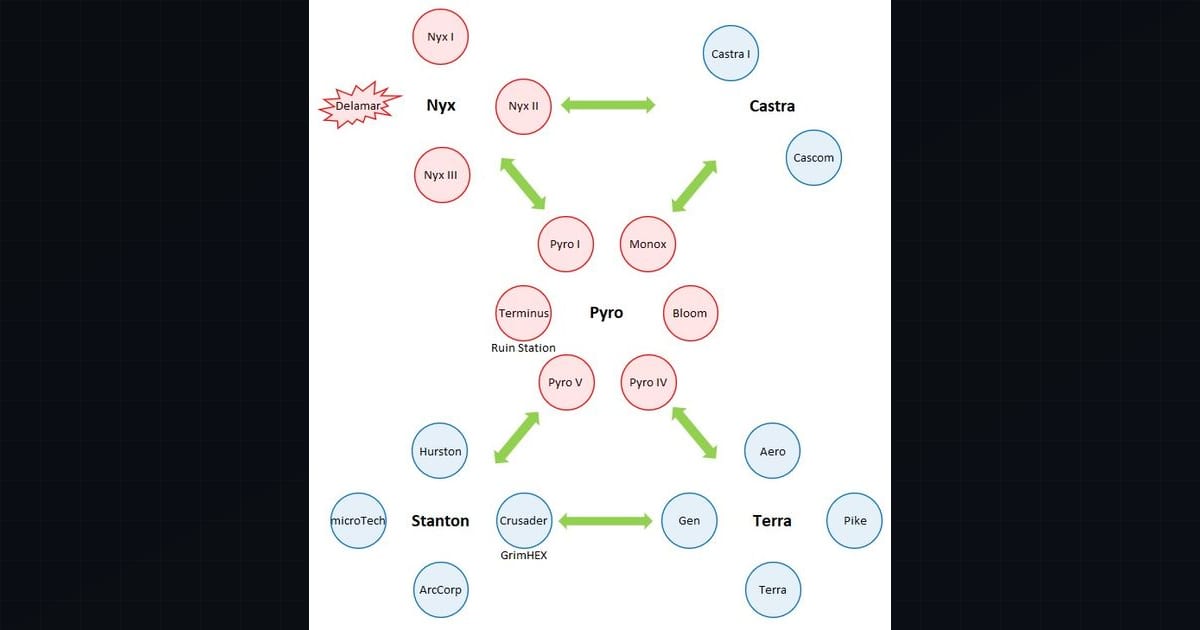
- Seamless System Transitions: Traveling through jump gates between the Stanton and Pyro star systems smoothly hand-offs player network sockets between regional server clusters.
- Object Container Streaming (OCS): Client PCs stream high-resolution planet textures, station interiors, and ship interiors in real-time, drastically reducing VRAMVRAM. Video RAM — memory on the graphics card used for textures and frames; more of it lets you run higher settings. overhead.
2. Vulkan RHI Render Pipeline
CIG has completed the migration from legacy DirectX 11 to a multi-threaded Vulkan RHI rendering pipeline, unlocking higher draw-call throughput and lowering CPU frame times in dense capital cities like Orison and Lorville.
Why It Matters: The Single-Shard MMO, Finally Earned
For two decades the MMO genre has quietly accepted a lie: “massively multiplayer” really means “a few hundred people per zone, with the rest shuffled into parallel shards you’ll never meet.” EVE Online’s single-shard Tranquility server is the famous exception, and even it leans on time-dilation rather than true dynamic load distribution. Everything else—World of Warcraft, Final Fantasy XIV, New World—partitions its player base into instances and calls it a world.
Server Meshing v1.0 is CIG’s bet that this compromise is no longer necessary. By making the Replication Layer the authoritative state owner and demoting dedicated servers to stateless compute workers, CIG decouples where a player is from which machine is simulating them. A server crash no longer ejects you to a login screen; the state survives, and a fresh node picks up the simulation. That is the architectural precondition for a persistent universe that can lose hardware without losing players—and it is the difference between a tech demo and a live service people can actually invest years into.
The Take: Persistence Is the Real Feature
The headline number everyone wants from Star Citizen is “thousands of concurrent players.” That is the wrong metric to fixate on. The genuinely consequential design decision in these whitepapers is state isolation: the Replication Layer holding cargo, ship positions, and player data independently of the simulation nodes.
This matters because the single most corrosive failure mode in live MMOs is the rollback. A server dies, a dupe exploit surfaces, an economy glitch propagates, and the studio’s only honest response is to rewind hours of player progress—eroding trust every time. A clean separation between authoritative state and ephemeral simulation makes rollbacks surgical rather than systemic. You can recompute a region without nuking the universe. You can hot-swap a buggy server node without a maintenance window. The feature players will actually feel is not “more people on screen”; it is “the thing I spent four hours earning is still there tomorrow.”
Pair that with seamless jump-gate handoffs between Stanton and Pyro and the product proposition sharpens: Star Citizen is selling a contiguous, consequential universe, not a lobby with a space skin. If the Replication Layer holds up under load, that is a genuinely new bar for the genre.
What It Signals: The Genre’s Infrastructure Arms Race
Read alongside recent moves from other studios, CIG’s whitepapers land in a broader context:
| Project | Context | Outcome |
|---|---|---|
| Dual Universe | Voxel MMO with a similar single-shard ambition | Folded — proving the engineering is necessary but not sufficient; you also need a sustainable economy and shipping cadence |
| Starfield | Shipped a vast universe that is, by design, single-player and instance-light | Sidestepped the networking problem entirely |
| New World | Amazon’s entry in the genre | Has iterated toward smaller, more controlled concurrency rather than outward |
CIG is betting the opposite direction: that the audience for a high-fidelity, shared, persistent space-sim MMO is large enough to justify a custom networking stack that no off-the-shelf engine provides. The Vulkan RHI migration reinforces that bet—it is the renderer-side equivalent of “we will own the hard layer ourselves.” Multi-threaded command submission and reduced CPU frame time in dense hubs like Orison and Lorville are not just polish; they are the client-side precondition for meshing to feel good. You cannot deliver a single-shard universe where the player’s own machine is the bottleneck every time they enter a city.
The risk, as ever with Star Citizen, is execution velocity versus the clock. The architecture described here is correct and arguably industry-leading on paper. The open question is whether the surrounding game—content cadence, economy balance, bug surface, server cost economics—can keep pace with the engineering. Meshing v1.0 solves the “can it exist” question. It does not solve the “will people stay” question.
Context: Hardware, Not Hype
The recommended spec—Core i7-14700K or Ryzen 7 7800X3D, 64 GB RAM, an RTX 4080—reads less like a marketing flex and more like an honest acknowledgment of what this architecture demands on the client. Object Container Streaming shifts work from VRAM to streaming bandwidth; Vulkan multi-threading shifts work from the GPU queue to CPU cores; meshing shifts work from one server to many. Every layer of the design assumes the player is running near-contemporary hardware with headroom to spare.
For a silicon-focused audience that is the real signal: Star Citizen is becoming a benchmark for whether enthusiast-class PCs can sustain a genuinely shared persistent world at acceptable frame rates. If Alpha 4.0 delivers on the whitepaper’s claims, the 7800X3D’s cache hierarchy and the 4080’s VRAM become the de facto reference platform for high-concurrency MMO client rendering—and the next generation of consoles, starved of that memory bandwidth and CPU thread budget, will look even less capable of running it.
The whitepaper’s claims face their first public verdict when Alpha 4.0 ships in 2026 with the Pyro system live under meshing. If the Replication Layer holds under real population load, the recommended 7800X3D/RTX 4080-class client becomes the genre’s new reference platform; if it does not, the single-shard bet returns to the drawing board.
Next read
- For the packet-level mechanics behind all this, see our Star Citizen server meshing netcode explainer.
- For what the 3.X economy means for your hangar, see the Star Citizen patch economy & ship buyer guide.
- Every Star Citizen breakdown lives on the coverage hub.