You can fly from a hangar on one planet, cross a jump point into an entirely different star system, and land at a station hosted by a completely different machine — and Star Citizen never shows you a loading screen. That trick is server meshingserver meshing. A technique that stitches many game servers together so players see one seamless world, even across server boundaries., and it is the single most important piece of technology in the game’s persistent universe. Here is how it actually works, what changed when it shipped, and where Cloud Imperium Games says it is going next.
What changed
For most of its alpha history, Star Citizen’s persistent universe ran on what the studio now calls the 3.x-era architecture: one game server simulated the entire universe for a shardshard. A separate copy of a game world running on its own server; players on one shard don't share the world with another., and the player cap per shard sat around 100. Everything — every planet, every station, every player, every AI — lived inside that single server process. When that server struggled, everyone on the shard felt it, and when it died, the shard went down with it.
Chris Roberts’ Letter from the Chairman laid out the shift: with the 4.0 generation of the game, “each planet, landing zone, or major station is now covered by different game servers,” and “server boundaries are effectively invisible, even at our high levels of fidelity, ensuring smooth, uninterrupted gameplay.” Just as important, the letter notes that “server performance, playability, and overall health are now local to each of the nodes in the server mesh.” A problem in one corner of the universe no longer has to be everyone’s problem.
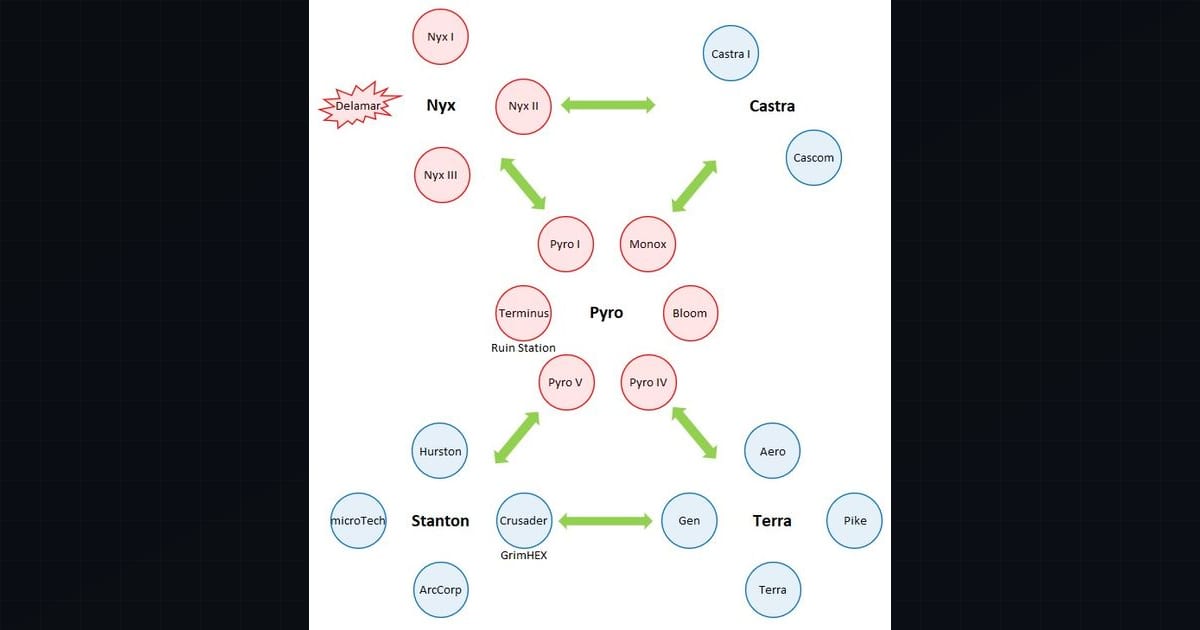
The launch of the networked architecture also enabled Stanton and the Pyro system to run in parallel, with players travelling between them through jump points — physically moving between different server layers while doing so. In an official CIG press release accompanying Alpha 4.1.1, the studio reported an over-90% reduction in unstable or unrecoverable servers since the start of 2025, and described the Aegis Idris capital ship as a live stress test that pushed concurrency and the static mesh configuration to their highest levels yet, with the mesh “properly segmenting universe zones with minimal issues.”
How it works
The current live setup is static server meshing. CIG’s technical staff have described it in detail on official broadcasts: the universe is divided into territories — top-level regions of the game’s giant scene tree, such as individual planets, moons, landing zones, and stations — and each territory is assigned ahead of time to a dedicated game server. The studio has said it currently runs around ten game servers per shard, with the configuration adjusted patch by patch to put computing power where players congregate, such as event locations.
Two design choices distinguish CIG’s approach from the classic “grid of zones” model other MMOs have used for decades.
First, simulation and replication are separated. In earlier architectures (and in most MMOs), one server both simulates the world and synchronizes state to clients. Star Citizen extracts the networking side into a dedicated layer — internally referred to as the “hybrid” — that holds the shard’s full state in memory and handles replication. Your client connects to that layer, not directly to whichever server is simulating your area. The game servers effectively act as clients with authority over specific territories. CIG has explained that this layer is held to an extremely strict standard: a single crash in it is enough to block a patch, because it is the component every player traffic flows through.
Second, authority is mapped in 3D space against a tree, not a flat grid. Because the universe is a hierarchy of nested containers (a room inside a station, a station near a moon, a moon around a planet), authority can move up and down that tree. CIG’s engineers have given the example of an underused server being despawned so that its parent node can absorb authority over everything it was handling — a building block for scaling the mesh up and down rather than running a fixed layout forever.
What this means in practice: crossing a territory boundary hands you from one simulating server to another without a transition screen, and because replication flows through a shared layer, projectiles and entities can traverse the boundary rather than vanishing into a zone seam.
Build path
CIG has been public about how this architecture was staged. The roadmap shows the sequence of prerequisites that shipped across the 3.x era — server-side object container streaming, the persistent entity streaming layer, and the replication layer — before static meshing could exist at all. Roberts’ letter notes that the Tech Preview Channel was created precisely to validate major technology like the replication layer and server meshing in isolation, on builds “uninfluenced by new code,” before merging it into the main development stream. That channel has since been extended to gameplay feature testing as well.
The studio has also described what comes next in concrete terms. Dynamic server meshing is the end state: instead of a hand-authored territory map, the mesh would reconfigure at runtime, subdividing the scene tree arbitrarily — any node deemed a “streaming group” could get its own server authority, and servers could be spun up or despawned based on live load. CIG engineers have said the load formula they are learning from the static mesh involves player count, the resource footprint of the location itself, the ships present, and the proximity of neighboring areas — data gathered from reconfiguring the live static mesh every patch.
Closely tied to that work is instancing. The game already has a primitive version in instanced hangars: multiple stacked copies of a location exist at once, but only yours is bound and replicated to your client. CIG has stated that the instancing technology it is building shares mechanics with dynamic meshing, with the goal of distributing instances across the mesh so no location has to be tied to one physical server. The studio has also been candid that it will not flip a single “dynamic meshing is live” switch; it expects to ship meshing improvements incrementally — despawning underused servers, dynamic scaling of the territory map, then instancing support — each through tech previews first. Higher per-shard player counts remain a someday goal, but CIG has explicitly said raw player count is not the current priority; automatic workload distribution is.
What it means
The measurable effects on players have been significant. On the official Star Citizen Live tech talk with CTO Benoit Beausejour, the studio described the before-and-after in blunt terms: the 3.x era meant roughly 100 players per shard with single simulated-server performance in the low single digits of server frames per second, while post-meshing shards average roughly 20 server FPSframerate. How many images (frames) the game shows per second; higher = smoother motion. 60 fps is a common target. and have been pushed to 600–800 concurrent players in testing. Beausejour also said average session length has roughly multiplied compared to the 3.x era, attributing part of that to server recovery, which keeps a session alive through server failures that would previously have ended it.
There are honest caveats. The mesh is static, so its layout is only as good as the current patch’s configuration, and events that concentrate players can still drag down the server responsible for that territory. Bugs specific to a multi-server universe — from quantum-drive transitions losing power mid-handoff to freight elevator desyncs — have been regular patch-note material, and CIG tracks per-territory performance statistics precisely because health is now local rather than global. Cross-system features like medical signals also had to be rebuilt for a meshed world, with the studio describing a new backend service that maintains a lightweight symbolic view of the universe so gameplay systems can coordinate across servers.
The bigger picture is structural. Server meshing turned Star Citizen from one overloaded simulation per shard into a distributed system that can grow territory by territory, which is the only plausible path toward the studio’s stated goal of a much larger shared universe. It is also the scaffolding for everything announced afterward: additional star systems travelling through more jump points, instanced group content that can pick up where you logged off, and event-scale encounters that assume the mesh can absorb concentrated load. The foundation is live and measurable today; the dynamic version, and whatever shard sizes it eventually allows, is the part still being built in front of the community.