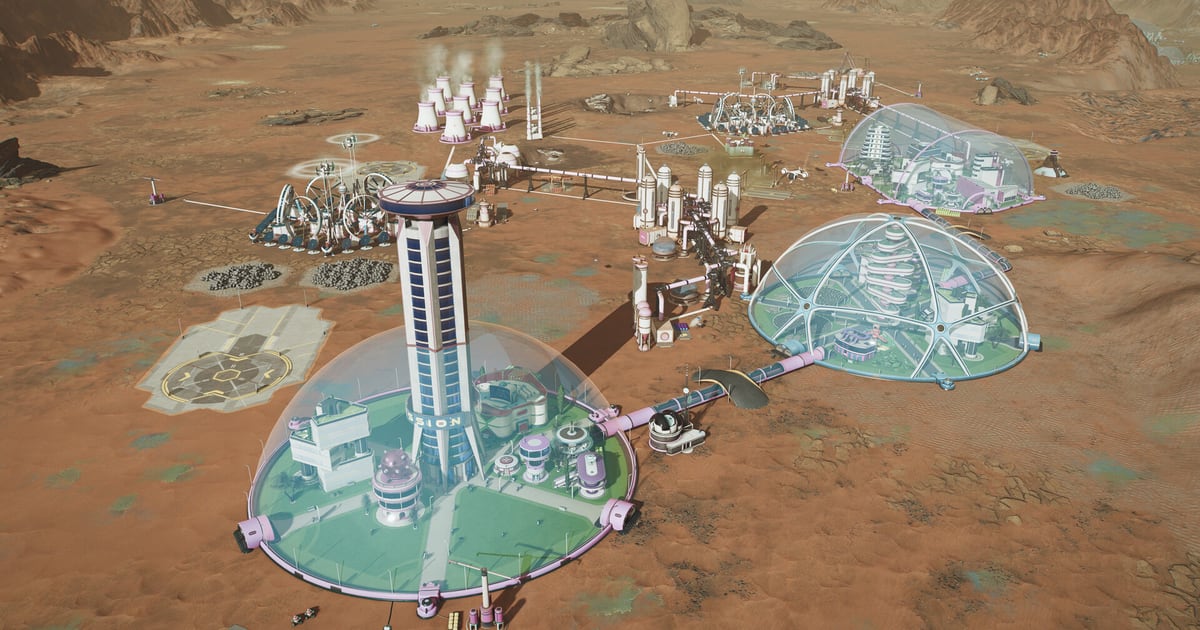
Surviving Mars: Relaunched asks for two names before it gives you a colony: the sponsor that funds the expedition and the commander profile that leads it. The official wiki lists fourteen sponsor rows, one of them from the Prime Mission expansion pass, and eighteen commander profiles across the base game and Feeding the Future. Together they set funding, the colonist pool, research, the rare metals price, rockets, starting technologies and difficulty.
This piece reads those tables as a decision. The colony guides here start after that point — RimWorld’s day-0-to-30 plan works from traits and precepts once a tile is chosen, Farthest Frontier’s first winter from map overlays — while Relaunched puts a briefing before either question. Everything below assumes patch 1.1.1, published 23 September 2026, with the 1.1.0 Services & Science rework underneath.
What this covers: The sponsor and commander tables row by row, what each figure changes about the opening sols, and which combinations to take first. Why it matters: Starting funding, rockets and research are fixed at the briefing, and patch 1.1.1 changed how the power, water and oxygen grids fail under shortage. Who should care: Anyone starting a first Relaunched colony, or restarting after a sponsored run that felt too thin.
What the sponsor sets, and what the commander sets
The wiki defines sponsors narrowly: they “fund the initial Mars expedition, provide a base amount of research and pay for rare metals”. That covers the economy — money, people, research, export income — plus a unique building, a unique vehicle, sometimes a pre-researched technology and a difficulty tag. One trap in the page’s fine print: unique buildings “are lost if the colony becomes independent but can be unlocked again by completing a Mission Goal”, so a signature building is a mid-game asset, not a permanent one.
The commander is a single exception on top. Profiles are “descriptions of the leader of the mission”, each offering “a bonus (almost all of them permanent)” and, in almost every case, “a technology already researched”; during Story Bits some add extra options for the problem in front of you.
Paradox Interactive is gated by an account action rather than money: its product page offers an “Exclusive Mission Sponsor” for signing up to the Relaunched newsletter, and the wiki states it is unlocked through that signup.
The sponsor table
Figures are printed as the wiki prints them: funding in millions, rare metals as the per-sponsor export figure, rockets as the count you start with.
| Sponsor | Funding | Colonists | Research | Rare metals | Rockets | Difficulty |
|---|---|---|---|---|---|---|
| International Mars Mission | 30,000M | 200 | 300 | $25M | 4 | 0% |
| USA | 8,000M | 100 | 300 | $25M | 3 | +40% |
| Blue Sun Corporation | 10,000M | 100 | 100 | $30M | 2 | +50% |
| China | 8,000M | 200 | 200 | $25M | 3 | +60% |
| India | 7,000M | 150 | 100 | $24M | 3 | +90% |
| Brazil | 9,000M | 100 | 100 | $35M | 1 | +100% |
| Terraforming Initiative | 8,000M | 100 | 100 | $24M | 2 | +100% |
| Europe | 6,000M | 100 | 400 | $22M | 2 | +110% |
| SpaceY | 6,000M | 75 | 200 | $20M | 5 | +130% |
| Church of the New Ark | 4,000M | 120 | 0 | $20M | 1 | +170% |
| Japan | 6,000M | 50 | 100 | $20M | 1 | +170% |
| Russia | 5,000M | 100 | 200 | $22M | 2 | +180% |
| Paradox Interactive | 4,000M | 75 | 100 | $24M | 1 | +200% |
| Interplanetary Codex | 4,000M | 200 | 150 | $25M | 3 | 0% |
Read it as five dials, not one slider.
- Funding has the widest spread: 30,000M for the International Mars Mission against 4,000M for the Church, Paradox Interactive and the Codex.
- Colonists runs from 50 (Japan) to 200 (International Mars Mission, China, Codex). A small pool leaves less slack when people stop working.
- Research is the column most people skip. Europe starts at 400, the International Mars Mission and USA at 300, the Church at 0 — the only zero row.
- Rare metals is the export price paid: $35M for Brazil at the top, $20M for SpaceY, the Church and Japan.
- Rockets is the count you start with; Rocket Scientist adds two to whatever you have.
The Codex row is not base-game content. The Feeding the Future launch announcement describes the Ultimate Edition as bundling the base game with the “Prime Mission” Expansion Pass, “including the Instant Unlock – Interplanetary Codex, a new Mission Sponsor, Feeding the Future, and Machine Utopia”, and the wiki tags its DLC as Prime Mission. Own the base game only and thirteen rows apply.
The commander table
| Profile | What it changes | Starts with | Difficulty |
|---|---|---|---|
| Rocket Scientist (Recommended) | Two extra rockets | CO2 Jet Propulsion, Advanced Martian Engines | 0% |
| City Mayor | 2,000M extra funding, less frequent upkeep | Mars Nouveau | -30% |
| Oligarch | Fuel production +100%, fuel exportable | Arcology | -30% |
| Geo Engineer | Seeds imports -50%, terraforming prefabs | Designed Forestation (breakthrough) | -20% |
| Space Miner | Asteroid found, free Asteroid Lander | Recon Center, Micro-G Mining | -20% |
| Spelunker | Sanity regained underground, Elevator prefab | Low-G Shaft Tunnelling | -20% |
| Transport Tycoon | Track cost halved, station prefabs | Martian Railways, Large Stations | -20% |
| CEO | All funding gains +20% | Martian Patents | 0% |
| Politician | Law prep -50%, two laws at once, happier factions | None | 0% |
| Inventor | Drones keep improving until Sol 100 | Autonomous Hubs (breakthrough) | +10% |
| Doctor | Birth comfort threshold -15 | Stem Reconstruction | +10% |
| Transhumanist | +5 sanity resting at home | Behavioral Shaping | +10% |
| Ecologist | Decorations +10 comfort, spire prefab | Hanging Gardens | +10% |
| Hydro Engineer | Water deposit revealed, domes -25% water | Water Reclamation | +20% |
| Astrogeologist | Rare metals deposit revealed, extractors +20 performance | Deep Scanning, Deep Asteroid Survey | +20% |
| Futurist | Breakthroughs refund 50% research, extra choice | None | +30% |
| Agronomist (Feeding the Future) | Vegetation and Open Farm thresholds -30%, crops 33% faster | Soil Adaptation | -30% |
| Horticulturalist (Feeding the Future) | Hydroponic Farms need no workers | Utility Crops, Gene Adaptation | -30% |
Rocket Scientist carries the wiki’s own “Recommended” tag, and its two technologies explain why: CO2 Jet Propulsion “Unlocks Shuttle Hub and long-range transportation”, and Advanced Martian Engines makes rockets and shuttles “require less fuel”. Transport is the constraint the opening is made of.
How the difficulty figure behaves
The sign convention is visible in the wiki’s game-rules table, which uses the same scale: Easy Maintenance -200%, Twister +30%, Armageddon +50%. Negative describes an easier run, positive a harder one. That page also states the challenge level “will never drop below 100%”, that the hardest setting from game rules alone is 780%, and that “the difficulty rating will be affected by Sponsor, Commander, Mystery and the map you choose”.
Four inputs are named; the arithmetic is not published there. Sponsor and commander are two of only four things settled before the colony exists, so a -30% profile against a +170% sponsor reads as a smaller penalty, not an easy run.
Rockets, then money
Rockets carry what arrives from Earth, and base travel time is 25 hours each way — a figure the game-rules page gives while describing Long Ride, which triples it, “or 100h for Russia”. That longer travel is one of Russia’s listed drawbacks.
That makes the rocket column compound where funding does not. The International Mars Mission starts with four and Rocket Scientist adds two, for six; SpaceY starts with five and reaches seven the same way. Brazil, the Church, Japan and Paradox Interactive each start with one and reach three — one import pipeline against three. Fuel is the other half: the International Mars Mission’s rockets “synthesize Fuel (self-refuel)”, removing the fuel chain from the first sols, while the Paradox sponsor’s base rockets carry a “80 Fuel” refuel requirement listed as a drawback.
Starting funding buys the first wave of buildings; income traits keep the colony solvent. USA collects 500M every five sols. Brazil pays 10M per colonist on arrival, turning passenger rockets into revenue. Europe pays 150M per researched non-breakthrough technology and 300M per breakthrough. India reduces all building costs by 20%. The Codex pays 50M per happy factionfaction. An in-game group or nation players can align with or fight against, with its own goals and reputation system..
CEO raises all funding gains by 20%, and its starting technology was reworked in 1.1.0: Martian Patents “now provides Funding per Sol, increasing with each Tech Point spent, rather than a flat one-time gain”. That makes CEO strongest beside sponsors whose income arrives in many small payments — Brazil’s per-colonist, Europe’s per-technology, the Codex’s per-faction.
Research became a different currency in 1.1.0
Services & Science replaced the research queue with Tech Points: research accumulates toward Tech Points, “All Technologies cost 1 Tech Point”, each new point needs more research than the last, and technologies sit on a hex grid where points can only be spent adjacent to what you already researched.
That makes the research column more valuable, not less. A sponsor starting at 300 or 400 begins closer to its first Tech Point, and because every technology costs exactly one, an early point is worth as much as a late one. It also matters for Rocket Scientist: its two pre-researched technologies are two grid nodes you never had to walk to.
Japan reads oddly until you check the notes. It earns research per scanned sector, “1000 if a sector that was still unexplored is Deep Scanned directly”, and 1.1.0 says Haemimont “doubled Japan’s deep-scan bonus so a direct deep scan matches scanning in two steps”. Its 50 colonists are the smallest pool in the table, but 1,000 research for one deep scan is a real opening.
The traits that change one resource
Hydro Engineer answers water three ways: a deposit revealed at the start, 25% less water per dome, and Water Reclamation as its starting technology. Astrogeologist does the same for rare metals — deposit revealed, plus 20 performance on extractors — which turns an export economy on before the first passenger lands.
Power and fuel: Oligarch doubles fuel production and lets you export it; Russia makes the Fueled Extractors upgrade free and halves the Fuel Refinery prefab cost; SpaceY’s unique building is the Solar Array, its drone hubs hold four extra drones and 20 more command capacity, and advanced resources from Earth cost 50% less.
Food: the Church doubles birthrate and starts every colonist with the Religious trait, but its Hydroponic Farms take a flat -30 penalty since 1.1.0, where it had been -50%. The International Mars Mission pulls the other lever, multiplying food from passenger rockets by five.
Terraforming: Geo Engineer halves seed import cost and starts with two GHG Factories and two Forestation Plants as prefabs; the Terraforming Initiative gets a 50% boost to terraforming technologies, Forestation Plants that need no power, and RC Dozers from the start.
What 1.1.1 changed that touches this decision
The 1.1.1 notes change grid behaviour under shortage: “Instead of turning the whole grid off, buildings will be disabled in stages depending on their priority - first, all low priority buildings will shut down”. 1.1.0 had shut down all consumers on an unbalanceable shortage. Building priority is now a survival setting on your power, water and oxygen grids.
Earthsick changed in 1.1.0: Founders can no longer get Earthsick, and Earthsick now applies “when below the threshold of 30 Comfort rather than exactly at it”. The International Mars Mission’s “colonists never get Earthsick” trait is therefore less unique than it reads, though it still removes a mid-game failure mode.
Food also decays — 1.1.0 added “at the end of each Sol, 4% of stockpiled Food will disappear” — and building costs in Concrete and Metals went up. Both push value toward construction discounts and away from stockpiling imports.
Four pairings worth taking
| Sponsor and commander | Tags | Why it works |
|---|---|---|
| International Mars Mission + Rocket Scientist | 0% and 0% | Six rockets, self-refuelling, passenger food multiplied by five, no Earthsick. The softest way to learn the new grid-priority rules. |
| Europe + City Mayor | +110% and -30% | 400 starting research with 150M per researched technology, plus 2,000M, cheaper Metal and Concrete builds and less frequent upkeep. |
| Brazil + CEO | +100% and 0% | The highest rare metals price in the table, 10M for every colonist that lands, and 20% on top of both. |
| SpaceY + Inventor | +130% and +10% | Seven rockets, drone hubs holding four extra drones and 20 more command capacity, and drones that keep improving until Sol 100. |
Avoid the high-difficulty rows on a first colony: Japan and the Church sit at +170% with one rocket each, and Paradox Interactive at +200% with one rocket and 75 colonists.
What to leave for the second colony
Two rows are endgame rows rather than opening rows. Politician matters for the law game, and laws are live from the start: tier 1 can be voted immediately, tiers 1 to 3 are always available, and the Martian Assembly spire unlocks tiers 4 to 11 plus the Governance laws. Preparing a law takes two sols, which Politician cuts to one, and it is the only profile that lets you prepare two at once. Strong for a politics run, wasted on a colony that never builds the Assembly; the Frostpunk 2 council guide is the closest thing on this site to that style of play.
The Codex is the other: a paid unlock whose traits assume a political layer the Founder stage does not reach for a while.
For a first colony on 1.1.1 the answer is unglamorous. The International Mars Mission with Rocket Scientist starts at 0% on both rows and hands you six rockets, free fuel, five times the passenger food and immunity to Earthsick; the other 0% rows — the Mission with CEO or Politician, or the Codex with any of the three — trade that transport package for income or politics. Pick a flag on the second run.