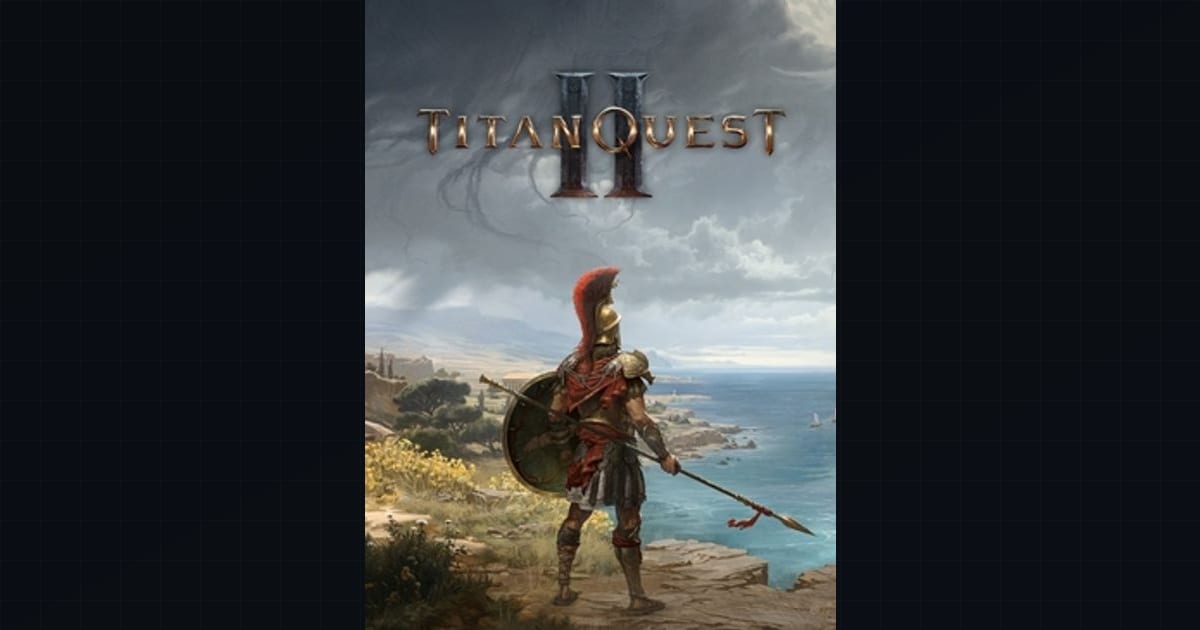
Grimlore Games and THQ Nordic have published developer blog notes for Titan Quest II, detailing how players combine any two elemental or martial Masteries to form unique hybrid character builds in ancient Greece. It is the most concrete mechanical signal yet that the sequel intends to honor the 2006 original’s identity rather than chase the action-RPGRPG. Role-Playing Game — a game built around character progression, story, and player choices. trends that have calcified the genre in the years since.
Dual-Mastery Character Building
- Hybrid Class Matrix: Combining Warfare with Storm creates a Tempest; combining Earth with Rogue creates an Ashstalker.
- Modifier Attributes: Attribute points directly influence skill behavior. High Agility grants extra projectile pierces, while Might increases status effect knockdowns.
- Hand-Crafted World Design: The campaign world features hand-designed terrain layouts rather than fully proceduralprocedural. Generated by rules or algorithms rather than hand-placed — e.g. terrain or quests that the game builds itself. maps, highlighting ancient Greek temples and mythological monster dens.
The headline mechanic is the dual-mastery system: pick any two of the game’s Masteries — elemental or martial — and the combination resolves into a named hybrid class. Warfare plus Storm yields the Tempest; Earth plus Rogue yields the Ashstalker. This is a direct revival of the combinatorial class model that made the original Titan Quest a sleeper legend, and it is the single most important design decision in the sequel’s pitch.
Why It Matters: Combinatorics Over Classes
The modern action-RPG has largely converged on one of two models: the fixed class tree (Diablo, Last Epoch, Grim Dawn’s later expansions) or the fully open skill economy (Path of Exile’s passive ocean). Dual-mastery sits in a deliberate middle lane. With N masteries, you get N×(N−1)/2 distinct named combinations, each with its own fantasy, stat priorities, and synergy surface. That is a level of build diversity that fixed classes cannot match, but it remains legible to a player in a way Path of Exile’s atlas of nodes does not.
The strategic payoff is replayability without content bloat. A studio does not need to ship ten distinct campaigns to give players ten distinct playthroughs — the same content refracts through a different mastery pair each time. For an Early Access title targeting Q4 2026, that is an economically sane way to promise depth before the full content arc is finished. It also gives the meta room to breathe: even if one combo is overtuned at launch, the long tail of undiscovered synergies keeps the community theorycrafting for months.
The Take: Attribute-Driven Skill Modifiers
The more quietly interesting detail is the modifier-attribute system. Points spent in Agility do not just raise a damage number — they grant extra projectile pierces. Might does not just add hit weight — it increases status-effect knockdowns. This is stat-as-skill-behavior rather than stat-as-multiplier, and it is the kind of design choice that separates a memorable build engine from a spreadsheet simulator.
The risk is obvious: when attributes reshape skill semantics, balance becomes combinatorial rather than linear. Every mastery pair interacts with every stat vector, and the knockdown-on-Might interaction on an Ashstalker will not behave like the same interaction on a Tempest. Grimlore is signing up for a balance surface that grows quadratically with mastery count. If the team treats that as a live-ops discipline rather than a launch-day checkbox, the game has a long healthy life. If they ship it and walk away, the meta will ossify into two or three “solved” builds within a quarter — the exact fate that hollowed out several recent ARPGARPG. Action RPG — an RPG with real-time combat rather than turn-based fights. launches.
Unreal EngineUnreal Engine. A widely-used commercial game engine from Epic Games; powers many large-studio (AAA) games. UE5 is the current generation. 5 & The Hand-Crafted Bet
The recommended spec — a Core i7-12700 or Ryzen 7 5700X, 32 GB of RAM, and an RTX 3070 Ti — is a clear tell that Titan Quest II is leaning on Unreal Engine 5’s Nanite and Lumen pipelines. The minimum spec’s RTX 2060 is the floor for Lumen’s software fallback; the recommended 3070 Ti is where hardware-accelerated ray-traced global illumination stops being a slideshow. This is not a game that will run on a Steam Deck at native resolution without aggressive upscaling.
What is more revealing than the GPUGPU. Graphics Processing Unit — the chip that renders the game's visuals; the main driver of framerate and image quality. ask is the world-design philosophy behind it: hand-crafted terrain, not procedural generation. In a genre that has spent the last decade optimizing for infinite replayability through randomized maps, Grimlore is making a contrarian bet — that authored Greek temples and mythological monster dens will hold player attention better than another shuffled tileset. It is a wager that ARPG fatigue is partly a content-pipeline fatigue, and that players will value a curated Hades-themed dungeon they remember over a procedural one they forget. Given how saturating the procedural-map market has become, it is the right bet to differentiate on.
Co-op, Endgame, and the 3-Player Constraint
Online co-op supports up to three players with dynamic loot instance scaling and monster difficulty adjustments. The three-player cap is worth pausing on. Four has been the ARPG co-op default since the original Titan Quest and Diablo III; dropping to three tightens the action economy, forces clearer party composition (one tank, one ranged, one support-flex), and reduces the visual noise floor that makes four-player ARPG screens read as particle soup. It is a small number with large combat-design implications — fewer bodies means each player’s build has to carry more identity, which loops cleanly back into why the dual-mastery system matters.
Dynamic loot scaling is the less glamorous but equally load-bearing piece. If drop rates and monster health do not scale gracefully with party size, co-op either trivializes the game or starves players of rewards. Grimlore calling this out in pre-Early-Access notes suggests they have been burned by — or at least studied — the loot-economy failures of contemporaries that shipped co-op first and balanced it later.
What It Signals
Taken together, the notes describe a sequel that knows exactly what it wants to be: a combinatorial build engine in an authored mythological world, sized for a smaller, sharper co-op group, running on a modern lighting pipeline that justifies its GPU requirements. The danger for any nostalgic sequel is trying to be everything to everyone who loved the original. Titan Quest II’s early design choices — fewer players, authored maps, semantic stats — read as a willingness to subtract in service of identity. That restraint is the strongest indicator yet that this is a sequel worth following into Early Access.