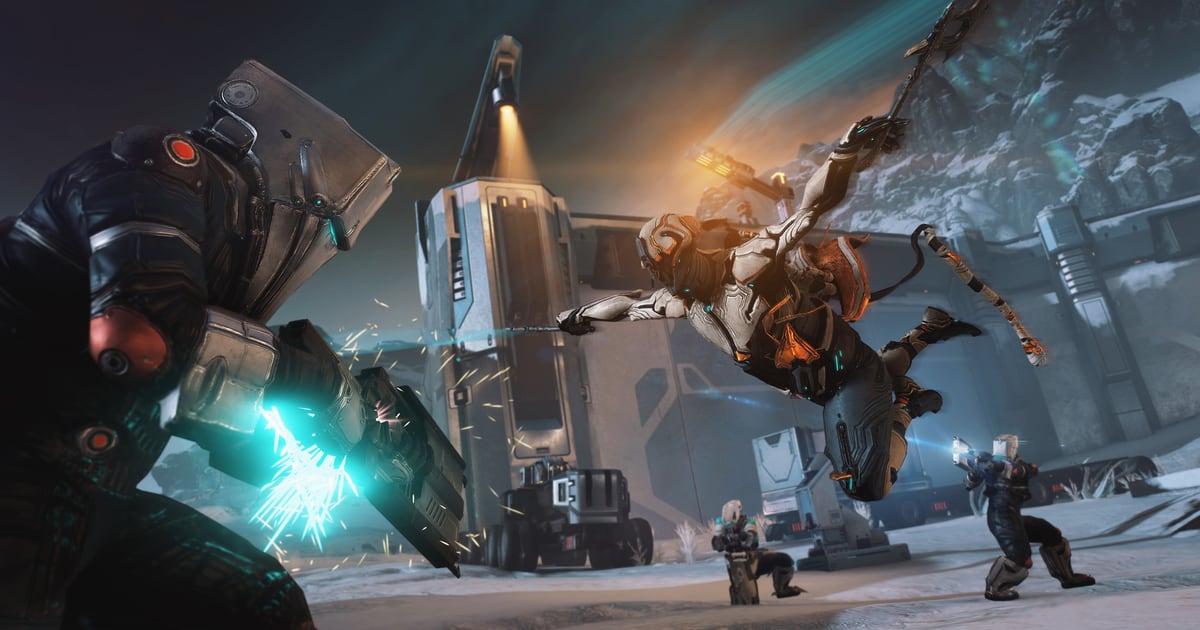
Digital Extremes opened October with a roundup that mixed a seasonal event, a returning Tactical Alert and a game mode the studio had already delayed once. Two weeks later it was still patching the newest of them. The month has three clocks rather than one: The Icebind, the six-player mission mode that went live on 7 October; Nights of Naberus, which opened on 1 October and runs to 2 November; and Epoch Operation: Taubound, the runway to the Tau chapter that begins on 15 October.
What changed: The Icebind, a six-player high-level mission mode, launched on 7 October after Digital Extremes delayed and renamed it from “Glacial Defiance”; Nights of Naberus and a returning Hallowed Nightmares Tactical Alert reopened the same month. Why it matters: The Icebind is the studio’s first six-player squads and the only source of Riven Splicers, and it is capped at three completions a week by design rather than by accident. Who should care: Tenno who have finished Angels of the Zariman and Whispers in the Walls, want a use for their Rivens, and are deciding how much of October to spend on the Tau runway.
The Icebind At A Glance
Almost every confirmed detail below comes from the official Dev Workshop that [DE]Taylor published on 5 October, two days before launch. The October roundup and the launch announcement carry the dates and the name.
| Question | What Digital Extremes has said |
|---|---|
| Squad size | “Six player squads, where there can be no more than one of each Warframe.” |
| Weekly cap | “Players can complete these missions three times a week”, and they “can stockpile up to six mission keys” |
| Enemy level | “Level 999+ Enemies.” |
| Mission length | “Approximately 10-15 minute long missions.” |
| Mission types | Survival (10 minutes), Mobile Defense (3 terminals of 3 minutes), Excavation (600 Cryotic), Disruption (8 conduits) |
| Enemy factions | Grineer, Corpus, Infested, The Murmur or Orokin, on any Origin System planet except Duviri, The Dark Refractory and Höllvania |
| Access | Completed Angels of the Zariman and Whispers in the Walls, and unlocked either Elite Temporal Archimedea or Elite Deep Archimedea |
| Matchmaking | “With its launch, The Icebind does not have public matchmaking” |
| Launch date | “Our 6 player game mode The Icebind (previously: Glacial Defiance) is launching on October 7th!” |
What The Icebind Actually Is
The mode starts at a bell, not a menu. Players claim Cryobells — mission keys — from an ice pillar atop the Earth node Yuvan Peak, then speak to Cephalon Melica and select “Ring a Cryobell”. Three Cryobells form each week at the weekly reset, which the Dev Workshop dates to midnight UTC on Sundays, and players can hold up to six if they skip a week. Each bell carries a randomized mission type, planet, factionfaction. An in-game group or nation players can align with or fight against, with its own goals and reputation system. and three modifiers the studio calls Binds: one Mission Bind, one Tactical Bind and one Personal Bind.
The Personal Bind is the one that surprises squads. It belongs to the player who owns the Cryobell and applies to that player whatever the squad ends up voting for, which is why the workshop says “Your choice of Cryobell matters”. After everyone has picked, the squad votes: a 60-second countdown, a random bell if nobody votes, and the Host’s vote breaking a tie. Cryobells are not spent until the squad extracts successfully, so a failed run costs time rather than a key.
The name itself was a mid-course correction. The October roundup states that the mode was “Originally intended to ship alongside Iceblade of Narin as ‘Glacial Defiance’”, but was “delayed to allow for additional development time and renamed to The Icebind”. The change has been stable since: Hotfix 44.1.2 on 15 October still shipped an “The Icebind Changes & Fixes” block, and the live game recognises the mode by that name.
The Binds Are The Point
The three Bind slots are what make the mode read as a puzzle rather than a longer Survival. Each slot draws from its own pool, and the pools are large enough that the same squad composition cannot solve every roll. The Dev Workshop lists five Mission Binds, fourteen Tactical Binds and twenty-three Personal Binds.
| Bind type | Example | What it does |
|---|---|---|
| Mission Bind | Miasmic Militia | “Enemies slowly take damage, but are immune to Toxin, Gas, Viral, and Corrosive status effects. On death, a Gas cloud is released.” |
| Tactical Bind | Archaic Armor | “Enemy armor is greatly increased and cannot be stripped normally. Each hit they take reduces their maximum armor by 1%.” |
| Personal Bind | Flankable | “Max shield capacity is reduced by 75%, but an impenetrable Volt shield is permanently in front of you.” |
On top of the Binds, every Icebind mission carries fixed restrictions. The studio calls the enemy scaling Empowered Enemies: enemy health, shields and armour “increased by 200% and an additional 100% for each squad member, stacking to a maximum of 800%”, with an increased chance of Eximus. No Self Revive removes the ordinary option: a downed Tenno leaves a Tombstone, and “at least 3 surviving Tenno must sacrifice part of their health temporarily” to bring them back — or all of them if fewer than three remain. Bleedout shortens after each revive down to a five-second floor, Last Gasp starts two seconds earlier every use, Restores gain a three-minute cooldown, Companion Recovery timers are doubled, and the full Shield Gate’s invulnerability window is halved.
One thing the mode does not do is restrict your loadout. The WARFRAME Wiki notes that, unlike Deep and Temporal Archimedea, The Icebind has “no loadout restrictions”, so the Warframe and weapons are a free choice against whatever Binds were rolled.
Five Side Objectives, And The Risk Built Into Them
Each mission can spawn up to three optional Squad Side Objectives, flagged by a purple waypoint. They are the difference between a clean run and a longer one, because each completion hands every eligible player a Frozen Key. The five at launch are Lockbox (carry Cyphers to a container), Cryothermia (hold a Cryo Core while it burns your health), Indomitable Ice (charge four ice crystals with sustained fire), Entropy Orb (stand in the safe quadrant of a pulsing orb’s telegraph) and Signal Chain (relay an energy beam between two points using Warframes).
The catch is stated plainly in the Dev Workshop: “failing a Squad Side Objective will fail your mission and require you to start again.” The studio’s own developer note explains the reasoning — “With the limited amount of Cryobells each week, failing a Side Objective would often lead to players abandoning the mission” — and adds that a Side Objective only counts as started once the team presses the “Start” prompt, so a misclick near a waypoint does not silently commit the squad.
When the mission ends, extraction is replaced by Melica’s Glacial Laboratory, a reward room players are taken to rather than a landing craft countdown. The WARFRAME Wiki records that the room holds eight audio logs covering Melica’s pre-Cephalon life, with one unlocked per completion.
Rewards: Riven Splicers And Two Kinds Of Chest
The guaranteed reward is a Riven Splicer. The Dev Workshop is explicit that these are “obtained exclusively from The Icebind gamemode”, and they feed the second half of the studio’s Riven Expansion: Riven Splicing, which consumes two specific traits on a Riven to produce one new combined trait. That exclusivity is the main reason the weekly cap matters to a player who wants the system.
Two key types gate the chests. Every player receives a Crested Frozen Key on entering the laboratory, which opens a Crested Frozen Chest at the centre of the room and pays one of three Kuva amounts — 7,500, 17,500 or 100,000 — plus one additional reward. The Frozen Keys earned from Side Objectives open Frozen Chests on the room’s outer edges for a smaller Kuva roll and its own reward table. Digital Extremes publishes the reward lists in the workshop but points players to its official drop-table site for the weights; the per-item percentages circulating online, including the 100,000-Kuva row at a low single-digit chance, come from the WARFRAME Wiki and should be read as secondary.
Nights Of Naberus: The Other Half Of October
Nights of Naberus is the seasonal event that brackets the whole month. Digital Extremes dates it “October 1 @ 11 a.m. ET - November 2 @ 11 a.m. ET” and describes Daughter releasing “her inventory of new and returning seasonal Customizations in exchange for Mother Tokens”. The studio’s Halloween post lists four new offerings this year — the Calaverita Liset Skin, the Follie Coulrophobia Glyph, the Voruna Prime Massacre Glyph and the Sirius vs. Orion Poster — alongside the returning stock. Mother Tokens come from Bounties in the Cambion Drift or from trading resources to Grandmother.
Two other strands run on the same dates. Hallowed Nightmares, a Halloween-themed Tactical Alert the studio says has not been seen “for several years”, returns for the same 1 October to 2 November window and rewards the Jack O’Naut Keychain Sugatra, the Jack O’Naut Recall Glyph, a Manic Noggle and 50,000 Credits. And “Scare-o” Ki’Teer makes four weekend appearances, from 16 October to 8 November, on a fixed visit schedule.
Taubound Runs Alongside Both
The third October item is Epoch Operation: Taubound, dated “October 15 - November 17” on the same roundup. It is not part of The Icebind, but it shares the month and the destination: both events sit on the road the studio is describing as leading towards Warframe’s Tau chapter. The Tau, Fornax and Brysko primer covers Taubound’s mechanics, its access lift and its one-month-only window in detail, so this piece does not re-run that ground.
What Digital Extremes Has Not Said
Three questions are open. The first is matchmaking: the Dev Workshop says the studio will “evaluate The Icebind’s party creation system in phases”, with a next phase that “will include variable party sizes (i.e less than 6) with the potential for public matchmaking in the future” — a hedge the studio has not yet resolved. The second is whether the three-completions-a-week cap changes; Digital Extremes has framed the whole mode as an experiment it is “iterating on in phases”, but has not tied the cap to a date. The third is the reward weights, which this article takes from the WARFRAME Wiki rather than any Digital Extremes page quoted here.
One more thing worth flagging without dressing it up: the Dev Workshop thread drew a sustained pushback on the reward tables, with players arguing the Archon Shardshard. A separate copy of a game world running on its own server; players on one shard don't share the world with another. and booster options are thin for the level of coordination the mode asks for. That is community reaction in the thread, not a statement from Digital Extremes, and the studio had not answered it in the pages used here.