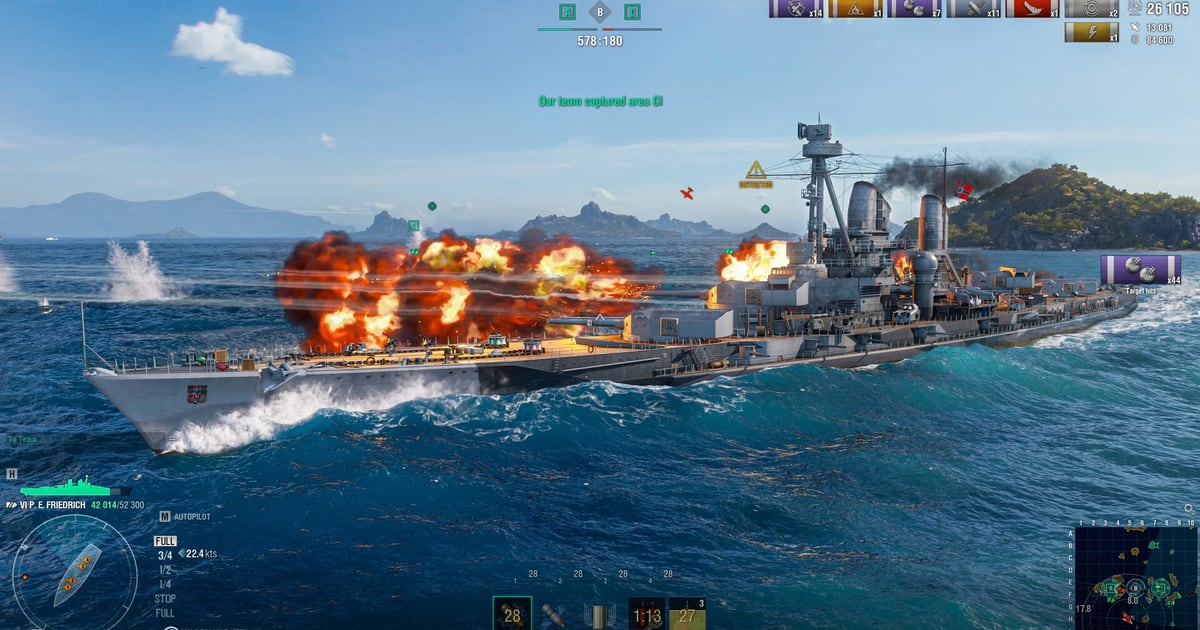
World of Warships Update 15.9 puts a strategy mini-game inside a naval shooter. The headline addition is Pacific Front, a fleet-management event that the official event page dates from October 7 to December 2, 2026 and that is playable both in the game client and from a desktop browser. Wargaming wraps it around four Black Friday ships, a Halloween-themed Event Pass, a weather rework for the Ocean map, and a matchmaking change aimed at the quiet hours.
What this covers: Pacific Front’s operations, Fleet Supplies, Progress Tokens and reward track, plus Update 15.9’s four Black Friday ships, the Halloween Event Pass and the Ocean map cyclone. Why it matters: Pacific Front is not a combat-mission chain. It is a resource-management layer where your fleet’s health carries between battles, so how you spend units matters more than how long you grind. Who should care: Captains who want the event’s final reward without wrecking their fleet in week one, and anyone deciding whether the Black Friday bundles are worth their tokens.
What Pacific Front is
Wargaming frames Pacific Front as a revamped version of Dunkirk 1940, the strategic event it ran in Update 14.4, and both the Work in Progress page and the closed-test development blog use that lineage. The structure underneath it is different. Battles are no longer standalone: they are grouped into operations, each operation is divided into stages, and each stage into several battles that Wargaming calls key points. Every battle in an operation puts your units up against four enemies, and each head-to-head skirmish your unit wins pays out rewards including Fleet Supplies.
Operations come in five difficulty levels, and the official page notes that harder operations can yield greater rewards and more Progress Tokens. A fresh set of operations arrives each day, and you play one at a time. Once an operation is running you can complete it, abandon it, or reset it. Abandoning keeps what you earned from that operation but the run cannot be replayed — you choose a different one instead. Resetting wipes the progress and gains but returns the resources you spent during the run, including consumed modifiers and unit HP.
Both the official event page and the development blog carry Wargaming’s standing caution that development-blog details are preliminary and can change several times during testing, so read the numbers below as the state of the build at publication rather than as a contract.
The two resources that decide a run
| Resource or mechanic | What it does | How it is earned or spent |
|---|---|---|
| Fleet Supplies | The main resource for expanding your fleet | Won from head-to-head skirmishes; spent on new units or on common modifiers |
| New units | Your roster of combat units | Buying a unit offers three randomly chosen options, and you pick one |
| Common modifiers | Boosts attached to a unit before a battle | Bought with Fleet Supplies; expire after the battle concludes |
| Rare / special modifiers | Stronger boosts that cannot be bought | Battle rewards or the reward track only |
| Unit HP (three segments) | Fewer segments mean less Power | One segment per battle; a repair modifier can restore HP before the unit reaches zero |
| Progress Tokens | Advance the event’s reward track | Defeating the primary target in an operation’s final battle always awards them; other enemies in that battle may too |
| Perfect Completion | Replaces the standard completion bonus with a bigger one | Destroy every enemy unit in the operation |
Two rules shape how you spread those resources. First, every unit has a three-segment health bar, it loses a segment per battle, and that damage carries from battle to battle inside the operation — a unit at zero HP cannot be deployed again, and a repair modifier only works before the unit hits zero. If every unit in your fleet reaches zero mid-run, the operation ends in a loss. Your fleet is fully restored automatically at the start of every new operation. Second, within a single stage a unit can be assigned to only one key point, though the same units can be reused in later stages as long as they still have HP.
There is no longer a heal timer to wait out: HP is tied to the operation itself. Unit performance in a battle depends on health, applied modifiers and buffs, plus a small random variation each time you start a battle, so the same unit can do a little better or worse from one fight to the next. Operations can also impose battle conditions that weaken your units, restrict them, or strengthen the enemy, and some units can buff an ally or debuff an enemy in a specific direction — green arrows in the interface show a buff’s direction, red arrows a debuff’s.
Progress Tokens and the event’s final reward
Progress Tokens are the currency that actually moves you down the reward track. Defeating the primary target in an operation’s final battle guarantees Tokens, and other enemies in that same battle may award more, which is why the official page recommends judging how much of an operation is worth clearing rather than always chasing a full sweep. Every operation ends in a showdown with a primary target that is sometimes a generic enemy and sometimes one of eight adversaries named after historical participants in the Pacific theater.
The reward track, per the official page, brings Credits, Free XP, Elite Commander XP, five Wings of Freedom containers, and the final reward. Wargaming’s development blog names that final prize: the track “ends with Monaghan as the final prize.” A secondary guide at wows-guides.com identifies Monaghan as an American Tier VI Premium destroyer and states that on the European server the event runs from October 8 to December 3, 2026.
If you already own the final ship, the official page says you receive Credits instead of the ship. The same secondary guide reports that the Public Test suggested a more generous Doubloon compensation and that this is not the system used on the live event — worth checking in the client rather than assuming. After the final reward you can keep clearing extra levels of the track, each of which brings one More Economic Rewards container.
Two collection objectives sit alongside the track: the Pacific Front Fleet flag for collecting all 30 Pacific Front units, and the Veteran of the Pacific flag for defeating all 23 unique enemy units including the eight primary targets. Wargaming says both flags are distributed after the event ends.
The Ocean map: a 15 km cyclone
Starting with Update 15.9 the Ocean map gets a weather makeover. Because Ocean has no islands it plays differently from other maps, especially for ships that rely on terrain and concealment early, and Wargaming’s answer is not to add islands but to add weather. Each battle features just one weather type rather than all three at once, and only the cyclone is live in 15.9.
| Weather | Timing | Effect | Live in 15.9? |
|---|---|---|---|
| Cyclone | Map-wide, active very early in the battle | Reduces visibility and detection range out to 15 km (the usual cyclone reduction is 8–12 km); dissipates after 7–9 minutes | Yes |
| Thunderstorm | Two storm zones drift across the map in a circling pattern for about 12 minutes | Increases dispersion, reduces firing-detection range, improves concealment and significantly reduces the spotting timer | No — arriving in a future update |
| Snowstorm | Forms at the centre at the start of the battle, spreads to the whole map over about 3 minutes, then contracts back | Same visibility and detection effects as thunderstorms | No — arriving in a future update |
The practical read on the cyclone is a 7-to-9-minute window at the start of an Ocean battle in which ships on both sides can close distance before the map opens back up. Wargaming has also added volumetric clouds, and says the change affects the Ocean Port as well.
Black Friday: four ships and a destruction counter
Black Friday arrives in the last week of Update 15.9, and Wargaming is adding four Black Friday ships to the fleet — each a special version of an existing ship.
| Ship | Nation, class, tier | Rarity | How it is offered |
|---|---|---|---|
| Incheon B | Pan-Asian Tier X cruiser | Uncommon | A single bundle unifying all three of the first ships, separate ship-plus-port-slot bundles, and the reworked Black Friday containers |
| Victoria B | Spanish Tier IX battleship | Rare | Same bundle and container routes as Incheon B |
| Hornet B | American Tier VIII aircraft carrier | Uncommon | Same bundle and container routes as Incheon B |
| Flandre B | French Tier VIII battleship | Uncommon | Only at the end of the sequential Doubloon bundle, alongside Black Friday containers, The Monochrome Enemy Destruction Effect and supercontainers |
The four ships also introduce an Enemy Destruction Counter, which tracks how many enemies each ship has destroyed. It is part of the Black Friday camouflage itself and can be switched off in the Camouflage section of ship customization. Wargaming labels it an experimental feature that may be refined later. It is supported in Random, Ranked and Co-op battles, each with its own separate tracker; it updates dynamically during a battle, resets to its pre-battle count if you leave early, and settles on the true total once the battle finishes. It stops updating once a ship reaches 99,999 enemies destroyed.
Containers matter here because that is where most of the fleet returns from. The reworked Black Friday 2026 container lists a 0.4% chance for the ships category, while the Black Friday 2026 Premium container lists 12%; in both, a ships drop when you already own every ship on the list converts to 2,500 Doubloons. The Black Friday Squadron also returns: assembling a matching pair of a standard ship and its Black Friday version unlocks combat missions that pay Doubloons and other resources, and the exception this year is Marlborough B, which counts even if you obtained it before the event began. Black Friday ships collected in previous years do not count. A Progress Bar fills with Black Friday Tokens earned by buying Black Friday Premium containers and some Doubloon bundles with real money, and its fifteen steps run from three days of Warships Premium Account to five Black Friday 2026 Premium containers.
The rest of 15.9: Event Pass, Brawls and matchmaking
The update’s Event Pass is Halloween-themed, running under the “Halloween Treats” banner. The first progression line includes three Jack-o’-Lantern containers, one Jack-o’-Lantern Premium container, the Rust permanent camouflage, and the Infernal permanent camouflage for Tier IX ships as its final reward. The second line adds the Infernal camouflage for Tier VIII ships immediately, then the Telesto permanent camouflage, a nationless version of Commander Max Strauss, and the Infernal camouflage for Tier X ships. Extra levels pay one More Signals container per level on the first line and one Rare Bonuses container per level on the second.
Three Brawls round out the mode list, all played on specially designed maps based on the Halloween event Transylvania: a Tier VIII 5v5, a Tier IX 3v3 with 25% faster ship speeds, and a Tier X 4v4 under the “Chaos reigns” recalibration, which strengthens cruiser and destroyer buffs while weakening battleship buffs. Battleships, cruisers and destroyers are eligible in all three.
Matchmaking gets one targeted change. Wargaming says the force start timer had stopped doing its job for quieter hours, so it has made force start settings more flexible at Tiers VI–X and for superships. In its own test data, battles with fewer than 12 players fell to 0.04% of all battles per day, average queue time for most ships and tiers barely moved, and in some cases — aircraft carriers among them — queue time can rise by 10 to 15 seconds.
The supporting patch notes for 15.9 are largely quality-of-life work. Concentrated AA Fire now shows its charge progress as a percentage on the H-menu icon, its countdown timer ticks smoothly instead of skipping fractions of a second, and a “Hold [O] to activate” prompt appears when the ability is ready with enemy planes in range. Asymmetric battles are rebalanced the same way in both directions, with Battle Tier VIII bots getting a bit stronger and Battle Tier IX bots a bit weaker. Texture fixes land on Taejong, Conte Verde, Marcílio Dias, Cuauhtémoc, Almirante Villar, Friedrich Carl and Niord.
A first-week plan
The early mistake Pacific Front invites is treating Fleet Supplies as a war chest for one heroic unit. Because a unit can fight only once per stage and its damage persists inside the operation, breadth beats height: spend early supplies on new units so you can cover several key points at once, and treat common modifiers as a per-battle expense rather than an investment. Keep your strongest units for the final battle, where Progress Tokens concentrate, and remember that a repair modifier is worthless the moment a unit reaches zero HP.
Token bonuses are worth hoarding for final battles rather than sprinkling across routine fights, since that is where the payout is largest. And if you are fighting on Ocean in the opening minutes of a match, the cyclone’s 15 km detection ceiling is a temporary corridor: use it to close distance, not to sail in a straight line. The same detection logic — patience, concealment and controlling when you are seen — is what makes surface and submarine play work in Hearts of Iron IV’s naval layer, and it carries over here.
Next read
- For how detection, spotting and concealment decide naval engagements in another strategy game, see HOI4 Naval and Air: Detection, Task Forces, Carriers.
- For the genre Pacific Front is competing with your evening against, see MMOs in 2026: WoW, FFXIV, ESO and GW2 Time-to-Fun.
- For another WWII-era combat system broken down by its underlying maths, see War Thunder: Bomber Damage Models and Cluster Bombs.