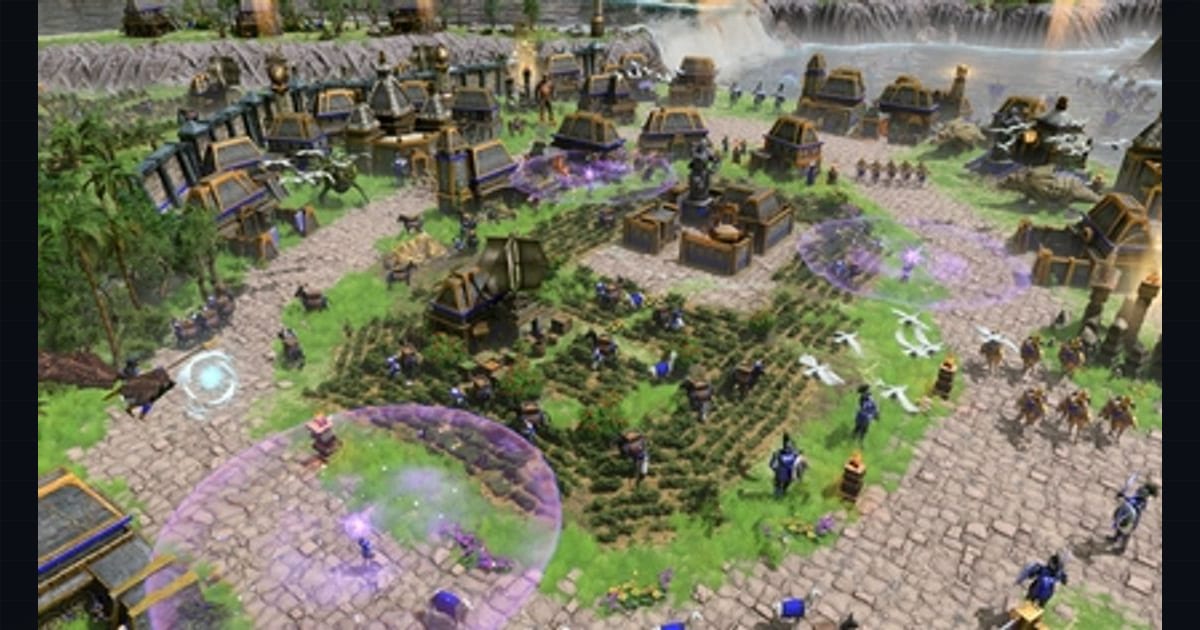
World’s Edge and Xbox Game Studios have published post-launch technical documentation for Age of Mythology: Retold, detailing how classic RTSRTS. Real-Time Strategy — a strategy game where everyone plays at the same time, continuously, instead of taking turns. mechanics were overhauled with modernized engine technology and balance updates. This is more than a remaster changelog: it is a design document that explains how a 2002-era ruleset was re-engineered for a 2020s audience without amputating what made the original distinct.
TL;DR
- What changed: World’s Edge documented reusable God Powers, myth unit reworks, and Bang Engine upgrades.
- Why it matters: Repeatable powers turn Favor into an economy decision, rewriting 2002-era strategy.
- Who should care: Classic RTS fans and competitive players weighing cross-play ladder health.
Core System Overhauls
- Reusable God Powers: Divine powers (Lightning Storm, Meteor, Earthquake) can now be cast multiple times per match by spending Favor resources.
- Population Cap & Myth Units: Myth units receive updated physics hitboxes and special ability meters, turning Minotaurs, Colossi, and Hydras into high-value frontline anchors.
- Modernized Engine & Netcode: Built on the upgraded Age of Empires Bang Engine branch supporting ray-traced reflections, 4K asset scaling, and ranked ladder matchmaking.
Each of these is worth unpacking, because each one rewrites a rule the original taught players to plan around.
Reusable God Powers are the most consequential change. In the original game, a God Power was a single-use, match-defining event — you hoarded Earthquake for one decisive siegesiege. A timed, large-scale attack on a settlement — attackers try to destroy it, defenders try to hold it. and Lightning Storm for one decisive army fight, and the entire strategic layer bent around timing those detonations. Making them repeatable but Favor-costed converts them from stored ultimates into an economic decision. Favor stops being a passive meter you spend on myth units and becomes a contested resource with an opportunity cost: every Lightning Storm you cast is myth unit production you didn’t buy. That is a fundamentally different resource triangle, and it rewards sustained Favor generation — town centers, monuments, hero worship — over stockpiling.
Myth unit rework addresses the original’s most persistent balance complaint: myth units were spectacular and mostly ornamental. Updated physics hitboxes mean a Colossus actually bodies a choke point instead of getting threaded by pathing units, and per-unit special ability meters give them a power curve inside a fight rather than a flat stat block. Calling them “high-value frontline anchors” is accurate — the design intent is clearly that myth units should function the way capital ships do in other strategy games: expensive, slow to replace, worth building an army’s shape around.
The engine modernization matters more than the bullet point suggests, and we break that down below.
Cross-Play & Console Support
Age of Mythology: Retold includes full cross-play between PC and Xbox Series X|S console players, along with custom controller radial menus for rapid base building.
Cross-play in an RTS is not a checkbox feature — it is an input-parity problem. Mouse-and-keyboard players have a structural advantage in selection speed, and the genre’s previous console attempts mostly solved this by segregating lobbies. World’s Edge is instead betting that a redesigned radial-menu control scheme plus the game’s moderate effective APM ceiling (myth units and God Powers reward timing over raw click throughput) keeps matches competitive across inputs. If it holds, it’s a template; if it doesn’t, expect ranked playlists to quietly split by input method within a season.
Why the Bang Engine Branch Is the Real Story
The headline features are player-facing, but the load-bearing change is architectural: Retold is built on the upgraded Age of Empires Bang Engine branch — the same technological lineage that powers Age of Empires IV — with ray-traced reflections, 4K asset scaling, and ranked ladder matchmaking.
That matters for three reasons. First, shared engine lineage means shared tooling: balance patches, replay systems, spectator features, and ladder infrastructure can be developed once and shipped across the Age of family instead of being rebuilt per title. That is how a niche RTS sustains a live-service cadence on a realistic budget. Second, 4K asset scaling is not cosmetic vanity — RTS readability at high zoom levels is a genuine usability problem, and hand-scaled assets solve the “unit soup” legibility failure that plagues remasters that simply upscale 2002 sprites. Third, integrated ranked matchmaking in the engine layer signals that World’s Edge treats Retold as a competitive platform, not a nostalgia product. Nostalgia products get a launch window; platforms get seasonal support.
The netcode point deserves emphasis. Classic Age of Mythology multiplayer survived on community infrastructure long after official support faded. Engine-native matchmaking with cross-platform lobbies centralizes the player pool, which is the single strongest predictor of long-term RTS ladder health.
What It Signals for the Genre
Zoom out, and Retold reads as Microsoft’s thesis for the RTS mid-tier: don’t chase StarCraft-scale esports, don’t abandon the genre either — instead modernize the back catalog on shared engine tech, ship day-one cross-play to maximize the matchmaking pool, and monetize through sustained content rather than launch spikes. The published hardware tiers back up the reach-for-everyone strategy:
| Tier | CPU | RAM | GPUGPU. Graphics Processing Unit — the chip that renders the game's visuals; the main driver of framerate and image quality. |
|---|---|---|---|
| Minimum | Intel Core i3-4130 / AMD FX-4350 | 8 GB | NVIDIA GTX 650 |
| Recommended | Intel Core i5-8400 / AMD Ryzen 5 2600 | 16 GB | NVIDIA GTX 1060 |
The documented spec floor — a GTX 650 and an i3-4130 at minimum — reinforces that reading. This game is engineered to run on a decade-old office PC, because addressable install base is the entire strategy. RTS died once before on hardware requirements and audience fragmentation; Retold is designed so neither can kill it again.
It also signals something subtler about design philosophy. The original Age of Mythology was the most experimental of the ensemble — asymmetric pantheons, hero units, divine intervention. The rework leans into that asymmetry (myth units as anchors, God Powers as economy) rather than sanding it down toward Age of Empires II symmetry. For a genre whose recent history is one of homogenization, a major studio choosing to deepen a weird ruleset instead of flattening it is worth noting.
The Take
The temptation with any “Definitive Edition” is skepticism — the label has covered everything from genuine rebuilds to repackaged ROMs with a launcher. Retold clears that bar decisively, and the reusable God Powers system is why. That one change touches economy, timing, scouting, and counterplay simultaneously; it’s the kind of alteration you only make if you intend the game to be played seriously for years, and it’s the kind you can only make if you have the engine and netcode foundation to support a live balance cycle. World’s Edge appears to have both.
The open risk is the Favor economy. Repeatable superweapons are precisely the sort of system that either becomes the game’s richest strategic layer or its most degenerate one, and which way it tips will be decided by Favor generation rates and diminishing returns — tuning knobs, in other words, not design intent. Watch the first two balance patches. If World’s Edge nerfs God Power cycling aggressively, they got the launch math wrong. If they don’t need to, Age of Mythology: Retold is the most credible case in years that a classic RTS can be rebuilt, not just repackaged — and that the genre’s future runs through its back catalog.
Next read
- For the sibling title on the same engine lineage, see our Age of Empires IV coverage.
- Tracking everything still to ship this year? Check the launch calendar.