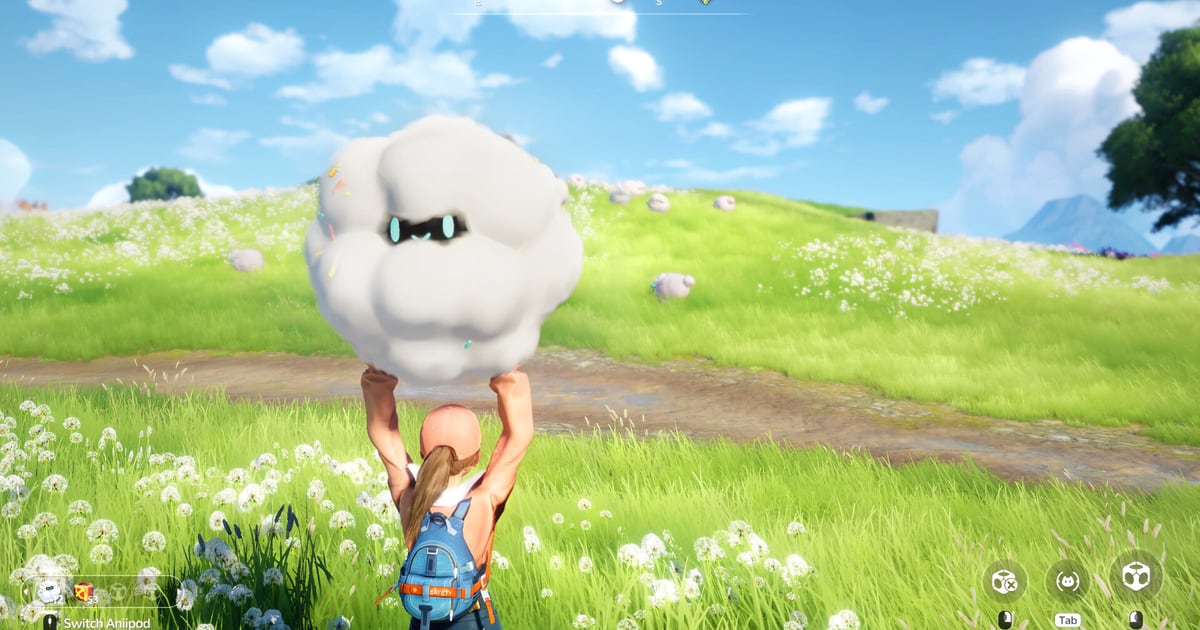
Aniimo is a free-to-play, creature-catching open-world RPGRPG. Role-Playing Game — a game built around character progression, story, and player choices. from Pawprint Studio, released on Steam on 15 Sep 2026. On the 2026-10-29 snapshot of Steam’s official Most Played chart it sat at #17 with 70,682 concurrent players and a same-day peak of 71,742; a second read shortly afterwards returned 69,891 at rank 18. The number moves; the shape does not.
What makes it worth a primer is that the developers publish a full probability page — the multipliers behind every catch, itemised — and run the game as three regional server groups with weekly resets. Both change how a new player should spend a first week, and neither shows up in the store blurb.
What this covers: the capture loop as Aniimo’s own published odds describe it, what the persistent MMOMMO. Massively Multiplayer Online — a game that hosts very large numbers of players together in one shared, persistent world. layer adds on top of it, and the early decisions the systems make expensive to reverse. Why it matters: almost every number below comes from a page the developer published, not from a wiki, so the progression choices can be reasoned about rather than guessed at. Who should care: anyone starting Aniimo now, and anyone deciding whether a free-to-play collector with regional weekly caps is worth a second week.
What the store page actually establishes
Developer, publisher and price are on the store page in plain text. Pawprint Studio is listed as both developer and publisher, and its own site describes it as “a development studio and publishing label backed by FunPlus,” with Aniimo as the first announced project. The game is free to play, with In-App Purchases among its features.
Release status is a full release, not early access: Steam carries a release date of 15 Sep 2026 and the launch announcement says “Aniimo is now live on Steam.” Platforms are PC and iOS as fetched — the official site links an App Store listing, and both listings flag in-app purchases. Console clients are referenced but unconfirmed: the support flow asks players to pick “Steam Relink (PSN/Xbox)” when an account link fails, which implies console accounts exist, but no page opened here says a console version is live. Cross-platform play is a Steam feature flag.
| Field | What the fetched sources say |
|---|---|
| Developer / publisher | Pawprint Studio, described on its own site as a FunPlus-backed studio and publishing label |
| Released | 15 Sep 2026 (Steam store page) |
| Price model | Free to play, with In-App Purchases |
| Steam features | Single-player, Online PvP, Online Co-op, Cross-Platform Multiplayer, kernel-level anti-cheat, third-party EULA |
| Platforms confirmed | PC (Windows 10, 40 GB) and iOS |
| Server groups | Aniimo-Europe, Aniimo-Americas, Aniimo-Apac |
| Review standing | Mostly Positive — 71% of 13,845 English reviews |
| Chart position, 2026-10-29 | #17 of Steam’s top 100, 70,682 concurrent, 71,742 peak |
The catch loop, measured rather than described
The store page explains the fantasy in marketing terms: catch Aniimo with Aniipods, “set traps and time your catch perfectly,” and different Aniimo “will appear according to the environment, weather, phenomena and time of day.” The official site’s Probability Details page goes further and prints the formula:
Final Catch Chance Outside Battle = Base Catch Chance × Aniipod Multiplier × Level Multiplier × Backstab Multiplier × Aniimo Status Multiplier Final Catch Chance In Battle = Base Catch Chance × Aniipod Multiplier × Level Multiplier × HP Multiplier × Aniimo Status Multiplier Final Catch Chance for Alpha Aniimo = Alpha Aniimo’s Base Catch Chance × Aniipod Multiplier
Two things follow. The outside-battle and in-battle routes exchange one term: a Backstab multiplier of ×1.5 outside combat, or an HP multiplier in combat running from ×2 at 0% HP down to ×0.8 at 100%. And Alpha Aniimo resolve differently — only the Aniipod term applies, against a flat 6% base, so weakening an Alpha does not improve the odds; the pod you bring is the whole decision.
The base is not a constant either. Base Catch Chance equals the species’ own base multiplied by (1 + the Pathfinder’s catch bonus), and that bonus comes from Branches or Regional Badges. The species base is a grid of area progression against three named stages:
| Area progression | Lumin stage | Gamma stage | Nova stage |
|---|---|---|---|
| Early-game areas | 56% | 42% | 28% |
| Early-mid-game areas | 50% | 38% | 25% |
| Mid-game areas | 44% | 33% | 22% |
| Mid-late-game areas | 38% | 29% | 19% |
| Late-game areas | 32% | 24% | 16% |
The page never defines what Lumin, Gamma and Nova denote beyond the column headings, so treat them as three tiers of the same species. What the grid does establish is a soft anti-frustration design: the same species is easier where it appears early.
The item multipliers are where cost sits:
| Catching item | Multiplier |
|---|---|
| Aniipod | ×1 |
| Aniipod Pro | ×1.5 |
| Aniipod Hyper, Aniipod Trace, Aniipod Mega | ×2 |
| Tumbler | ×2 |
| Tumbler (for Aniimo gathered by Nurture) | ×6 |
| Aniipod Ultra, Sparkling Cube, Legendary Aniipod: Departure with the Wind | Guaranteed success |
The last row is not a high multiplier — the page prints “Guaranteed Success,” with no number attached. A level multiplier keyed to the gap between the Aniimo’s level and yours reads ×1 at a gap of 10 or less, then ×0.8, ×0.6, ×0.4 and ×0.2 for gaps of 11 through 14, and ×0.1 at 15 or more. A status multiplier resolves to the lowest active debuff, or the highest buff when nothing is debuffed, and a Backstab is invalid when a Tumbler is used, so the trap and the ambush do not stack.
Read together, the formula describes a resource-allocation problem disguised as a reflex check: the player never rolls a die they cannot see, they choose which of five terms to move, and every choice spends something.
What the persistent layer adds to collection pressure
A single-player collector can be finished. Aniimo runs as a live service across three regional server groups — Aniimo-Europe, Aniimo-Americas and Aniimo-Apac — which changes the arithmetic in four ways the store page never mentions.
The luck budget is weekly and capped. Two overlapping systems, “lucky” and “superlucky,” sit under the catch loop. Lucky fires at 1.00% for the first ten triggers each week, with a guaranteed trigger every 200 checks; from the eleventh the rate halves to 0.5% and the guarantee stretches to 400. Superlucky is rarer: 0.2% for the first each week against a 500-check guarantee, 0.1% and 1,000 checks for the second, then 0.05% and 3,000 checks from the third. Both counters reset per region, at Monday 04:00 in UTC+8 for Apac, UTC+0 for Europe and UTC-4 for the Americas. The consequence is blunt: there is an amount of luck each week and then there is not, and because a trigger stops the rest of a batch from counting, batching catches is worse than spacing them out.
Prismana has its own pity counter. Triggering Nurture with Vein Essence carries a 3% chance of directly triggering Prismana Flow, with 480 Prismatic Energy available directly and 10,500 Prismana listed as the amount required to trigger pity; lucky and superlucky each carry a 0.60% chance of granting Prismana Weather. The page does not explain the Vein Essence economy, so treat those as published thresholds, not a farm plan.
Seasons reset the target list. Season 1 is titled “Departure with the Wind,” and Part 2 went live with a maintenance window on 2026-10-29 — 07:00 to 15:00 UTC+8 for Apac, with earlier windows for Europe and the Americas — compensated with Glimmer ×500 for anyone registered before the update. It adds 51 new Aniimo, four of them season-exclusive Prismana forms (Jeburst, Glameep, Pouchwisp and Royalby), and opens the Whisperwake Isles across four regions: Crescent Bay, Rosy Mirelands, Wildwater Gorge and Cloudreach Falls.
The cadence is stated, and it is fast. In the 13 October dev feedback the team committed to “major updates each season, alongside smaller updates every two weeks,” with the first half of a season weighted to PvE and the second half to casual competitive modes. The same post addressed season-locked Collectibles: missing ones get “more reliable ways” to obtain them later in the season, and previous seasons’ Collectibles return through future events — so a missed season is a delay rather than a permanent hole.
Operation: Egg Heist sits inside that — the store page calls it a PvEVP mode where you “join a 3-player team anytime to engage in real-time searches and battles in the Lost Isles.” The dev feedback adds the vocabulary: Sanctum exploration, rescuing downed teammates, Chips, a Chaos Mode billed as the hardest tier, and a Limited-Time Challenge format future high-difficulty content will follow. A two-week cadence makes that balance a moving target, so if you want a static endgame to master this is the wrong shape of game — the site’s PvE-versus-PvP endgame comparison is the honest test.
First-week decisions that are hard to undo
The formula makes the first week unusually consequential, because several resources are one-way.
Which pod you spend on what. Aniipod Ultra and Sparkling Cube are in the guaranteed-success tier, and the launch welfare hands out Aniipod Ultra ×2 along with Tumblers and Sparkling Cubes. Spending a guaranteed catch on a 56% early-game spawn is the classic first-week error; the same item on a late-game Nova-stage species at a 16% base, or on a 6% Alpha, is worth many times more. The launch page also grants a rare Prismana Aniimo of your choice at Grade I Wayfarer, which argues for holding guaranteed items until the ladder is done. Nurture-gathered Aniimo take a ×6 Tumbler, though the pages fetched do not describe the Nurture loop itself.
Catching above your level. With the level multiplier falling to ×0.2 at a fourteen-level gap and ×0.1 at fifteen, an over-levelled target is close to uncatchable regardless of pod quality — the system stating the intended order of operations.
Farming Alphas too early. The published Alpha held-item table makes grade the gate on drops:
| Pathfinder grade | Rare held item | Epic held item | Legendary held item |
|---|---|---|---|
| Special Rookie, Student I–II | 100% | 0% | 0% |
| Student III, Wayfarer I–II | 75% | 25% | 0% |
| Wayfarer III, Trailblazer I | 0% | 80% | 20% |
Legendary held items are unavailable below Wayfarer III, so an Alpha killed at Special Rookie grade is a Rare item and nothing else — which reframes early Alpha hunting from content to waste.
Rolled stats, and the willingness to re-cut them. The first Dev Dispatch addressed a complaint that one Legendary Aniimo, Irisalis, could arrive with 88 Potential when another player’s had 99. The fix removed the randomness: after version 1.1, Irisalis’s innate Potential is fixed at ATK 10, REGEN 10, HP 5, BREAK 5, M.DEF 5 and P.DEF 5, with any excess converted into Starcryst Essence as compensation. Players of collectors with inherited stat rolls — the Palworld breeding and passive inheritance guide covers the same tension — will recognise the shape: the roll is the reward and the thing players resent when it lands badly.
Cosmetic rerolls that reverse in one direction only. The Sparkling Style tables show a Sparkling Pigment reroll from Sparkling Type I landing back on Type I at 0.00%, while other types sit at 10.99% and the rare Dazzling and Shadow styles at 0.55%: roll off Type I and the pigment tables will not return you to it.
The pod that stays on the Aniimo. Version 1.1 lets a Legendary Aniipod be used on an already-Sparkling Aniimo, replacing the pod it was caught with and granting that pod’s exclusive Sparkling effect — so an early low-tier pod is not purely cosmetic long term.
What the money model is, and what it is not
Free to play is confirmed; so are in-app purchases on both Steam and the App Store. Beyond that, the fetched pages describe a narrower shop than speculation assumes. The patch notes for build v1.0.3629693.0 (30 September) announce an appearance set, Frostburst Punk, with the line “Visit Shop > Recommended to purchase the new Frostburst Punk set for 680 Lumin Crystals.” A later entry advertises a second outfit set, Batlock Holmes, through the same route. Currencies named across the sources include Lumin Crystals, Glimmer (maintenance and update compensation) and Starcryst Essence, with Prismatic Energy and Prismana attached to the catching systems.
One subscription-shaped object exists in the record: a bug-fix line in patch notes v1.0.3544783.0 refers to Companion Handbook EXP not displaying properly “on the Monthly Pass make-up check-in reward screen.” That establishes a Monthly Pass with check-in rewards — not a battle pass, which no page fetched here describes. The Probability Details page documents catch and Prismana odds, not a paid pull, and nothing opened here says Prismana or Lumin Crystals can be bought with money. The site’s Official Shop link redirected when fetched, so its contents cannot be described. Treat the shop as cosmetics plus an unquantified pass; the site’s MMO monetisation comparison is the right lens for pricing it.
Reading the player numbers correctly
A free-to-play launch chart number can mean almost anything, so two other figures help. Reviews stand at 13,845 English reviews and 71% positive, with the recent thirty-day window at 8,049 and the same 71% — a ratio that holds across a month. Then the gap between current and peak: 70,682 concurrent sat within 1,500 of the 71,742 same-day peak, a flat curve consistent with a stable daily population rather than an event spike. The developers separately claim global pre-registrations past 30 million and warned of “login queues or slower loading times” at launch — consistent with the chart, though only the developer’s word covers it.
The install is verifiable: 40 GB, Windows 10, an i7-4770 or Ryzen 7 2700 with 8 GB and a GTX 970 or RX 5600 at minimum, an i7-10700 or Ryzen 5 5600 with 16 GB and an RTX 3060 or RX 6700 recommended.
The short version: catching items and the weekly luck budget are the scarce things, and the Alpha drop table means the first thing to optimise is your Pathfinder grade.